
On the evening of May 7, Binh Duong General Hospital said that the patient (in Phu Tho) with boiling water burns is gradually improving positively. Currently, the patient can eat and drink on his own, instead of having to depend on relatives as before.
That is the case of patient N.V.T (31 years old, from Phu Tho province). In recent days, images of the patient have been shared, bringing to the online community emotion about the journey to find the face of this young man.
According to Binh Duong General Hospital, about 3 years ago, when Mr. T went to his girlfriend's house to play, he suddenly slipped and fell face down into a pot of boiling water that was steaming. The accident caused severe burns to his head, face, neck and eyes.
After initial emergency treatment, Mr. T continued to be transferred to Hanoi for treatment. Although he saved his life, the severe burn sequelae completely changed the life of the young man. Dense contracted scars appeared all over his face and neck, shifting the structure of his face. Both eyes were seriously damaged, the cornea was covered, causing him to almost completely lose vision. The mouth area was severely contracted to the point that it could only be opened about 1cm.
In early 2026, Mr. T was transferred to Binh Duong General Hospital for further treatment. After many consultations, doctors assessed this as a particularly complex injury case. The treatment goal is not only cosmetic surgery, but also to simultaneously restore many important functions such as eating, facial movements, protecting the eyeball and creating a premise for the ability to restore vision later.
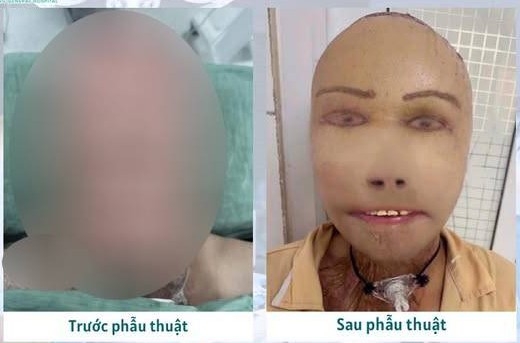
Mr. T underwent facial reconstruction surgery by the teams of 2 departments for 16 consecutive hours. Doctors proceeded to remove a patch of skin in the abdomen about 30x25cm in size and along with the patient's lower rib cartilage to make reconstructive materials. Doctors also removed a patch of abdominal skin with blood vessels feeding both sides - a tissue area that is still of sufficient quality and elasticity to regenerate the face.
At the same time, proceed to remove shrinkled scar tissue in the head, face, and neck area, release deformed structures and prepare the tissue base to receive the new graft.
After treating the injury, the team entered the microsurgery stage - a technique that requires very high accuracy, connecting the arteries and veins in the facial area with the vascular system of the skin patch to ensure blood circulation to nourish the graft tissue after surgery.
The rib cartilage is used to regenerate the upper eyelid cartilage and nose bridge, while restoring the supporting structures of the face area. Then, the skin flap is shaped to cover almost the entire missing skin area on the face, while regenerating the oral cavity, two nostrils and two eye sockets for the patient.
In addition, the eye area is also initially shaped to help improve the function of eyelid opening and closing. The entire process requires close coordination between many specialties with almost absolute accuracy.
After surgery, the patient's condition has improved positively. The mouth area is wider, eating ability has been significantly restored, and the patient can eat and drink on his own instead of having to rely entirely on relatives as before.


