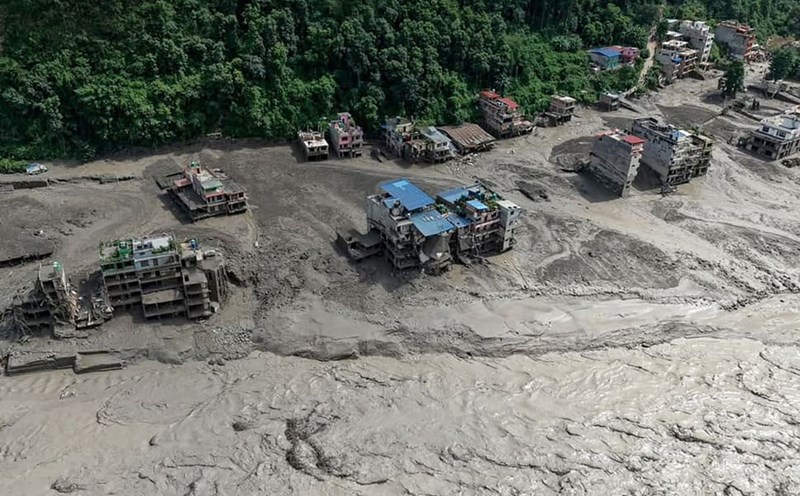
At least 160 people were killed and hundreds missing after the flood and landslide that occurred on the morning of August 26, in the Nepal - Tibet border area. Many missing people are believed to be foreign tourists.
According to AFP, mud and water flowed down at a very fast speed, creating a "fluid concrete" force. When floods were detected, people almost had no time to escape.
Landslides may have blocked the river
The exact cause of the disaster has not been determined. Nepalese Foreign Minister Shishir Khanal said that an earthquake may have caused landslides. Rocks then blocked the river, causing water to accumulate and suddenly overflow downstream when breaking the obstacle.
However, the US Geological Survey (USGS) said that the event was initially recorded as a magnitude 4.4 earthquake. Additional analysis of seismic waves showed that the energy causing the tremors was likely from landslides.
Preliminary assessment by the International Center for Integrated Mountain Development (ICIMOD), based in Kathmandu, did not detect any unusual signs on the Chinese border.
Mr. Sarthak Shrestha - an expert at ICIMOD - said that a rock and ice landslide may have occurred in Nepal, blocking the Lhende River. Water rushed behind the obstacle and formed a large flood.
This area was almost without rain before the flood occurred. Hydrological expert Hatim Sharif of the University of Texas at San Antonio said that this is the reason why conventional flood warning systems are difficult to be effective.
The mud flood is too fast to escape
According to Mr. Sharif, when seeing the mud flood coming, it is usually too late. Running or leaving by car is also difficult to escape because mud and water move at very high speeds. He said that people need to quickly find higher areas, at least about 6m high.
Researcher Dorothy Heinrich of the University of Reading, UK, said that rivers in mountainous areas often have narrow riverbeds. When the flow is blocked by landslides or snowfalls, water can quickly accumulate and form extremely strong floods.
ICIMOD expert Qianggong Zhang warned of the risk of another flood because the river may still be blocked upstream.
Climate change can increase risks
Nepal also frequently faces flash floods (GLOF), which occur when large amounts of water from ice-melting lakes suddenly drain.
A similar disaster in July 2025 originated from Gyirong district of China and then flooded into Rasuwa district of Nepal. However, officials have not confirmed whether GLOF is the cause of the latest flood.
AFP said it is still too early to determine the link between this disaster and climate change. Scientists will continue to study to assess the possibility of the event occurring in the current climate conditions compared to the pre-industrial period.