
Below is key information about the Venezuelan oil industry, in the context that Venezuelan President Nicolas Maduro was arrested by US forces on January 3, according to a statement by US President Donald Trump.
Storage
Venezuela holds about 17% of global oil reserves, equivalent to 303 billion barrels, surpassing Saudi Arabia - the leading country of the Organization of the Petroleum Exporting Countries (OPEC), according to data from the Energy Institute based in London.
Most of this reserve is heavy oil, concentrated in the Orinoco Belt in central Venezuela. According to the US Department of Energy, this type of oil has a higher exploitation cost, but technically it is relatively easy to handle.
Venezuela is one of the founding members of OPEC, along with Iran, Iraq, Kuwait and Saudi Arabia.
In the 1970s, this country once exploited up to 3.5 million barrels/day, accounting for more than 7% of global oil production at that time. In the 2010s, production decreased to below 2 million barrels/day and last year only averaged about 1.1 million barrels/day, equivalent to 1% of world production.
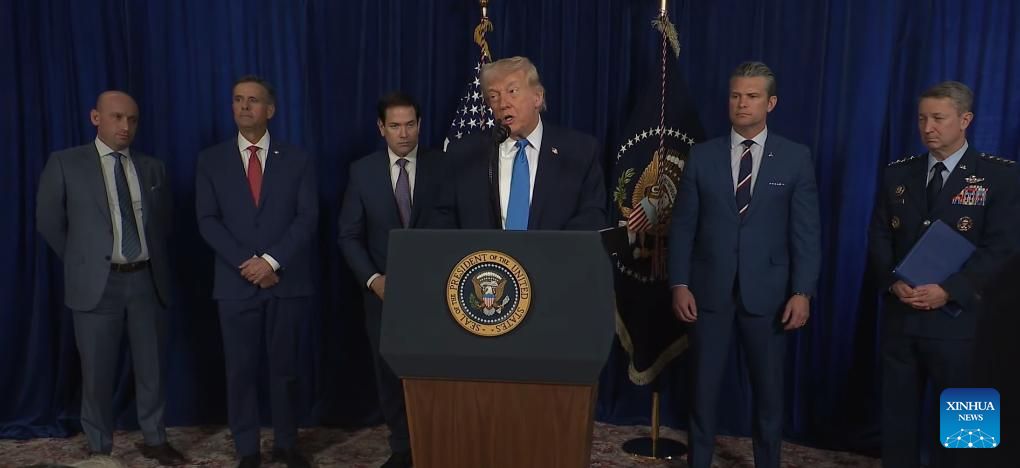
President Donald Trump said the US will "participate very strongly" in Venezuela's oil sector.
Oil and gas joint venture
Venezuela's oil industry was nationalized in the 1970s, with the birth of the national oil and gas corporation Petroleos de Venezuela S.A. (PDVSA).
In the 1990s, Venezuela opened up this sector to foreign investment. However, after Hugo Chavez was elected president in 1999, the government stipulated that PDVSA must hold a controlling stake in all oil and gas projects.
PDVSA has established many joint ventures to boost production and cooperate with international partners such as Chevron, China National Petroleum Group (CNPC), ENI, Total and Rosneft of Russia.
Exports and oil refining
Previously, the US was Venezuela's largest oil consumption market. However, after sanctions were imposed, China has become the main destination of Venezuelan crude oil in the past decade.
Venezuela currently owes China about 10 billion USD, after Beijing became the largest creditor under the late President Hugo Chavez. These loans are repaid with crude oil, transported on 3 super-large oil tankers once jointly owned by Venezuela and China.
Two of these ships approached Venezuela in December, when Mr. Trump announced the blockade of all oil tankers entering and leaving this South American country.
According to documents from PDVSA and maritime transport data, ships are currently awaiting new instructions, in the context of Venezuela's oil exports being almost stalled.
President Trump told Fox News that China "will receive oil", but did not specify.
Russia has also lent Venezuela billions of USD, but the exact scale of these loans has not yet been announced.


