
On March 18, the US Federal Reserve (Fed) decided to keep interest rates unchanged at 3.5%-3.75%, marking the second consecutive "standstill" after a series of last year's cuts. The decision was passed with a ratio of 11-1 in the Federal Open Market Committee (FOMC), with a dissenting opinion supporting a further 0.25 percentage point reduction.
Below are 5 notable points from policy decisions and speeches by Fed Chairman Jerome Powell:
Economy still grows but recruitment slows down
The Fed assesses that the US economy continues to expand at a "stable pace", but the labor market shows signs of cooling down. Slower job growth shows weakening recruitment demand, while inflation remains higher than target.
Inflation has not cooled down, under pressure from energy
Mr. Powell admitted that inflation is still a major concern. Rising energy prices due to Middle East tensions could push the general price level up in the short term.
Higher fuel costs also lead to a chain reaction effect on transportation, tourism and trade, exacerbating consumer price pressure.
Interest rates are in a "neutral" zone
According to Mr. Powell, the current interest rate is in a neutral range - that is, neither stimulus nor strongly restrain the economy. This allows the Fed more time to observe before taking further steps.
Still considering interest rate cuts but very cautious
The Fed continues to forecast that it may cut interest rates once in 2026 and again in 2027. However, this roadmap largely depends on inflation developments.
New forecasts show that inflation in 2026 will increase to 2.7%, growth will reach 2.4% and the unemployment rate will be about 4.4%.
Financial market reacts negatively
Immediately after the announcement, US stocks plummeted: Dow Jones lost 714 points, S&P 500 fell 1.2% and Nasdaq Composite lost 1.3%.
Investors are concerned that the Fed will maintain high interest rates longer than expected in the context of persistent inflation.
Mr. Powell also affirmed that he would continue in office until the US Department of Justice investigation into the renovation costs is completed, emphasizing the requirement for "transparency and final conclusions".
Gold price loses 5,000 USD/ounce mark
In that context, world gold prices have lost the 5,000 USD/ounce mark. The gold market has been under pressure before inflation data was released and is facing further sell-off pressure.
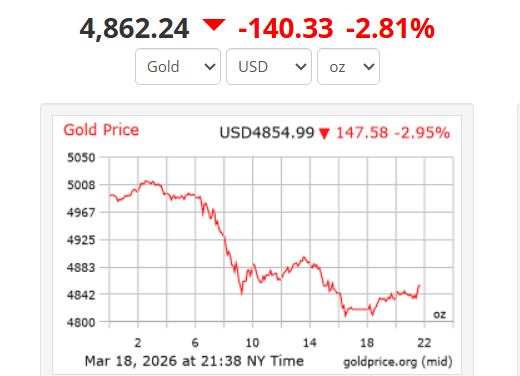
Spot gold price at 8:38 am on March 19 Vietnam time was traded at 4,862.24 USD/ounce, down 140.33 USD, equivalent to a decrease of 2.81%.
Regarding domestic gold prices in the Vietnamese market, SJC gold bar prices are traded at 180-183 million VND/tael (buying - selling). Bao Tin Minh Chau 9999 gold ring prices are traded at 178.8 - 181.8 million VND/tael (buying - selling).


