
Gold prices are escalating sharply amid geopolitical and global economic instability. However, the prospect ahead is not only an upward trend, but also accompanied by unpredictable fluctuations.
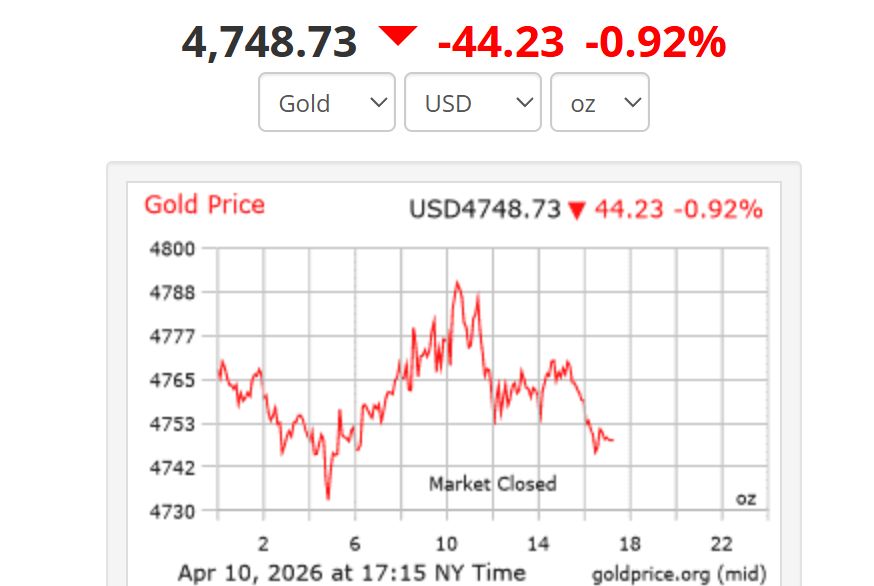
According to data from GoldPrice.org, as of April 11, world gold prices are still trading around the 4,748.73 USD/ounce mark. This increase comes after a volatile 2025, when the precious metal recorded an increase of up to 64%, reflecting increased safe-haven demand.
The main drivers behind gold prices
The diễn biến of gold prices is not accidental, but is affected by many macroeconomic factors.
First of all, inflation. When commodity and service prices escalate, the purchasing power of currencies decreases, investors tend to switch to limited assets such as gold. Reality shows that the period of strong global inflation from 2020-2022 has significantly boosted gold prices.
In addition, geopolitical instability also plays a key role. Tensions in the Middle East, especially conflicts related to Iran, along with issues in Europe and South America, are making the financial market more sensitive. In such times, gold is often seen as a "haven" for capital flows.
Global economic prospects are also clearly affected. The risk of recession, stock market volatility or rising unemployment rates both make investors cautious, thereby boosting demand for gold holdings.
Three major forecasts for gold prices
Although there is no definite answer for the future, many financial institutions have put forward noteworthy scenarios, according to Yahoo Finance.
First, the 6,000 USD/ounce mark is no longer too far.
Some experts believe that with central banks increasing gold stockpiling and global tensions not cooling down, gold prices may continue to rise. Even JPMorgan forecasts that a level of 6,300 USD/ounce could be reached in 2026.
Second, physical gold demand may increase.
The rate of physical gold ownership is still quite low compared to other investment channels. Only 10.8% of the US population invests in physical gold, according to U.S. Gold & Coin. This rate is much lower than those who invest in stocks; a 2025 Gallup survey showed that 62% of Americans own stocks.
However, in the context of increasing financial risks, the trend of holding gold bars, gold ingots or gold coins is forecast to be more common, especially as buying and selling becomes more convenient.
Third, price fluctuations may be stronger than before.
Unlike the "stable" image in the past, recent gold prices show a large fluctuation range. In just the first few days of February 2026, prices fell by about 14% after setting a short-term peak. This shows that the gold market is becoming more sensitive to economic and political shocks.
Although the long-term outlook for gold is still positively assessed in the context of many global risks, analysts note that the upward trend is not going straight. Strong corrections may appear at any time.
Regarding domestic gold prices in the Vietnamese market, on the morning of April 11, SJC gold bar prices and Bao Tin Minh Chau 9999 gold ring prices traded around 169.7 - 172.7 million VND/tael (buying - selling).


