US warns Peru loses sovereignty over China's super port

Lam Anh |

The US warned Peru that it is losing national control at China's Chancay super port, after a controversial legal ruling in the locality.

The incident broke out when a Peruvian judge ruled that Chancay port - a giant project worth 1.3 billion USD located near the capital Lima - would be exempt from some supervisory regulations of state management agencies.

Immediately after that, the Western Hemisphere Department of the US State Department expressed its views on social network X, stating that investment flows from China may be accompanied by barriers to the autonomy in infrastructure management of the receiving country.

These are considered the most direct responses from the US to the increasingly deep economic cooperation relationship between Peru and China.

Currently, Beijing has surpassed Washington to become the largest trading partner of this South American nation. Chancay Port, operated by Cosco Shipping Group, is expected to become an important link connecting trade between South America and Asia.

The focus of the issue lies in the supervisory power of the Peruvian infrastructure management agency over this port. While Ositran - the management, supervision and regulation agency of transport infrastructure has the authority to manage most other major seaports in Peru, Chancay port is registered under private ownership.

Leader Ositran believes that the lack of public supervision may reduce the level of protection of the rights of service providers at the port.
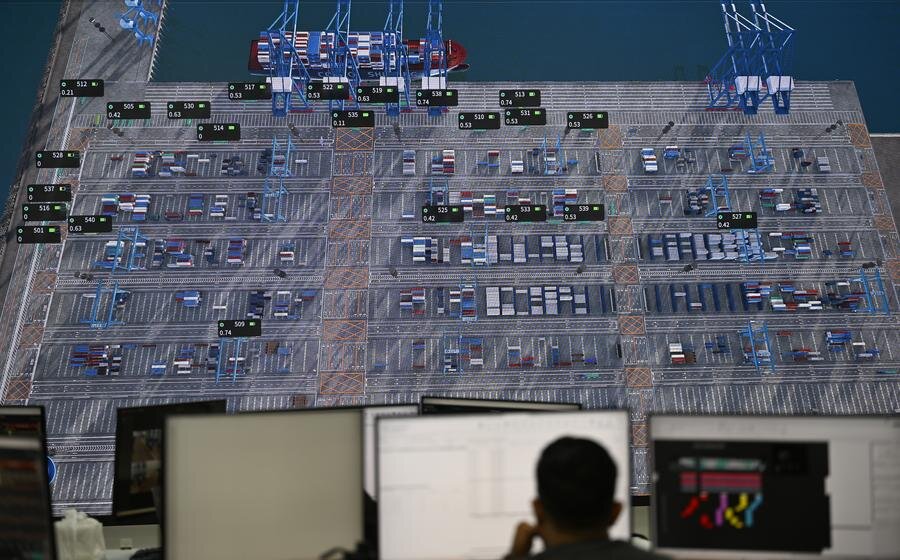
Một nhân viên giám sát quá trình vận hành tại trung tâm điều hành của siêu cảng Chancay (Peru) vào ngày 16.5.2025. Ảnh: Xinhua
An employee supervises the operation process at the operating center of the Chancay super port, Peru on May 16, 2025. Photo: Xinhua

In the opposite direction, Mr. Gonzalo Rios, Deputy Managing Director of Chancay Port, affirmed that this project is not outside the scope of Peru's sovereignty. He clarified that state agencies such as customs still fully perform their control functions here.

The dispute actually involves a surveillance fee equivalent to 1% of revenue, an expense that investors believe is not included in the initial financial plan.

This situation takes place in the context of the US's efforts to consolidate its influence in Latin America through security and economic cooperation commitments. To create a counterweight, the US has identified Peru as a "big ally outside NATO" and is discussing a project to build a new naval base for this country worth about 1.5 billion USD.

US Ambassador to Peru, Mr. Bernie Navarro, also shared the view that countries need to be cautious with short-term economic benefits to ensure long-term independence in development policies. He emphasized the importance of maintaining full autonomy over strategic infrastructure projects.

Disagreement over management authority at the Chancay superport shows that Peru is facing a problem of balancing interests between the two superpowers. While major infrastructure projects offer strong economic growth opportunities, they also set strict requirements for perfecting the legal framework to ensure harmony between investment attraction and state management.

Lam Anh
RELATED NEWS

US, China space race in modern deterrent strategy

|

The US and Chinese governments are racing to protect assets on orbit, a key factor in modern deterrence.

Venezuelan oil and the problem of repaying debt to China when the US takes control of exports

|

The US taking over Venezuelan oil exports has led to a shift in the direction of a large amount of crude oil used to pay debts to China.

US loosens control of chip exports to China

|

The US decision to allow the export of H200 chips to China is not only a victory in Nvidia's movement corridor, but also marks a new turning point in Washington's technology strategy. This adjustment could reshape the global AI race and balance the benefits between the two largest economies in the world.

Mai Thu Huyen talks about inviting NSND Quoc Khanh to play Ngoc Hoang

|

Without Tao Quan 2026, People's Artist Quoc Khanh still plays Ngoc Hoang in a short film series produced by Mai Thu Huyen's company.

China pledges to support Cuba ahead of US oil sanctions

|

China affirms it will provide maximum support for Cuba to overcome the energy crisis caused by new blockades from the US.

State funeral of former Vice Chairman of the Council of Ministers Doan Duy Thanh

|

The funeral of former Vice Chairman of the Council of Ministers Doan Duy Thanh was solemnly held at the National Funeral Home, Hanoi.

Indonesian newspaper suspects AFC's motive for naturalizing Malaysian player

|

Indonesian media suspects AFC, questioning the shift of responsibility to Vietnam regarding the Malaysian naturalized player case, although FIFA still keeps the accusing party secret.

Trade Union bus takes thousands of workers from Ho Chi Minh City to their hometowns for Tet

|

Ho Chi Minh City - Trade Union buses take thousands of workers in the North of Ho Chi Minh City to their hometowns to celebrate Tet with their families.

US, China space race in modern deterrent strategy

Hải Nguyễn |

The US and Chinese governments are racing to protect assets on orbit, a key factor in modern deterrence.

Venezuelan oil and the problem of repaying debt to China when the US takes control of exports

Thanh Hà |

The US taking over Venezuelan oil exports has led to a shift in the direction of a large amount of crude oil used to pay debts to China.

US loosens control of chip exports to China

Song Minh |

The US decision to allow the export of H200 chips to China is not only a victory in Nvidia's movement corridor, but also marks a new turning point in Washington's technology strategy. This adjustment could reshape the global AI race and balance the benefits between the two largest economies in the world.