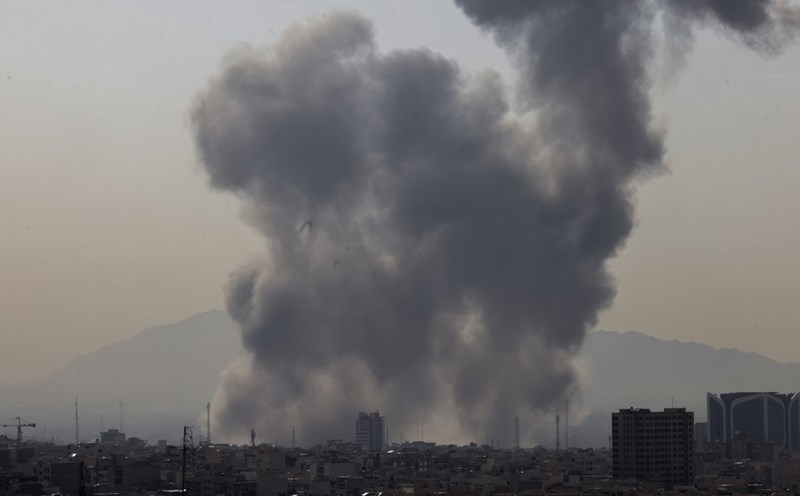
In the early morning of March 1 (local time), the US and Israel launched another air strike on targets in Iran, just 1 day after confirming that Iranian Supreme Leader, Supreme Leader Ali Khamenei, had been killed in the airstrike on February 28.
The Israeli military said that in the latest series of attacks, they targeted at least 30 locations in western and central Iran, including air defense systems, missile launchers and military command centers.
On the Truth Social platform, US President Donald Trump declared that "strong and accurate bombings" targeting Iran will "continue without interruption throughout the week or longer if necessary". He also warned Iran not to carry out the attack that Tehran declared "the strongest ever".
“Iran says they will attack very strongly today, stronger than ever. They are better off not doing so, because if they do, we will retaliate with an unprecedented force,” Trump wrote.
Iran immediately issued a tough response message. Iranian Parliament Speaker Mohammad Bagher Qalibaf declared on television that the US and Israel had "crossed the red line" and "had to pay the price".
Meanwhile, the Iranian Islamic Revolutionary Guard Corps (IRGC) announced that it would launch "the most intense offensive campaign in the history of Iranian armed forces", targeting US and Israeli military bases.
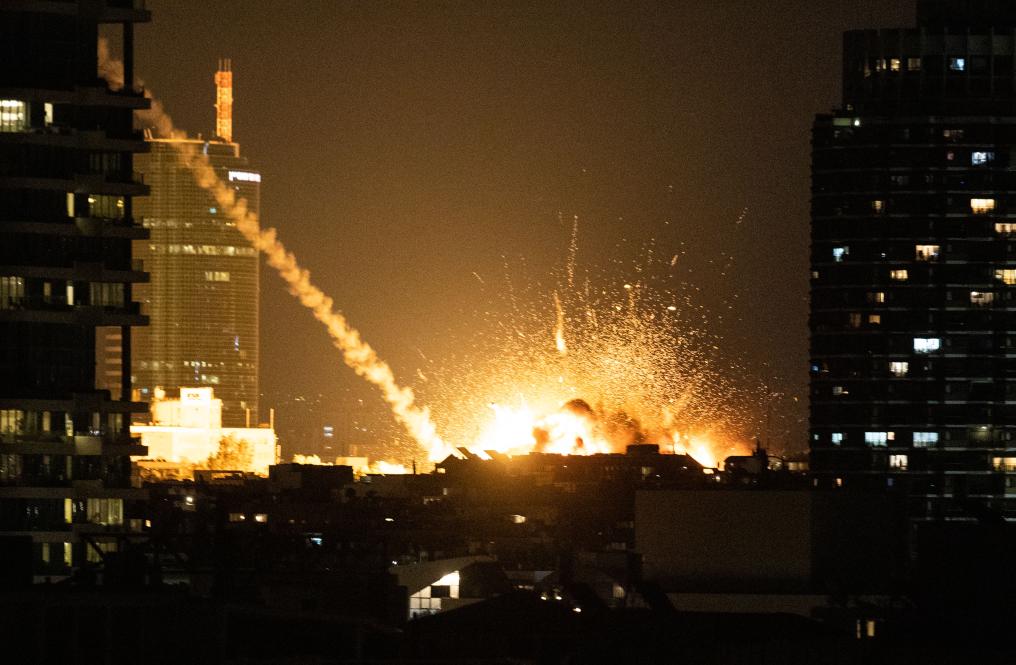
On the morning of March 1st, sirens rang throughout central Israel after Iran launched missiles towards the country. The Israel Defense Forces (IDF) said the warning system was activated shortly after 6:30 am. On social media, the IDF wrote that "for the 20th time in the past 24 hours, millions of Israelis have had to flee to shelters under Iranian missiles.
It is not clear how many missiles penetrated Israel's multi-layered missile defense system. However, previously an Iranian missile hit a residential area in Tel Aviv, killing 1 person and injuring more than 20 others.
Not only Israel, the Gulf region is also shaken. Explosions were recorded in Dubai (UAE), Doha (Qatar) and Manama (Bahrain). UAE officials said Iran launched 137 missiles and 209 drones into its territory, affecting many infrastructures, including the airport. Smoke and fire were seen near symbols such as Palm Jumeirah and the Burj Al Arab hotel.
Dubai International Airport, Abu Dhabi Airport and Kuwait airport all recorded "incidents", in which Abu Dhabi alone had 1 death. Oman is the only country in the region that has not been attacked, in the context that this country is considered an intermediary.
On the Iranian side, state television confirmed that the Chief of the General Staff of the Iranian Army, General Abdol Rahim Mousavi, and Defense Minister Aziz Nasirzadeh were killed in an airstrike targeting a meeting of the National Defense Council.
Previously, state media also confirmed the death of IRGC Commander, Major General Mohammad Pakpour, and Senior Security Advisor Ali Shamkhani.
According to US sources, the initial airstrike was said to have killed about 40 Iranian officials. The death of Supreme Leader Ali Khamenei is considered the biggest turning point since the US-Israel air campaign began, pushing the Middle East into a spiral of direct confrontation between the two blocs of forces.
New developments show that the conflict has far exceeded the limited "preemptive strikes", shifting to a large-scale retaliatory phase, with the risk of spreading throughout the region.