
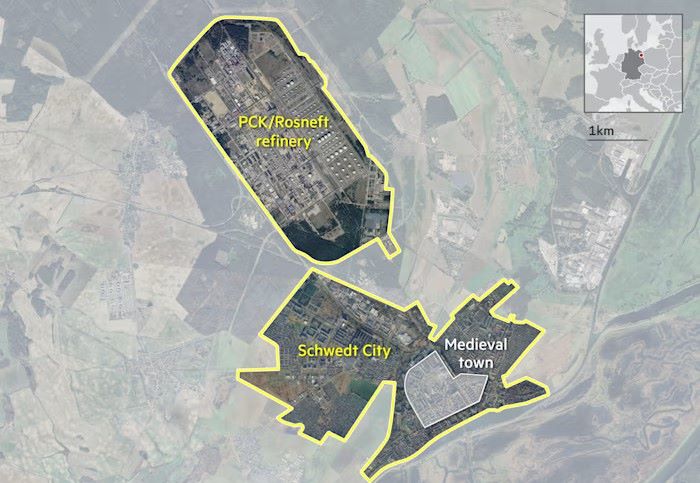
About 100km north of Berlin, there is a refinery that is becoming Germany's most dangerous geopolitical bottleneck.
The PCK plant in the town of Schwedt is owned by the Russian corporation Rosneft, operated by Germany, but may be "squeezed" by the US with sanctions. If the worst-case scenario occurs, the capital Berlin is at risk of serious fuel shortages.
PCK Schwedt is not a normal facility. This plant supplies 90% of gasoline, heating oil and aviation fuel to Berlin, the capital's airport, and the entire state of Brandenburg. The plant shutdown is not just an industrial accident, but a direct blow to Germany's energy security.
The danger is very close. On April 29, the US sanctions immunity period for the plant will expire. The German government is urgently negotiating with the US to request an extension, and at the same time, Berlin has quietly restarted the nationalization plan - which was once considered a "red line".
Signs from the US are positive, but with this administration, no one is sure" - a well-informed source said. "Therefore, the asset requisition scenario is being considered again.
Time is not on Berlin's side. Oil tankers must be pre-ordered for 1 to 2 months. Banks and suppliers are requesting a commitment that PCK is still able to pay and maintain the contract. If the plant is forced to stop, thousands of trucks will have to transport fuel from Bavaria and across Germany day and night to save Berlin from paralysis.
For many years, German governments have avoided nationalization for fear of Russian retaliation by confiscating assets of German businesses in Russia. But with the cabinet of Chancellor Friedrich Merz, the choice is running out.
In 2022, Berlin placed PCK under the supervision of the federal energy regulator, but did not confiscate shares. Rosneft still holds 54% of shares, Shell owns 37.5%. This "half-hearted" decision stemmed from Moscow's fear of retaliation. At that time, Russian crude oil was still flowing through the 4,000km long Druzhba oil pipeline to Schwedt - a flow that lasted for 6 decades.
The turning point came in October last year, when the US imposed new sanctions on Rosneft and assets in Europe, amid Washington and Moscow exploring dialogue on Ukraine. This move was not coordinated with Berlin, causing PCK to almost go bankrupt. Germany was forced to ask the US for a 6-month exemption, arguing that Rosneft no longer had actual control of the plant.
For the town of Schwedt - where the factory was built in the 1960s - PCK is the lifeblood. "Everything runs on fuel from here: buses, police cars, ambulances, airplanes. This factory cannot stop," Mayor Annekathrin Hoppe said.
Replacing Russian oil is not easy. Kazakhstan is currently the main supplier, but the price is higher and requires prepayment. PCK also has to import oil through Polish and German ports, costs increase sharply, and adjust technology to treat many different types of oil. Although the capacity has recovered to more than 85%, cash flow is still eroded.
In Schwedt, many people still hope that one day Russian oil will flow back. "We hope for peace for Ukraine," a resident said, "and also a little selfish for ourselves: When peace is sufficiently sustainable, Germany will have to trade with Russia again.


