
World gold prices extend their strong rise amid a weakening USD and expectations that the next Chairman of the US Federal Reserve (Fed) will pursue a softer monetary stance.
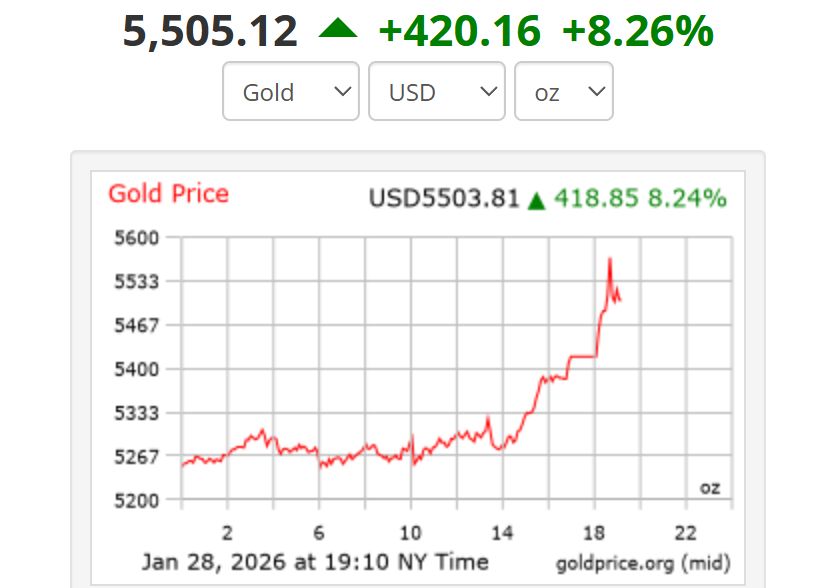
In the early morning trading session of January 29, world gold prices at one point increased by 8.26%, exceeding 5,500 USD/ounce, after increasing by 4.6% in the previous session - the strongest increase in a day since the peak period of the COVID-19 pandemic in March 2020.
Accordingly, the world gold price at 7:10 am on January 29 Vietnam time traded at 5,505.12 USD/ounce, up to 420.16 USD, equivalent to 8.26%.
This breakthrough reflects the psychology of looking for safe assets that is spreading on the global market.
Since the beginning of the year, gold has continuously risen thanks to a combination of many factors, notably increased geopolitical instability and the trend of escaping national currencies as well as government bonds.
According to analysts, tensions in the Middle East, purchases by central banks, along with military and geopolitical moves by US President Donald Trump - including military intervention in Venezuela and promoting the plan to buy Greenland - have contributed to pushing up the demand for tangible assets.
At the same time, the USD plunged to its 4-year low, further strengthening the role of gold as a defensive barrier against economic and financial instability.
In the context of the market betting that the next Fed leader may prioritize monetary easing, the attractiveness of gold - a non-profitable asset but capable of holding its price - continues to increase.
Gold price forecasts are also being assessed very positively by investors. Forecasts from the London Gold Market Association (LBMA) show that gold prices may reach the 6,000-7,000 USD/ounce range this year. Meanwhile, Bank of America analysts believe that the 6,000 USD/ounce mark may appear right from spring.
Notably, the strong increase in gold prices brought significant financial benefits to Russia. The added value of gold reserves has helped Moscow compensate for most of the approximately 300 billion USD of central bank reserves frozen by the West.
Unlike assets frozen abroad, the amount of gold held domestically by Russia can be sold or used as collateral, creating more financial flexibility.
According to published data, the Central Bank of Russia's gold reserves reached 74.8 million ounces of troy (equivalent to 2,326.54 tons) in early 2026. The market value of this asset has increased by nearly 67% in 2025, from 195.7 billion USD to 326.5 billion USD, thanks to the unprecedented escalation of global gold prices.
Regarding domestic gold prices in the Vietnamese market, SJC gold bar prices are traded around 181.7 - 184.2 million VND/tael (buying - selling).
The price of 9999 Bao Tin Minh Chau gold rings is trading around 180 - 183 million VND/tael (buying - selling).


