
Some sections of the city wall in Sanxingdui were destroyed by time, but Chinese archaeologists at the Sichuan Provincial Institute of Cultural Relics and Archeology have reconstructed the city's basic layout based on explore the existing city walls, China Daily reported.
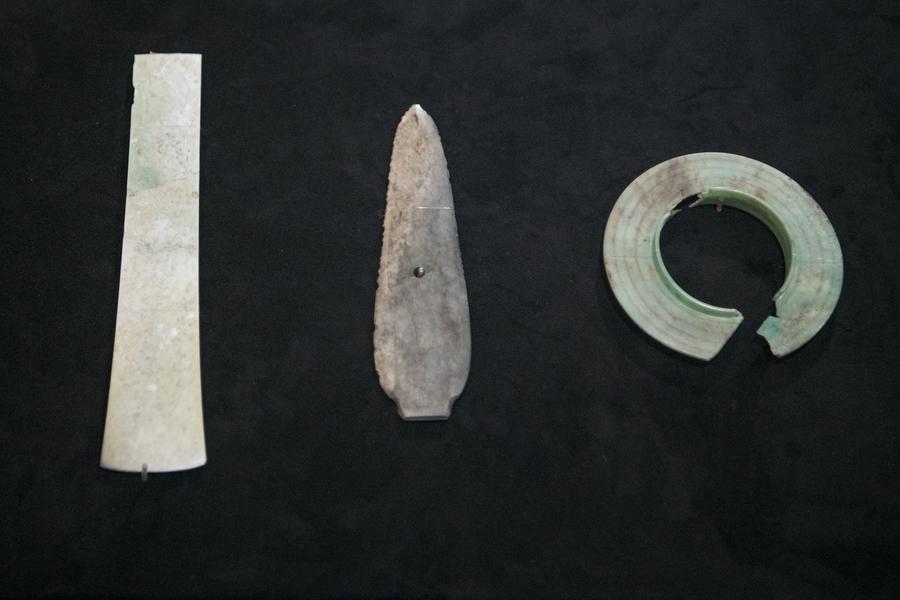
Sanxingdui ancient city ruins in Guanghan, Sichuan province, has an area of about 3.6 km2 and is arranged in a northwest - southeast direction, basically suitable for the foundations of high-end buildings and factories. The jade artifact was discovered in 2022.
Based on the newly discovered aqueducts and city gates, the main axis of Sanxingdui city is the result of the ancient Chinese adapting to the local geographical environment, as well as the mountains and rivers. natural river at that time, Xu Danyang - Deputy Director of Sanxingdui Relics at the Sichuan Provincial Archaeological and Cultural Relics Research Institute - said.
The northern and southern parts of Sanxingdui city were separated by a river, with the northern part being the palace and workshop area, while the southern part was the sacrificial area.
The water gates are located on the east and west sides of Tam Tinh Doi ancient citadel. This ancient citadel has thick walls, many gates and roads connecting with surrounding areas.
The layout is convenient for both daily production and water collection, as well as using waterways to connect with the outside world, reflecting advanced urban construction ideas, Xu Danyang said.
Scholars believe that San Tinh Doi was founded 2,800 to 4,800 years ago. Archaeological discoveries show that Tam Tinh Doi was a prosperous, highly developed cultural center.
The legendary Sanxingdui archaeological site in China was discovered in 1929 when Yan Daocheng - a local resident - dug a hole filled with jade and stone artifacts while repairing a sewage ditch next to his house.
Chinese archaeologists have been excavating here since the 1930s. A major breakthrough was achieved in 1984 when archaeologists unearthed the ruins of major palaces and part of the eastern and southern city walls. west and south of an ancient city. In 1986, Chinese archaeologists unearthed two large pits filled with bronze artifacts, including masks and figurines.
These important archaeological discoveries have confirmed that Sanxingdui - an archaeological site containing the ruins of a city - was once the political, economic and cultural center of the ancient Shu Kingdom, an ancient civilization. Ancient civilization existed in what is now Sichuan province, China.
Sanxingdui is recognized as one of China's most important archaeological discoveries of the 20th century.
Since 2020, six new sacrificial pits have been excavated after the first two. Artifacts unearthed at these 6 sacrificial pits are on display in the Tam Tinh Doi Museum. Sanxingdui Museum opened last July and has attracted more than 5 million visitors from around the world.


