
According to a statement from the Cambodian Ministry of Interior on January 7, Chen Zhi, 38 years old, of Chinese and Cambodian nationality, has been arrested and extradited to China after months of joint investigation between the two countries.
Cambodia said it had stripped Chen Zhi of Cambodian citizenship before handing him over, and affirmed that the arrest was within the framework of transnational crime prevention cooperation.
Chen Zhi was arrested along with 2 other Chinese citizens at the request of Beijing. However, to date, there is no official information about the charges that Chen Zhi faces in China.
Business empire and crime accusation
Chen Zhi is the founder and Chairman of Prince Group, a group that introduces itself as one of the largest groups in Cambodia, operating in the fields of high-end real estate, banking, hotels and large-scale construction projects.
However, according to US federal prosecutors, behind the glamorous business empire is a global-scale fraud and labor exploitation machine.
The US accuses Chen Zhi and her associates of operating cryptocurrency scam centers, using forced labor, targeting victims around the world, with revenue at times reaching 30 million USD per day.
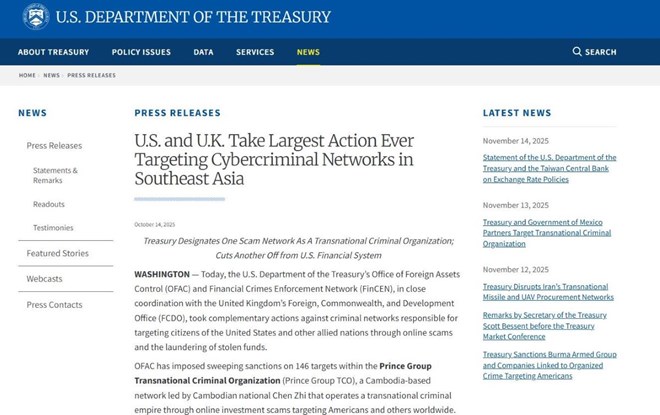
In October last year, the US Treasury Department and the British Foreign Office imposed sanctions on Prince Group and dozens of related companies, classifying them as transnational criminal organizations. Chen Zhi was indicted in New York on charges of money laundering and telecommunications fraud, along with many other associates.
The US Department of Justice also said it had seized about 15 billion USD of cryptocurrency related to Chen Zhi after years of investigation - described as the largest asset seizure in US judicial history.
After that, a series of legal areas such as Singapore, Thailand, Hong Kong (China) and Taiwan (China) announced the freezing or seizure of hundreds of millions of USD of related assets.
Prince Group has repeatedly rejected the accusations, calling them "unfounded" accusations and aiming to "legalize the illegal confiscation of assets".
International pressure and Phnom Penh's decision
In the past time, Cambodia has been under increasing pressure from the international community to allow fraud networks to operate on its territory.
The United Nations Office on Drugs and Crime (UNODC) warns that organizations operating "fraud camps" in Southeast Asia are expanding at an unprecedented rate, despite massive crackdowns.
According to Mr. Jacob Sims, a transnational crime expert and researcher at Harvard University's Asia Center, the arrest of Chen Zhi reflects that international pressure has reached a level that Phnom Penh can hardly continue to ignore.
Is the US at risk of losing jurisdiction?
Analysts believe that Chen Zhi's extradition to China means that the possibility of him having to appear in court in the US is very low, at least in the short term. China has no extradition agreement with the US, while relations between the two countries are deeply tense both geopolitically and economically.
“This development has actually shielded Chen from US jurisdiction” - Sims said.
According to US prosecutors, Chen Zhi and his associates are accused of operating at least 10 forced labor camps in Cambodia since 2015, forcing thousands of people to participate in investment and emotional scams, also known as "pig butchering". The money collected was then laundered through a network of more than 100 "shell" companies in at least 12 countries and territories.
The US also accused Chen Zhi of using illegal money to buy Picasso paintings, private jets, real estate in luxury buildings in London, and bribed officials to evade investigation.


