
Domestic pepper prices: Sharp increase
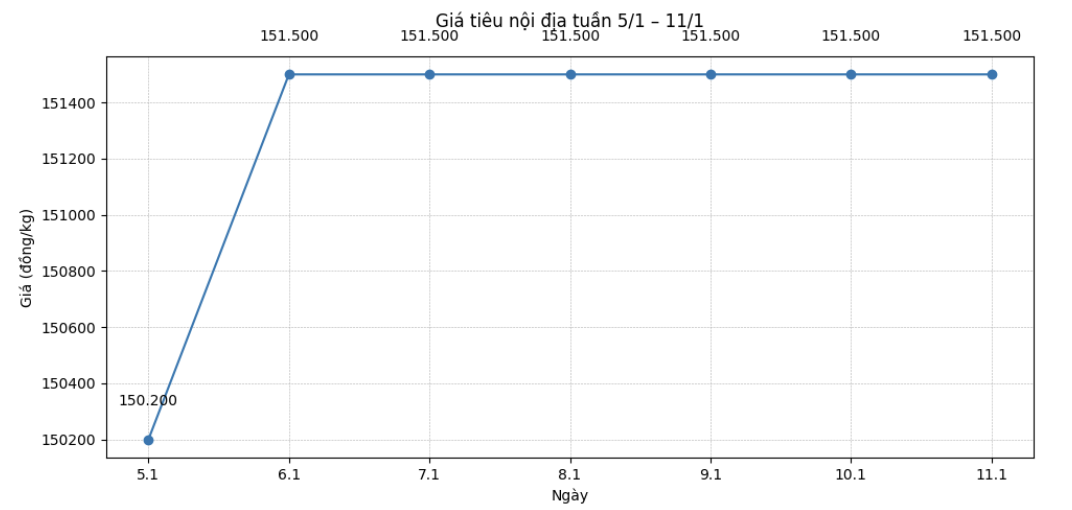
Today (January 11), domestic pepper prices traded in the range of 151,000 - 152,500 VND/kg, an increase of 1,500-2,500 VND/kg in all regions compared to the previous week.
At the end of last week, pepper prices in Dong Nai recorded an increase of 2,000 VND/kg, reaching the milestone of 151,000 VND/kg.
Conversely, the pepper price in Gia Lai remains unchanged, currently being purchased at 150,000 VND/kg.
Meanwhile, pepper prices in Dak Lak and Lam Dong province increased to a maximum of 2,500 VND/kg, anchored at the threshold of 152,000 VND/kg. Similarly, pepper prices in Ho Chi Minh City increased by an additional 1,500 VND/kg, trading at 151,500 VND/kg.
World pepper prices: Increase and decrease alternate
According to the International Pepper Corporation (IPC), world pepper prices have increased and decreased in opposite directions.
Indonesian black pepper price decreased by 47 USD/ton compared to the previous week, down to 6,717 USD/ton. At the same time as the survey, Indonesian white pepper price decreased by 59 USD/ton compared to the previous week, reaching 9,143 USD/ton.
Brazilian black pepper ASTA 570 increased by another 50 USD/ton, to 6,150 USD/ton. Meanwhile, the price of black and white ASTA Malaysia pepper remained unchanged, selling at 9,000 USD/ton and 12,000 USD/ton respectively.
In Vietnam, black pepper export prices simultaneously increased by 100 USD/ton compared to the closing price last week, at 6,600-6,800 USD/ton for 500 g/l and 550 g/l types. At the same increase, ASTA white pepper price is currently at 9,350 USD/ton.
Perspectives and forecasts
Compared to the beginning of the week, domestic pepper prices have hardly had major fluctuations, continuing to maintain a stable level in key growing areas. After the hot increase session, the market quickly returned to a sideways state, reflecting the cautious psychology of both sellers and traders in the context that supply and demand do not have a sudden factor.
Forecast for next week, pepper prices are likely to continue to fluctuate in a narrow range, the main trend is still stable or slightly increasing or decreasing depending on the time.
If export demand improves and the amount of goods sold by farmers does not increase sharply, prices may slightly increase. Conversely, in cases where the initial supply to the market is higher, pepper prices may be under adjustment pressure, but the decrease is assessed as not large.


