
Domestic pepper prices: Week extends upward momentum
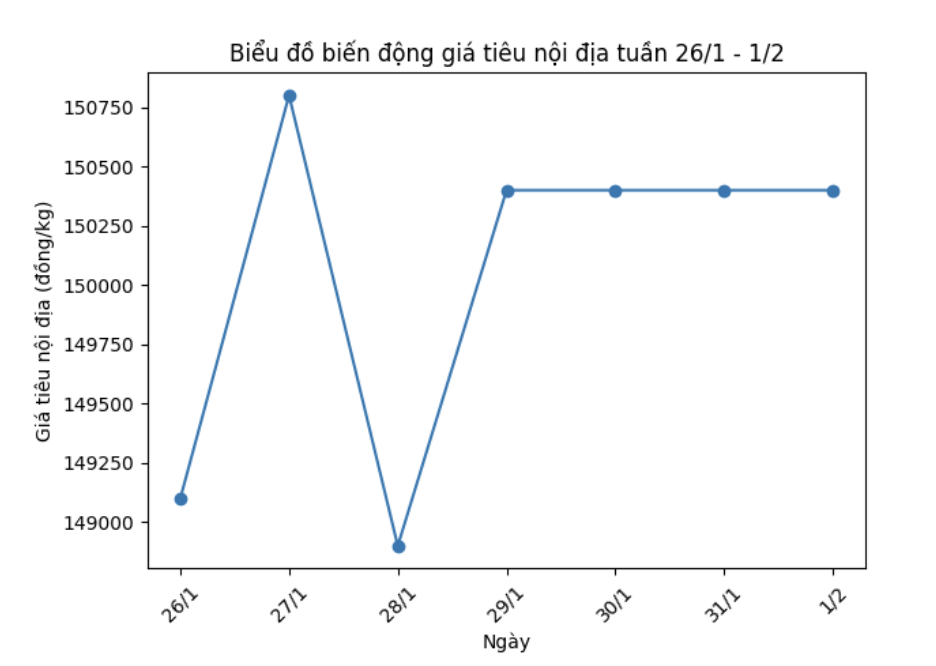
Today (February 1st), domestic pepper prices traded in the range of 149,000 - 152,000 VND/kg, an increase of 1,000-2,000 VND/kg in all regions compared to the previous week.
At the end of last week, Dak Lak pepper prices are being purchased at the highest level of 152,000 VND/kg, an increase of 2,000 VND/kg compared to the previous week.
In other localities such as Lam Dong and Dong Nai provinces, pepper prices also simultaneously increased by 2,000 VND/kg, respectively being bought at 151,000 VND/kg and 150,000 VND/kg.
Pepper prices in Ho Chi Minh City recorded an increase of 1,000 VND/kg, at 150,000 VND/kg.
In Gia Lai alone, pepper prices increased slightly by 500 VND/kg and stood at the lowest level of 149,000 VND/kg.
World pepper prices: Rise
According to the International Pepper Association (IPC), world pepper prices are rising.
Indonesian black pepper price ended last week at 6,732 USD/ton, up 1.28% (equivalent to 85 USD/ton) compared to the previous week. At the same time of the survey, Indonesian white pepper price was quoted at 9,263 USD/ton, up 1.33% (equivalent to 122 USD/ton) compared to the previous week.
Brazilian black pepper ASTA 570 reversed to increase by 50 USD/ton, reaching 6,150 USD/ton. Meanwhile, the price of black and white ASTA Malaysia pepper remained unchanged, selling at 9,000 USD/ton and 12,000 USD/ton respectively.
In Vietnam, the export price of black pepper continues to fluctuate in the range of 6,400-6,600 USD/ton for types 500 g/l and 550 g/l. Similarly, the current price of ASTA white pepper is at 9,150 USD/ton.
Assessments and forecasts
The domestic pepper market had a trading week with a fairly wide growth range. This is considered a positive signal showing the strong recovery of Vietnam's "black gold" after a sideways period.
The decline of the USD is the main reason pushing pepper prices to break through. The deep decline of the DXY index to the 95.50 point mark has created an important leverage to help Vietnamese agricultural exports benefit from prices.
Meanwhile, the domestic market is vibrant, the International Pepper Association (IPC) recorded a contrasting picture in India when this country continuously declined in price in the past two weeks. This clear differentiation affirms that the exchange rate factor is playing a key role, directly dominating the value of pepper on the current global trading map.


