
Domestic pepper prices: Extending the series of stagnant days
As of 11:30 am today (March 18), domestic pepper prices remained unchanged compared to the closing session yesterday, averaging 141,200 VND/kg. Currently, key areas are trading in the range of 140,500 - 143,000 VND/kg.
Domestic pepper prices after a series of deep declines have temporarily stopped adjusting, specifically as follows:
Gia Lai and Ho Chi Minh City provinces respectively listed at the marks of 140,50 VND/kg and 141,000 VND/kg.
Dong Nai province maintains the threshold of 140,500 VND/kg. This is also one of the provinces with the lowest prices in the region.
Dak Lak, Lam Dong recorded prices in the range of 141,000-143,000 VND/kg.
World pepper prices: Stable
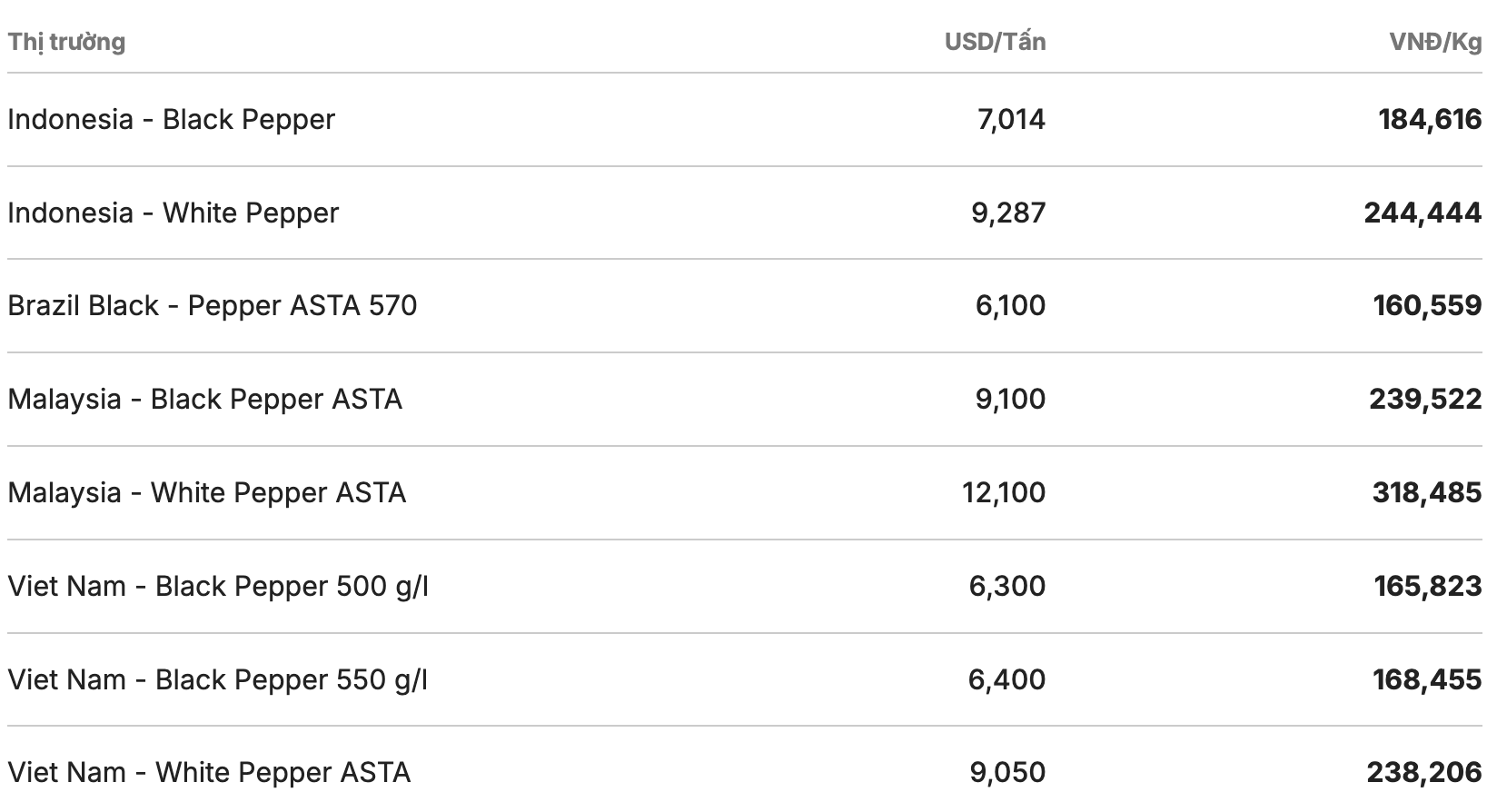
In the world market, pepper prices remained unchanged compared to the previous closing session. The Indonesian exchange - one of the most vibrant markets - was no exception. Black and white peppers traded in the range of 7.014 - 9,287 USD/ton (equivalent to 184,616 VND/kg - 244,444 VND/kg).
The Brazilian market maintained an increase of 50 USD/ton, listed at 6,100 USD/ton (about 160,559 VND/kg). Notably, black and white peppers maintained an increase of 100 USD/ton for many days, trading at 12,100 USD/ton and 9,100 USD/ton.
In Vietnam's pepper export market, black pepper prices of 500 g/l and 550 g/l are anchored at 6,300 - 6,400 USD/ton. Meanwhile, ASTA white pepper price remains unchanged, offered for sale at 9,050 USD/ton (equivalent to 238,206 VND/kg).
Assessments and forecasts
According to experts, the sharp price decrease in the context of peak harvest is an inevitable development when warehouses and export businesses in Hai Phong city or Ho Chi Minh City are tending to pressure prices to collect cheap goods.
Meanwhile, the listed price on the international market has not had new fluctuations, in fact, the strong USD (DXY maintained above the 100 point mark) is causing purchasing power from traditional markets such as the EU and North America to tighten. International importers are taking advantage of the downward momentum of domestic prices in Vietnam to negotiate futures contracts with higher discount rates.


