
Domestic pepper prices
As of 11:30 am today (July 20), domestic pepper prices reversed to decrease, listed at 138,400 VND/kg. Currently, key areas are trading in the range of 137,000 - 140,500 VND/kg.
Domestic pepper prices remained unchanged in the first trading session of the week. Currently, provinces and cities list prices as follows:
Gia Lai and Dong Nai simultaneously listed at the mark of 137,000 VND/kg.
In the same direction, pepper prices in Ho Chi Minh City are anchored at the threshold of 137,500 VND/kg.
Similarly, Lam Dong and Dak Lak offer for sale at the highest purchase price in the whole region in the range of 140,000 - 140,500 VND/kg.
World pepper price
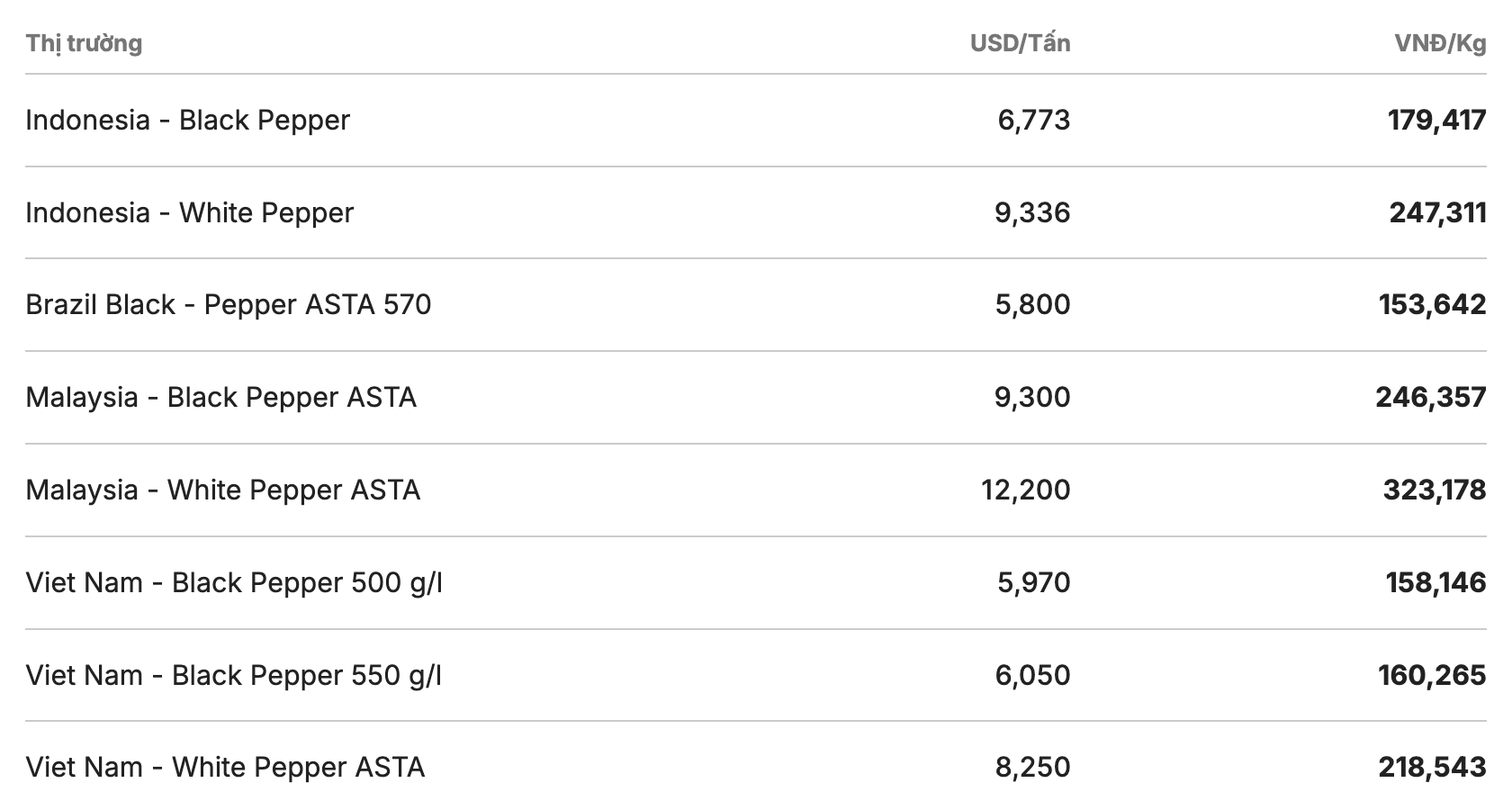
In the world market, pepper prices are stable in all countries. Indonesian black pepper and white pepper are no exception, trading in the range of 6,773 - 9,336 USD/ton (equivalent to 179417 VND/kg - 247,311 VND/kg).
Meanwhile, the price of black pepper in Brazil remained unchanged at the market selling price of 5,800 USD/ton (about 153,642 VND/kg). Notably, black and white pepper in Malaysia are still trading at high prices, respectively 12,200 USD/ton and 9,300 USD/ton.
In Vietnam's pepper export market, the price of black peppers of 500 g/l and 550 g/l is currently at 5,970 - 6,050 USD/ton. In the same direction, ASTA white pepper is offered for sale at 8,250 USD/ton (equivalent to 218,543 VND/kg).
Assessments and forecasts
According to data from the Vietnam Pepper and Spice Plant Association (VPSA), in the first 6 months of the year, our country exported a total of 145,686 tons of pepper, earning a turnover value of 940.5 million USD. Compared to the same period in 2025, this figure marks a growth of 17.4% in volume and 10.6% in value.
However, in June 2026 alone, the market began to show signs of stagnation after the boom period of May. In which, exports in June reached 23,103 tons with a turnover of 151.3 million USD, down 8.2% in volume and 8.9% in value compared to the previous month, due to weakening demand from markets in Asia, Africa and America.
Currently, traditional and key markets such as the United States, the European Union (EU) and the UAE still maintain stable purchasing power, playing an important "midwife" role for the export activities of domestic enterprises.


