
Domestic pepper prices
As of 11:30 AM today (July 18), domestic pepper prices remained unchanged after a week of fluctuations, listed at 138,400 VND/kg. Currently, key areas are trading in the range of 137,000 - 140,500 VND/kg.
Domestic pepper prices after the sudden adjustment have temporarily stood still. Currently, provinces and cities list prices as follows:
Gia Lai and Dong Nai simultaneously listed at the mark of 137,000 VND/kg.
In the same direction, Ho Chi Minh City anchored at the threshold of 137,500 VND/kg.
Similarly, Lam Dong and Dak Lak offer for sale at the highest purchase price in the whole region in the range of 140,000 - 140,500 VND/kg.
Compared to the same period 2 months ago, domestic pepper prices are still lower by 800 - 4,700 VND/kg. This shows that the trend of domestic pepper prices continues to adjust deeply downwards.
World pepper price
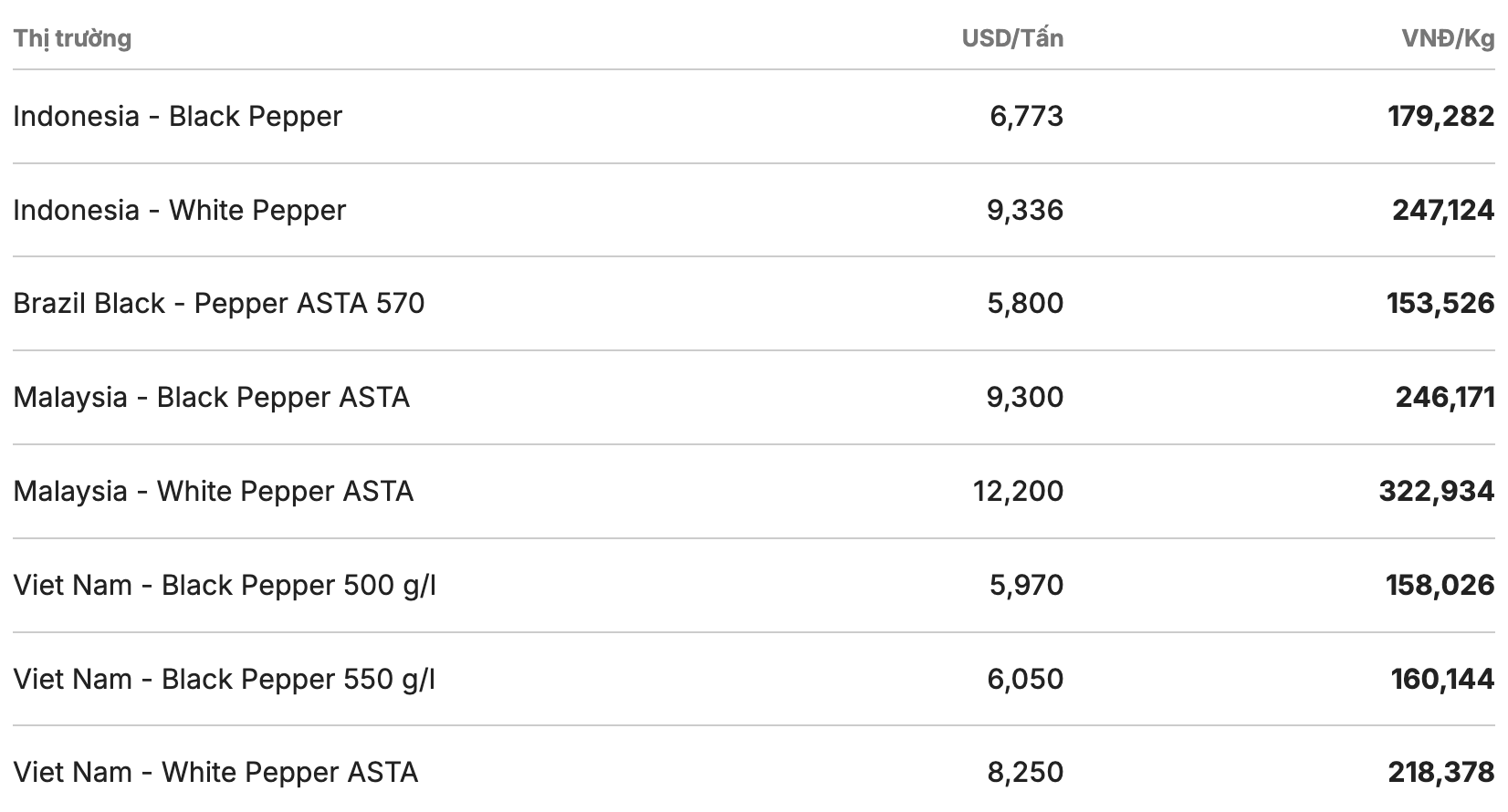
In the world market, pepper prices simultaneously adjusted in all countries after nearly 2 weeks of stagnation. Indonesian black pepper and white pepper increased and decreased in opposite directions, respectively trading in the range of 6,773 - 9,336 USD/ton (equivalent to 179,282 VND/kg - 247,124 VND/kg), sharply decreasing by 306 USD/ton and increasing by 138 USD/ton.
Meanwhile, the price of black pepper in Brazil decreased by 100 USD/ton, the market selling price is 5,800 USD/ton (about 153,526 VND/kg). Notably, black and white pepper in Malaysia suddenly slipped out of the high price zone, both down 50 USD/ton, respectively 12,200 USD/ton and 9,300 USD/ton.
In the opposite direction, in Vietnam's pepper export market, black pepper prices of 500 g/l and 550 g/l increased by 120 USD/ton and 100 USD/ton, currently at 5,970 - 6,050 USD/ton. In the same direction, ASTA white pepper price increased slightly by 50 USD/ton, offered for sale at 8,250 USD/ton (equivalent to 218,378 VND/kg).
Assessments and forecasts
Currently, supply from Brazil and Indonesia is gradually being brought to the market, creating more pressure on world pepper prices. However, import demand in many markets is still assessed as quite positive, contributing to limiting the decline.
For the domestic market, the remaining amount of pepper in the planted gardens is not as abundant as in previous years, so the selling pressure is not too great. This is considered a supporting factor to help pepper prices maintain in high areas.


