
Domestic pepper prices
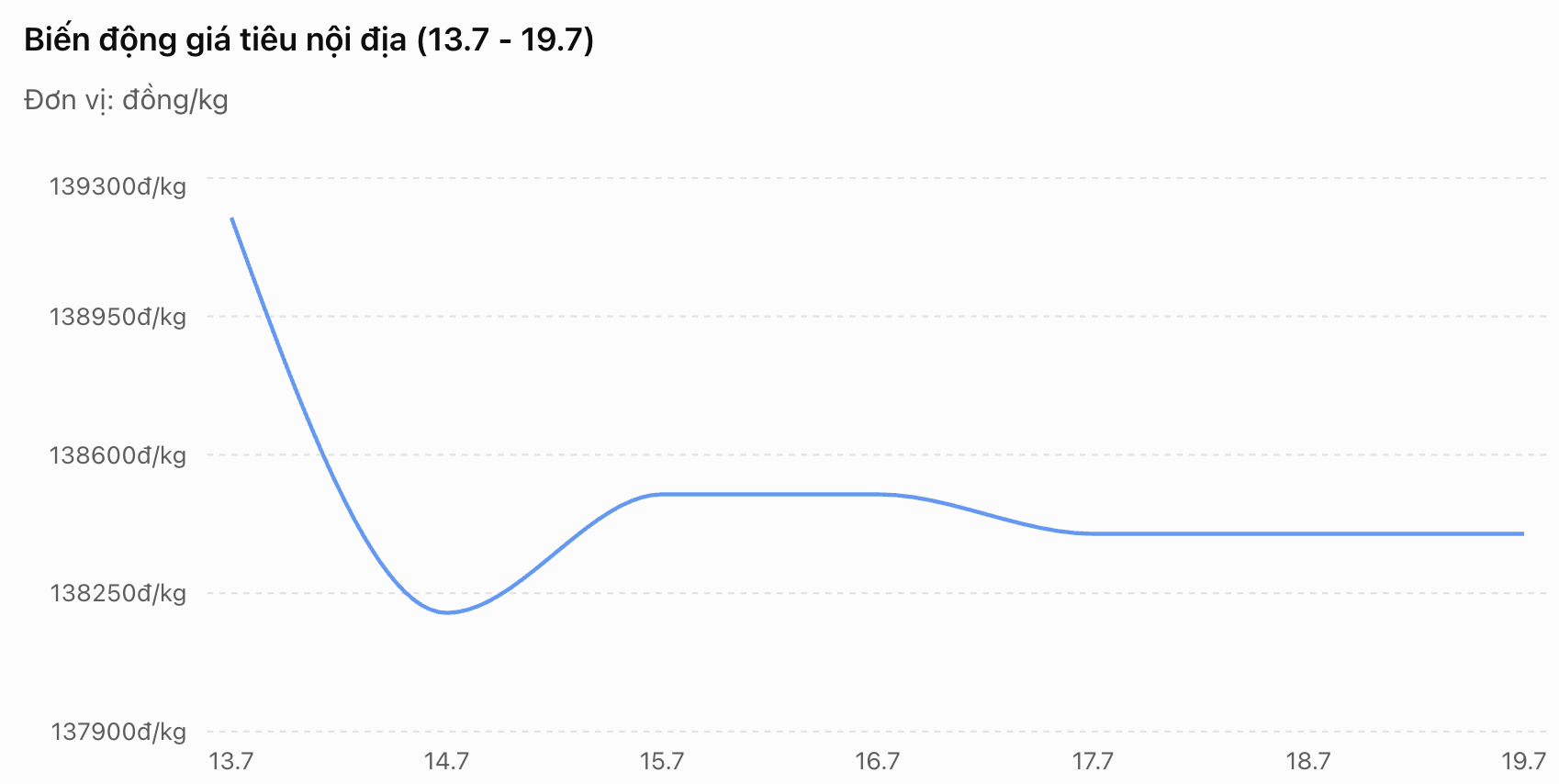
Today (July 19), domestic pepper prices traded in the range of 137,000 - 140,500 VND/kg, down from 500 - 1,500 VND/kg compared to last week.
At the end of last week, Gia Lai and Dong Nai both anchored at the threshold of 137,000 VND/kg, down 1,000 VND/kg.
Ho Chi Minh City announced pepper prices at 137,500 VND/kg, down 1,500 VND/kg.
Dak Lak and Lam Dong are no exception when the downward trend covers the entire region. However, these are two areas with a decrease of at least 500 VND/kg, bringing the transaction price in the range of 140,000 - 140,500 VND/kg.
World pepper price
According to data from the International Pepper Corporation (IPC), pepper prices last week fluctuated in opposite directions.
Indonesian black pepper prices last week interrupted a long series of sideways movements, currently listed at 6,773 USD/ton, down sharply by 306 USD/ton compared to the previous closing session.
In the same direction, the price of Brazilian black pepper type ASTA 570 decreased by 100 USD/ton, anchored at the threshold of 5,800 USD/ton. Notably, the price of black and white Malaysian pepper both decreased by 50 USD/ton, anchored at 9,300 USD/ton and 12,200 USD/ton in the past week.
Meanwhile, Indonesia's Muntok white pepper price jumped up 138 USD/ton compared to last week, reaching 9,336 USD/ton.
In Vietnam's pepper export market, black pepper prices of 500 g/l and 550 g/l increased by 120 USD/ton and 100 USD/ton, currently at 5,970 - 6,050 USD/ton. In the same direction, ASTA white pepper price increased slightly by 50 USD/ton, offered for sale at 8,250 USD/ton (equivalent to 218,378 VND/kg).
Assessments and forecasts
Price fluctuations in the 3rd week of July 2026 show that the world pepper market has not formed a clear trend but is in a stage of adjustment and differentiation according to each producing country.
For Vietnam, the fact that export prices have broken the stable daily streak, diễn biến in the direction of price increases creates a positive signal, showing proactiveness in implementing export contracts and limiting risks from short-term price fluctuations.


