
Domestic pepper prices: Rise
As of 11:30 am today (June 4), domestic pepper prices suddenly increased again, averaging an increase of 1,000 VND/kg, anchored at 138,400 VND/kg. Currently, key areas are trading in the range of 137,000 - 140,000 VND/kg.
Domestic pepper prices adjusted up after holding prices for 2 consecutive days, currently the listed prices in areas are as follows:
Gia Lai and Dong Nai provinces both increased by 1,000 VND/kg, trading at the mark of 137,000 VND/kg.
Ho Chi Minh City increased by another 1,000 VND/kg, listed at a price of 138,000 VND/kg.
In the same direction, Dak Lak and Lam Dong offered for sale at the highest purchase price of 140,000 VND/kg, an increase of 1,000 VND/kg compared to the previous closing session.
World pepper prices: Fall
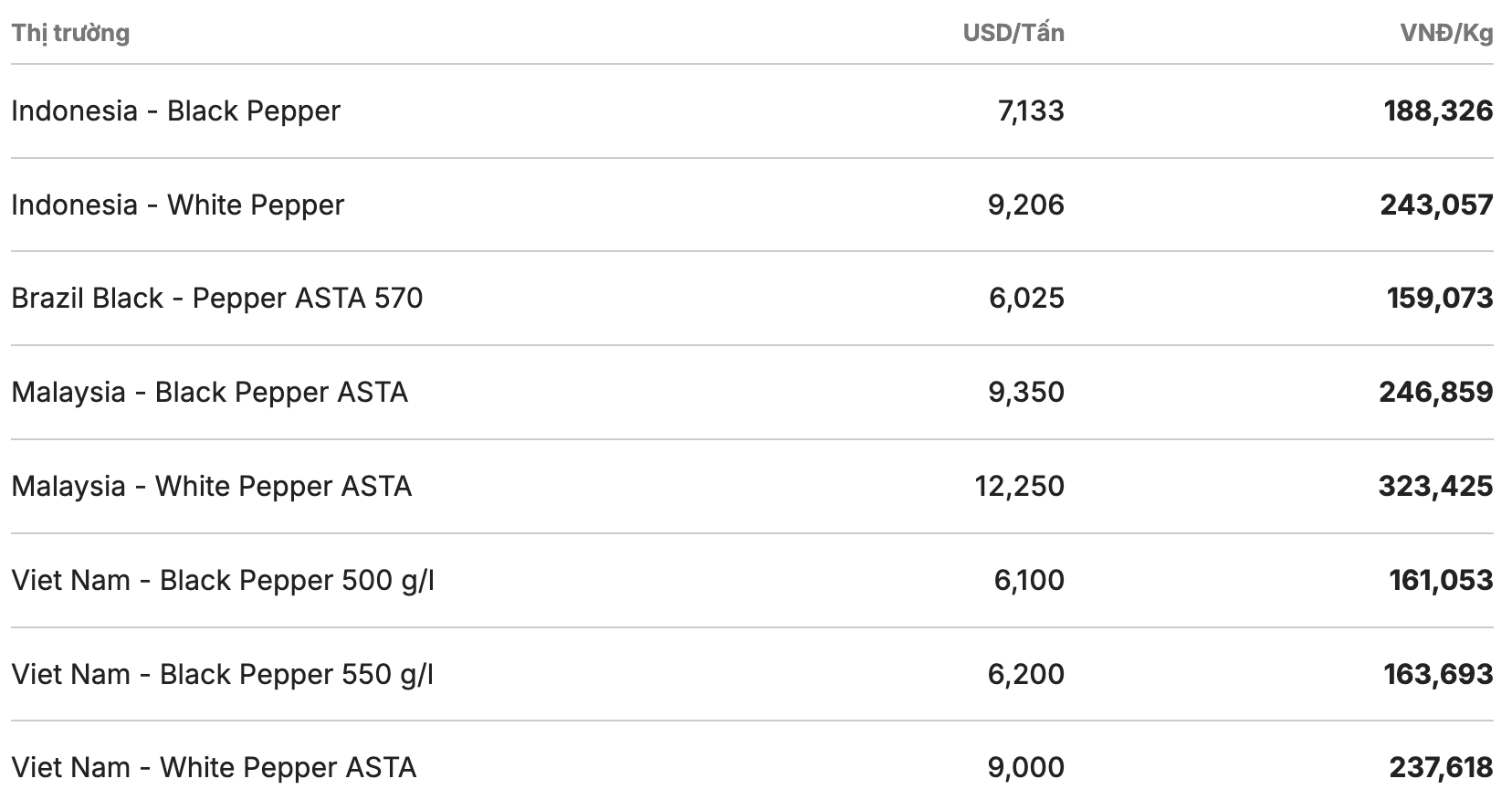
In the world market, pepper prices fluctuate in some countries. The two items of black and white pepper in Indonesia surged, trading in the range of 7,133 - 9,206 USD/ton (equivalent to 188,326 VND/kg - 243,057 VND/kg), respectively decreasing by 27 USD/ton and 35 USD/ton.
In the opposite direction, the Brazilian market maintained a decrease of 75 USD/ton, holding at 6,025 USD/ton (about 156,073 VND/kg). Notably, black and white peppers are still trading at high prices, respectively 12,250 USD/ton and 9,350 USD/ton.
In Vietnam's pepper export market, the price of black pepper of 500 g/l and 550 g/l remains unchanged at 6,100 - 6,200 USD/ton. In the same direction, ASTA white pepper is offered for sale at 9,000 USD/ton (equivalent to 237,618 VND/kg).
Assessments and forecasts
Domestic pepper prices adjusted up by 1,000 VND/kg in today's trading session is a technical development after a period of strong increase before. The fundamental factors of the market are still relatively positive as global supply shows no signs of strong increase, while consumption demand in major markets continues to remain stable.
Pepper production in many key producing countries is still affected by climate change and increased production costs, making the supply prospects in the medium and long term not as abundant as in previous years.


