
Domestic pepper prices: Rise again
As of 11:30 am today (March 5), domestic pepper prices suddenly increased again, averaging 145,000 VND/kg. Currently, key areas are trading in the range of 144,000 - 146,000 VND/kg.
Domestic pepper prices simultaneously increased after a series of price drops, specifically as follows:
Gia Lai and Dong Nai provinces increased by 500 VND/kg, listed at the mark of 144,000 VND/kg.
Ho Chi Minh City recorded a slightly higher increase of 1,000 VND/kg, anchored at the threshold of 145,000 VND/kg.
Dak Lak and Lam Dong simultaneously put a price of 146,000 VND/kg on the market, an increase of 2,000 VND/kg.
World pepper prices: Continuing the downward trend
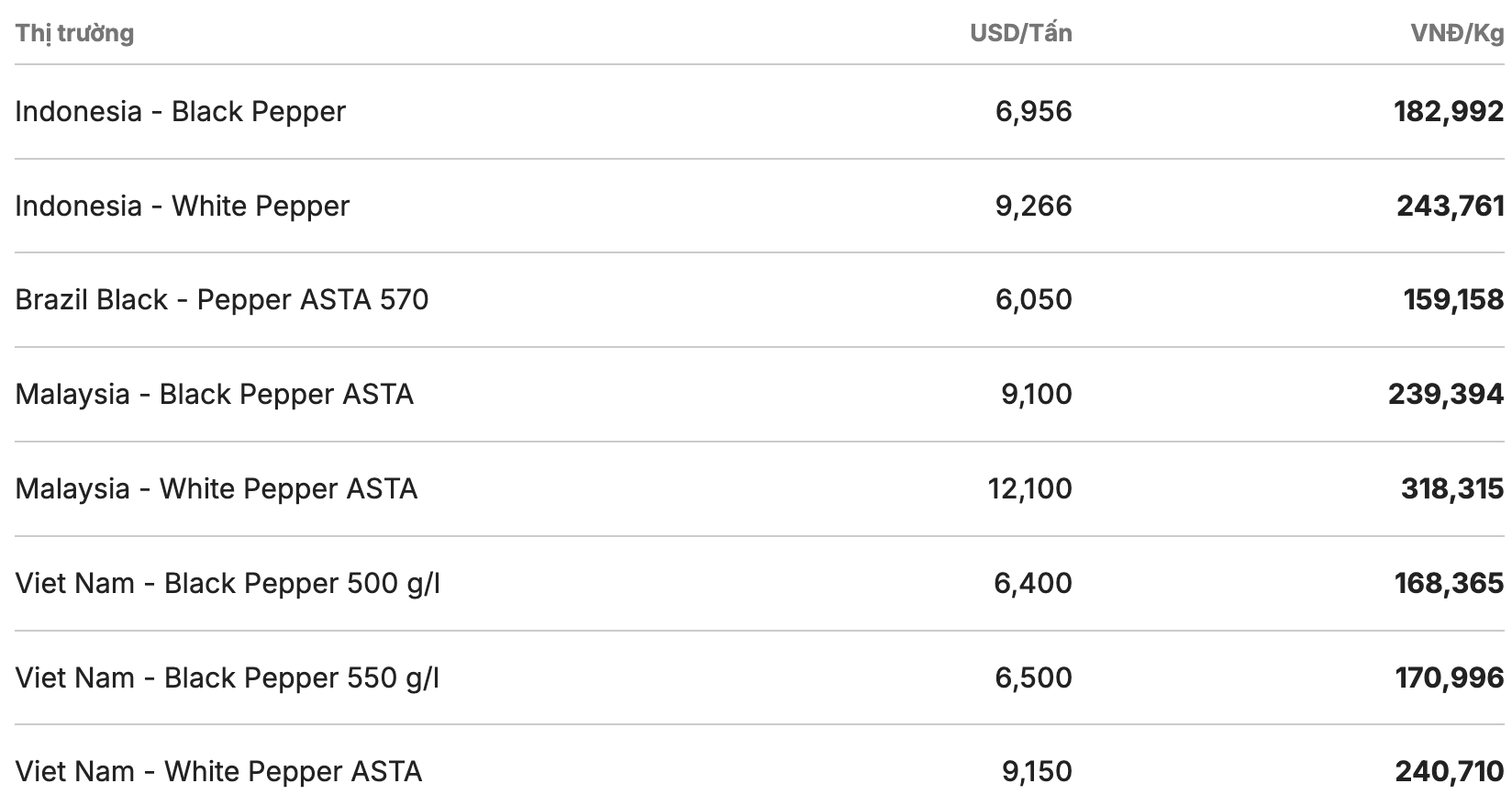
In the world market, pepper prices continued to decline in some regions. The Indonesian exchange - one of the most vibrant markets is no exception. Black and white peppers traded in the range of 6,956 - 9,266 USD/ton (equivalent to 182,992 VND/kg - 243,761 VND/kg), down 17 USD/ton and 23 USD/ton respectively.
The Brazilian market decreased by 125 USD/ton, listed at the mark of 6,050 USD/ton (about 159. 158 VND/kg). Notably, black and white peppers maintained an increase of 100 USD/ton, trading at 12. 100 USD/ton and 9. 100 USD/ton.
In Vietnam's pepper export market, the price of black pepper of 500 g/l and 550 g/l is maintained at 6,400 - 6,600 USD/ton. ASTA white pepper price continues to be offered for sale at 9,150 USD/ton (equivalent to 240,000-710 VND/kg).
Assessments and forecasts
According to estimates from the Import-Export Department (Ministry of Industry and Trade), due to coinciding with the long Lunar New Year holiday, Vietnam's pepper exports in February 2026 reached about 14 thousand tons, worth 92 million USD, down 36.2% in volume and 34% in value compared to the previous month, and down 3.4% in volume and 5.2% in value compared to the same period last year.
However, in general, in the first 2 months of 2026, pepper exports still reached 35 thousand tons, worth 231 million USD, a sharp increase of 30.4% in volume and 25.6% in value compared to the same period in 2025.
Although the pressure from farmers bringing new goods to the market is increasing day by day, due to limited inventory from the previous crop year, export enterprises are still forced to keep prices high to ensure raw material sources for international orders.


