
Domestic pepper prices
Today (September 5th), domestic pepper prices remained unchanged for the week, trading in the range of 135,000 - 137,000 VND/kg.
At the end of the recent trading session, Gia Lai, Ho Chi Minh City and Dong Nai all anchored at the threshold of 135,000 VND/kg.
In the same direction, Dak Lak announced a price of 136,500 VND/kg.
In Lam Dong, pepper prices are currently at the highest level of 137,000 VND/kg.
World pepper price
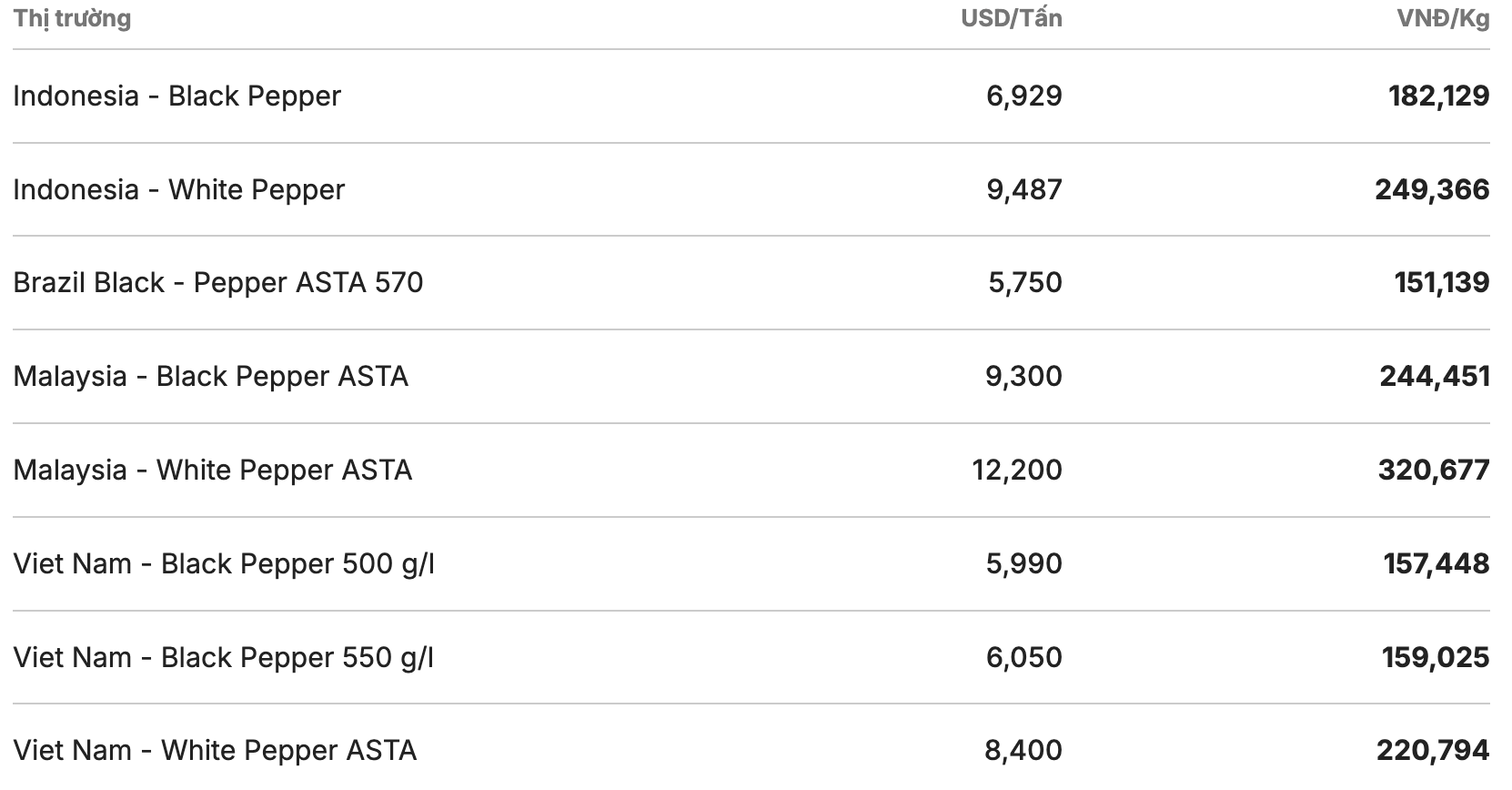
In the world market, pepper prices are adjusted in some countries. Indonesia's black and white peppers are no exception, trading in the range of 6,929 - 9,487 USD/ton (equivalent to 182,129 VND/kg - 249,366 VND/kg), increasing by 36 USD/ton and 49 USD/ton respectively.
Meanwhile, the price of black pepper in Brazil slightly decreased by 50 USD/ton, selling to the market at 5,750 USD/ton (about 151,139 VND/kg). Black and white pepper in Malaysia still maintained the same price range, trading at high prices, respectively 12,200 USD/ton and 9,300 USD/ton.
Notably, in Vietnam's pepper export market, black pepper prices of 500 g/l and 550 g/l are traded at 5,990 - 6,050 USD/ton. ASTA white pepper is offered for sale at 8,400 USD/ton (equivalent to 220,794 VND/kg).
Assessments and forecasts
According to data from the US International Trade Commission, US pepper imports in the first 6 months of 2026 reached 47.6 thousand tons, worth 359.8 million USD, an increase of 4.6% in volume and 4.8% in value compared to the same period in 2025. The average import price of pepper into the United States in the first 6 months of 2026 reached 7,564 USD/ton, an increase of 0.2% compared to the same period in 2025.
Vietnam is the largest supplier of pepper to the US market in the first 6 months of 2026, reaching 38.2 thousand tons, worth 290.2 million USD, an increase of 24.4% in volume and 22.7% in value compared to the same period last year.
Vietnam's pepper market share in total US pepper imports increased sharply from 67.6% to 80.4%, while the proportion in value also increased from 68.9% to 80.7%.
Meanwhile, US pepper imports from the next two major supplier markets, India and Indonesia, decreased.


