
Domestic pepper prices: Continuously changing direction
As of 11:30 am today (April 8), domestic pepper prices have decreased compared to the closing session yesterday, averaging 138,300 VND/kg. Currently, key areas are trading in the range of 138,000 - 139,000 VND/kg.
Domestic pepper prices simultaneously decreased in provinces and cities. Currently, key areas list prices as follows:
Gia Lai and Dong Nai provinces decreased by 500 VND/kg, both listed at the mark of 138,000 VND/kg.
Ho Chi Minh City recorded a decrease of up to 1,000 VND/kg, anchored at the mark of 138,000 VND/kg.
Meanwhile, Dak Lak and Lam Dong, after many days of the same selling price to the market, now have a difference. These two regions have decreased by 500 VND/kg and 1,000 VND/kg respectively, selling at prices of 138,500 VND/kg and 139,000 VND/kg.
World pepper prices: Indonesia continues to decline
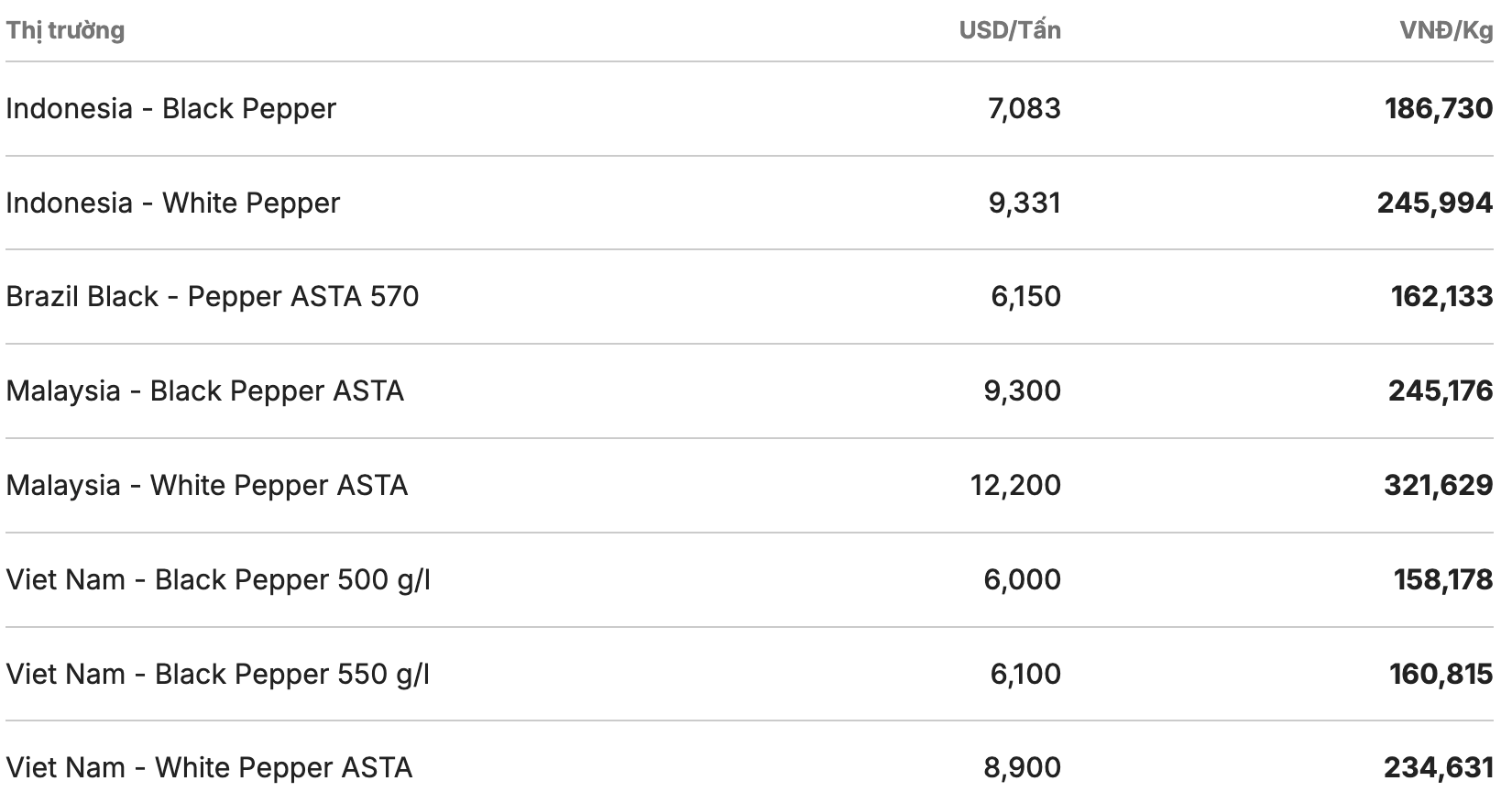
In the world market, pepper prices are mostly stable, except for the Indonesian exchange. Two items, black and white pepper, Indonesia traded in the range of 7,083 - 9,331 USD/ton (equivalent to 186,730 VND/kg - 245,994 VND/kg), down 23 USD/ton and 31 USD/ton respectively.
Meanwhile, the Brazilian market maintained an increase of 50 USD/ton, listed at 6,150 USD/ton (about 162.133 VND/kg). Notably, black and white peppers maintained an increase of 100 - 200 USD/ton, trading at 12,200 USD/ton and 9,300 USD/ton.
In Vietnam's pepper export market, the price of black peppers of 500 g/l and 550 g/l remained unchanged, anchored at the 6,000 - 6,100 USD/ton mark. In the same direction, ASTA white pepper price offered for sale at 8,900 USD/ton (equivalent to 234,631 VND/kg).
Assessments and forecasts
After the price increase day, filled with green color, pepper prices today are under short-term adjustment pressure due to supply and demand factors and international market developments. However, stable consumption demand in many areas is still a factor supporting the market.
According to experts, in the coming time, pepper prices may continue to fluctuate according to export developments and global consumer demand. Factors such as transportation costs, exchange rates and trade policies will directly affect price trends.


