
Not letting the document be complete but when it happens it cannot be operated
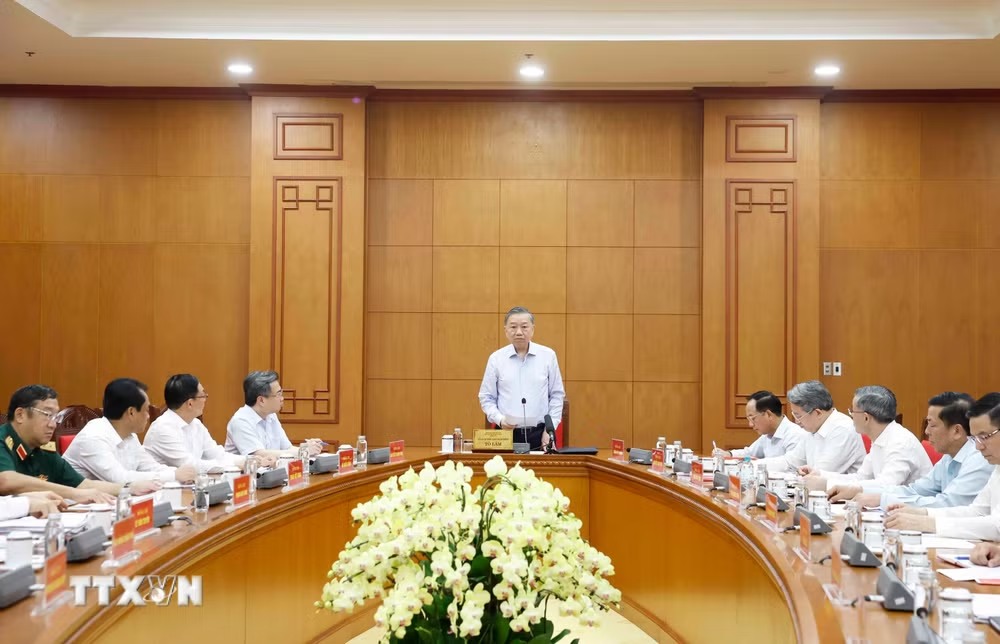
On the afternoon of June 29, at the Party Central Committee Headquarters, General Secretary and President To Lam chaired a working session with the Government Party Committee and relevant agencies on storm and flood prevention, extreme natural disasters and climate change from now until the end of 2026, according to VNA.
Concluding at the working session, the General Secretary and President emphasized that the general spirit is to strongly shift from passive response to proactive risk management; from handling consequences to early and remote prevention; from seasonal direction to regular preparation; from methods mainly based on experience to methods based on data, science, technology, law, planning discipline and the responsibility of heads.
General Secretary and President To Lam pointed out that fewer storms does not mean less danger; heavier drought does not mean no more risk of major floods; it is necessary to prepare for worse, faster, wider, and more complex situations, so as not to be passive or surprised.
Regarding the guiding viewpoint, the General Secretary and President requested that protecting people's lives is the highest requirement, the highest order. All plans, all command decisions, and all mobilized resources must first focus on protecting people, especially the elderly, children, pregnant women, people with disabilities, sick people, poor households, lonely households, and people in dangerous areas.
Discipline, order and responsibility of the head must be put first; where management is lax, that place must be responsible.
The General Secretary and President requested to review and update the entire natural disaster scenario for 2026. The scenario must be close to each region, each area, each basin, each group of works, and each group of vulnerable population.
Do not use the old plan for the new situation; do not copy plans between localities; do not leave very complete documents but when situations occur, they cannot be operated.
Protect people's lives in all situations. The commune level must firmly grasp each household in areas at risk of flash floods, landslides, deep flooding, downstream of reservoirs, riverside, coastal areas, weak houses, and temporary houses.
The list must be real, updated truthfully, and assign people to be in charge truthfully. Do not wait until natural disasters occur to ask people where they are, who needs rescue first, where materials are, which forces come. Inspect the safety of key projects and essential infrastructure.
Any critical project must have an immediate handling plan; if it has not been handled, there must be warnings, guards, prohibition or restriction of travel, arrangement of forces, materials, and evacuation plans for downstream areas. Do not let dangerous spots be known in advance but not handled, and when an incident occurs, say it is due to objective reasons.
Do not let a commune, a village, a hamlet be alone before the flash flood
General Secretary and President emphasized to reorganize the "four on-the-spot" motto to suit reality. It is necessary to review the on-the-spot force in each commune, village, and hamlet; do not generalize "mobilizing people" when in reality many places lack young people, lack healthy people, and lack people who know how to operate machinery and vehicles.
It is necessary to make a list of people who are capable of participating in rescue, evacuation, and vehicle operation; mobilize militia, commune police, grassroots health care, teachers, unions, cooperatives, businesses, vehicle owners, construction teams, excavator drivers, truck drivers, and boat drivers; and it is even more impossible to put the burden of rescue on the shoulders of the elderly, women, and children and call it "on the spot".
When the situation exceeds the grassroots capacity, there must be provincial-level mobile forces, army, and police support. Do not let a commune, a village, or a hamlet be alone in the face of flash floods, landslides, major storms, and deep flooding.
Orienting the 2026-2030 period, the General Secretary and President clearly stated that it is necessary to identify this as a stage to create a basic foundation to shift from disaster response to disaster risk management.
First of all, it is necessary to improve the legal system, review, amend, and supplement laws and documents related to disaster prevention and control, civil defense, water resources, irrigation, dykes, meteorology and hydrology, planning, public investment, budget, insurance, rescue, mobilization of forces and assets.


