
Discussing at the National Assembly hall on socio-economic issues on April 21, delegate Le Thi Ngoc Linh (Ca Mau Delegation) said that population aging in our country is happening rapidly, while the birth rate is decreasing. This is an issue that has a profound impact on socio-economics in the long term.
According to statistics, Vietnam's total fertility rate is currently about 1.91 children/woman, lower than the replacement fertility rate of 2.1 children. This trend shows that the family size is shrinking, and the number of children born is not enough to maintain a stable population size in the long term.
If in 2022, the birth rate remained around the replacement threshold, by 2023 it decreased to about 1.96 children/woman and in 2024 to 1.91 children/woman, showing a rapid downward trend in the past two years, especially in urban areas.
The delegate worried that Vietnam is shifting from the "golden population" to the "aging population" at a rapid pace, as the proportion of people aged 60 and over increases, while the young labor force tends to decrease.
To overcome the situation of low birth rates and accompanying consequences, delegates proposed to continue adjusting population policy in the direction of strongly shifting from "family planning" to "maintaining sustainable replacement birth rates".
It is necessary to clearly zone policies, prioritizing localities with low birth rates, large cities, and industrial parks; encourage couples to have enough two children, considering this as a social responsibility associated with sustainable development.
The State needs to have practical and long-term financial support policies for families who give birth and raise young children, such as supporting childbirth costs, childcare; expanding policies to exempt and reduce medical expenses for children; and at the same time, it is necessary to have preferential tax policies for households raising young children.
Delegates proposed investing in developing a synchronous and quality childcare service system suitable to practical needs; expanding the network of nurseries and kindergartens, especially in urban areas and industrial parks; developing flexible overtime childcare services.
At the same time, there needs to be policies to support housing and employment, and increase income for young couples.
In particular, it is necessary to promote communication and education to change social awareness about marriage and childbirth in a positive, modern direction while still ensuring sustainable family values.
Besides encouraging marriage and childbirth at the right age, reducing the trend of delaying marriage and childbirth among young people, delegates believe that it is necessary to strongly shift to proactive, synchronous, long-term "pro-birth" policies, taking family and women as the center, respecting the right to choose to have children, creating a favorable environment for people to "want to have children and can have children".
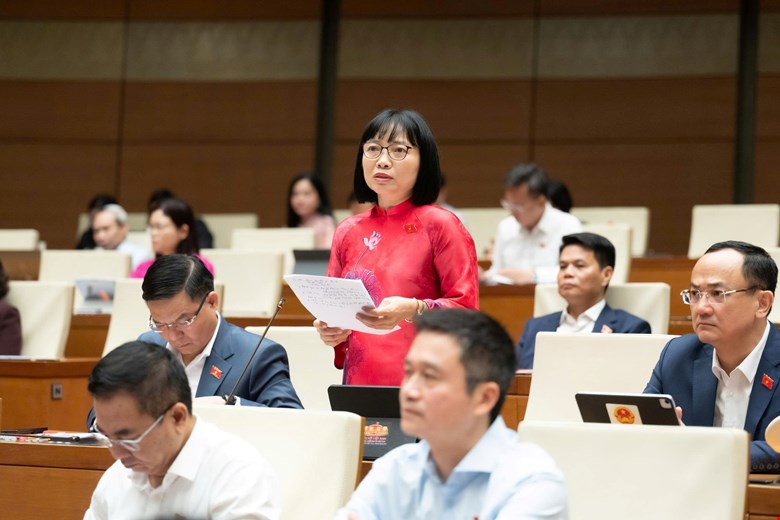
Delegate Nguyen Thi Viet Nga (Hai Phong Delegation) said that it is necessary to consider the results of gender equality implementation as criteria for evaluating the level of task completion and quality of governance of agencies and units.
Building a synchronous, modern, and interconnected gender data system that not only reflects participation rates but also measures participation quality, accessibility and benefit levels.
Data must become the foundation for policy making and implementation monitoring, overcoming the situation of "following the policy but not targeting the right people".


