
On the morning of May 20, in Hanoi, Politburo Member, National Assembly Chairman Tran Thanh Man worked with the Standing Committee of the Economic and Finance Committee on key tasks for 2026 and the term 2026 - 2031.
Speaking at the working session, National Assembly Chairman Tran Thanh Man requested the Standing Committee to focus on clarifying 6 major issues.
First, regarding policy advisory thinking, innovating operating methods needs to clarify how to shift from "profile-based inspection" to "policy inspection". That is, it must be based heavily on policy analysis, data, impact assessment and risk forecasting, and actively participate in the policy cycle earlier.
Second, regarding perfecting the development institution, it is necessary to clarify the advantages, difficulties, and obstacles in advising and appraising draft laws and resolutions in the context of having to amend many major laws at the same time.
In which, clarify what is the biggest bottleneck currently? Dossier quality, verification time, lack of data, lack of impact assessment or unsynchronized coordination? What should be the responsibility of the Committee in participating early and remotely, detecting legal conflicts, and proposing to remove institutional bottlenecks?
The National Assembly Chairman requested that for draft laws, if there are no draft decrees attached or there are draft decrees but the quality is not guaranteed, the Committee shall have a written report to the Prime Minister and the National Assembly Chairman.
Third, regarding the supervision of law enforcement organization, it is required to clarify and propose key supervision in this term in the fields of banking, securities, insurance, public investment, budget, key projects and the private economy.
Fourth, about high growth targets and new growth models. Regarding this issue, the Committee will advise the National Assembly and the National Assembly Standing Committee on how to control macroeconomic stability, financial and budgetary discipline, public debt safety; and at the same time create policy space for growth, innovation and the development of new production forces.
What is the responsibility of the Economic and Financial Committee, in addition to appraising targets, also contributing to shaping the policy framework? Especially clarifying bottlenecks in mobilizing public financial resources, land, resources, human resources, private sector, public-private partnerships (PPP), capital market, green finance?" - National Assembly Chairman emphasized.
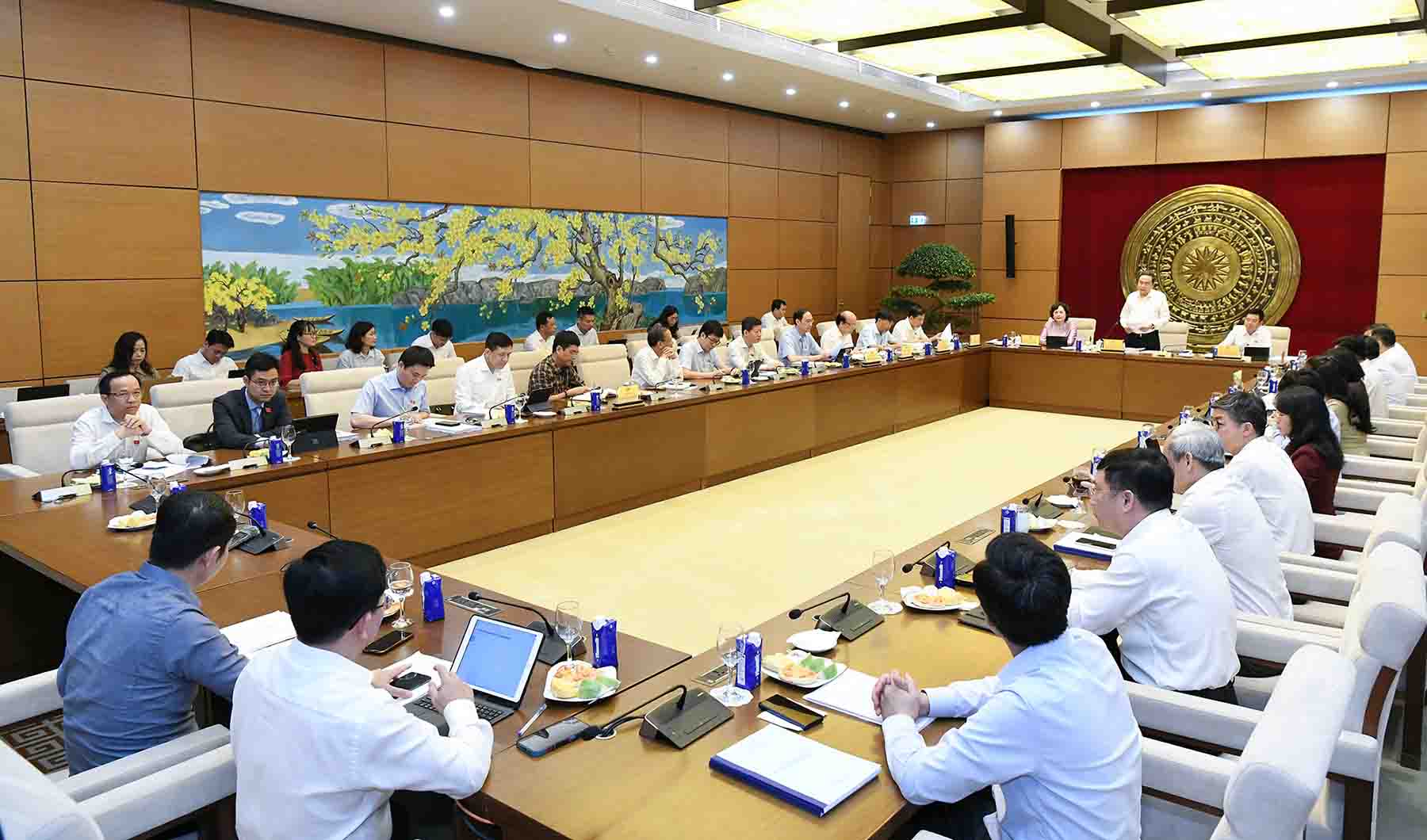
Fifth, regarding the organizational structure and advisory capacity, the Standing Committee of the Committee shall clearly report on the model of 6 specialized sub-committees after arrangement; the coordination mechanism between the Standing Committee of the Committee and the Economic - Finance Department, the need for experts, data, digital tools, staff and policy analysis capacity.
Sixth, it is necessary to clarify more about specific recommendations. Thereby clarifying what is under the authority of the Committee, then proactively do it immediately without further recommendations; what is related to the Government, ministries, and sectors, then propose specific, clear, time-limited, product-based, and responsible coordination mechanisms.
According to the National Assembly Chairwoman, the Economic and Finance Committee has a special position and role, as an advisory body, directly inspecting many major national issues: macroeconomics, finance - budget, public investment, public debt, growth model, private economy, key projects and development institutions.


