
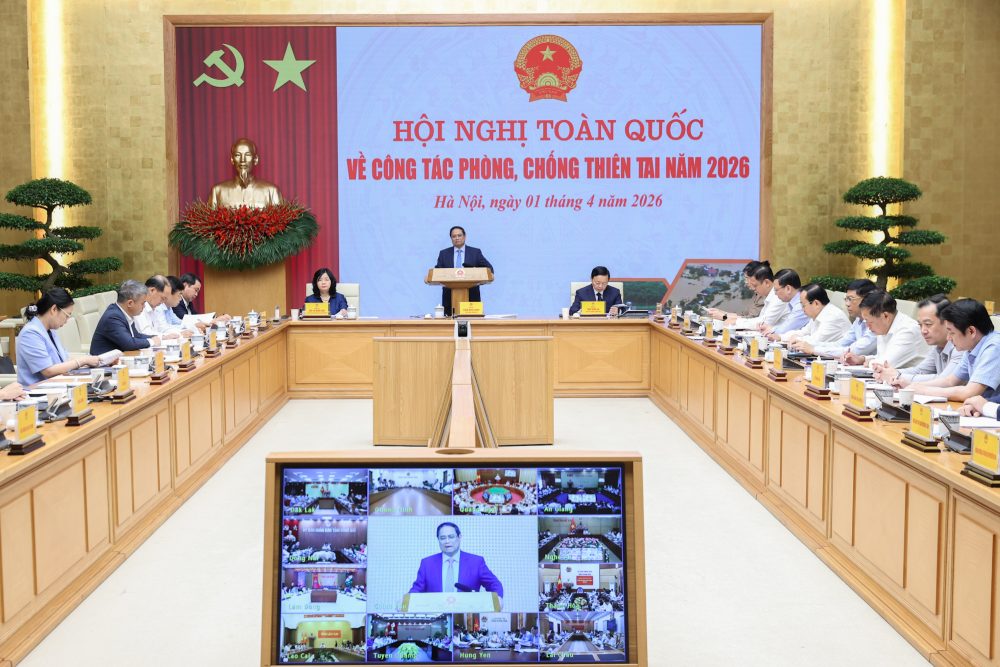
In the afternoon of April 1st, Prime Minister Pham Minh Chinh - Head of the National Steering Committee for Civil Defense chaired the National Conference on disaster prevention and control in 2026.
Concluding the conference, the Prime Minister emphasized that the situation of natural disasters and storms is increasingly complicated. In 2025, Vietnam continuously suffered extreme, complex, unusual, and even abnormal weather phenomena; causing heavy damage that is difficult to quantify.
The Prime Minister requested to continue to improve institutions and laws related to disaster prevention and control; invest adequately, in the direction of modernizing forecasting work; invest in building communes, wards, and special zones as solid fortresses in disaster prevention and control.
The Ministry of National Defense directs forces to maintain on-duty work, not to be passive or surprised by any possible situations; deploy the 112 switchboard system, serving to receive information and support disaster response and search and rescue.
At the same time, directing units stationed in areas frequently affected by storms and floods to review plans to arrange forces and vehicles to be ready to support localities in deploying storm and flood response work, especially supporting evacuation, relocation of residents, and rescue and relief.
The Ministry of Public Security directs forces to be ready to coordinate, arrange vehicles and forces to respond to natural disasters; coordinate to inspect and strictly handle violations of the law on dikes, encroachment on riverbeds and riverbanks; develop plans to ensure security and order, rescue, and traffic safety when storms and floods occur.
The Ministry of Industry and Trade directs hydropower reservoir owners to strictly implement regulations on dam safety management, reservoir and inter-reservoir operation procedures; resolutely handle and revoke business licenses of violating reservoir owners.
Develop contingency plans, quickly restore the power system after natural disasters to serve the work of overcoming consequences, restoring production, and serving people's livelihoods; direct the stockpiling of essential goods, especially serving areas that are frequently deeply flooded and divided, in accordance with the situation, avoiding waste.
The Ministry of Science and Technology shall preside over and coordinate with relevant agencies and units to strengthen the application of science and technology, especially artificial intelligence, digital transformation in disaster prevention and control and search and rescue activities; have plans to ensure communication when major natural disasters make landfall, especially in mountainous areas with a high risk of fragmentation.
The Ministry of Finance should study and propose policies on disaster risk insurance, especially in the agricultural sector; prioritize allocating resources in the state budget, medium-term public investment plans for the period 2026-2030 to serve disaster recovery and investment and upgrading of damaged and degraded disaster prevention and control works; relocate people from high-risk disaster areas.
The Prime Minister directs the Chairmen of People's Committees of provinces and cities to direct the development of plans for disaster prevention and control, plans to respond to disaster risk levels; develop resettlement plans for people, especially in high-risk areas.
Provinces must well implement management to ensure the safety of dyke and dam systems; build, consolidate, and improve the operational efficiency of shock teams for disaster prevention and control at the commune level; allocate resources, increase investment in equipment and support tools for agencies directly involved in disaster prevention and control and recovery.


