
On the afternoon of April 1st, the Executive Committee of the Ho Chi Minh City Party Committee held the 5th conference, term 2025 - 2030, focusing on assessing the socio-economic development situation and strategic orientations for the coming time.
Speaking at the opening, Politburo Member, Secretary of the City Party Committee Tran Luu Quang said that the conference will take opinions on the action program of the Executive Committee of the Ho Chi Minh City Party Committee regarding the resolution on agriculture, rural areas, and farmers.
Mr. Tran Luu Quang said that although it is a large city, agriculture still contributes a significant proportion to Ho Chi Minh City's growth. The upcoming orientation is to develop high-tech agriculture associated with post-harvest technology based on the application of science and technology.
Speaking at the conference, Dr. Truong Minh Huy Vu - Director of the Ho Chi Minh City Institute for Development Studies - said that in the context of the world economy still having many unpredictable fluctuations, the double-digit growth target for the period 2026 - 2030 sets very high requirements for the city.
According to Mr. Vu, the growth rate of over 8% in the first quarter is a positive start, but not enough to ensure the target for the whole year. To achieve the set goal, Ho Chi Minh City is forced to accelerate strongly in the second quarter and subsequent quarters, with growth rates ranging from 11.5 - 12.5%.
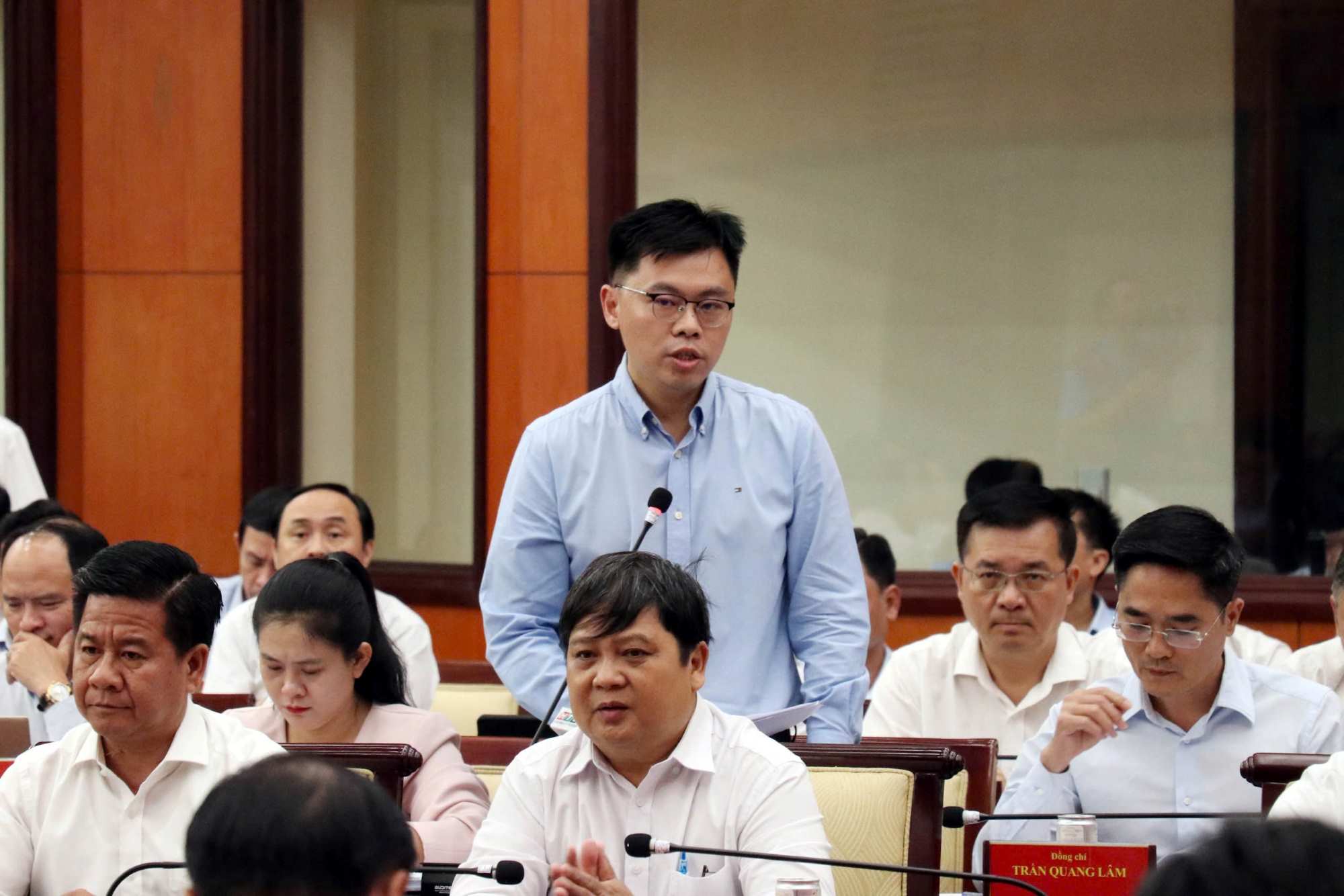
Mr. Vu emphasized that, besides traditional drivers such as investment, consumption and export, institutional factors will play a key role in creating breakthroughs.
According to Mr. Vu, in the next 9 months, there will be 2 important institutional levers including the Law on Special Urban Areas and the Ho Chi Minh City Master Plan. This is not only an administrative tool but also a basis for Ho Chi Minh City to shift from being a local implementer to proactively creating policies.
According to the research orientation, Ho Chi Minh City will develop according to a multi-polar, multi-center, multi- corridor and multi-dynamic urban model. Urban space is expanded in many directions, combining the development of both underground, ground and low-lying spaces, in order to optimize resources and meet growth requirements.
Regarding institutions, experts propose that the city should be decentralized and depowered more strongly, especially in the field of finance and organizational structure, at a level equivalent to or higher than the Capital Law. At the same time, it is necessary to effectively exploit land funds through urban financial tools, develop the TOD model (urban according to traffic axis) and take advantage of new development space.
Ho Chi Minh City is also oriented to form institutional trial areas such as Con Dao special zone, high-tech zone, concentrated technology zone, thereby promoting key areas such as science and technology, innovation, digital transformation, green finance and marine economy.
From the perspective of planning, Director of Ho Chi Minh City Department of Planning and Architecture Vo Hoang Ngan said that the merger of boundaries has opened up a completely new development space, bringing Ho Chi Minh City closer to the large-scale integrated megacity model.
Accordingly, the city's master plan is built with a long-term vision of 50 - 100 years, aiming to become a sustainable, innovative and livable city in the Asia-Pacific region, while playing the role of a financial, commercial, logistics and innovation center.
The development structure is established according to the model "one space - three regions - one special zone".
In which, the core area of Ho Chi Minh City plays the role of financial and service center; the Binh Duong area (old) develops into a high-tech industrial center; the Ba Ria - Vung Tau area (old) is the gateway to marine economy, seaports and energy; while the Con Dao special zone is oriented to become a unique eco-tourism and resort center.
Leaders of the Department of Planning and Architecture emphasized that the development of the master plan is not only a professional requirement but also a strategic political task, laying the foundation for the long-term development of Ho Chi Minh City in the coming decades.


