
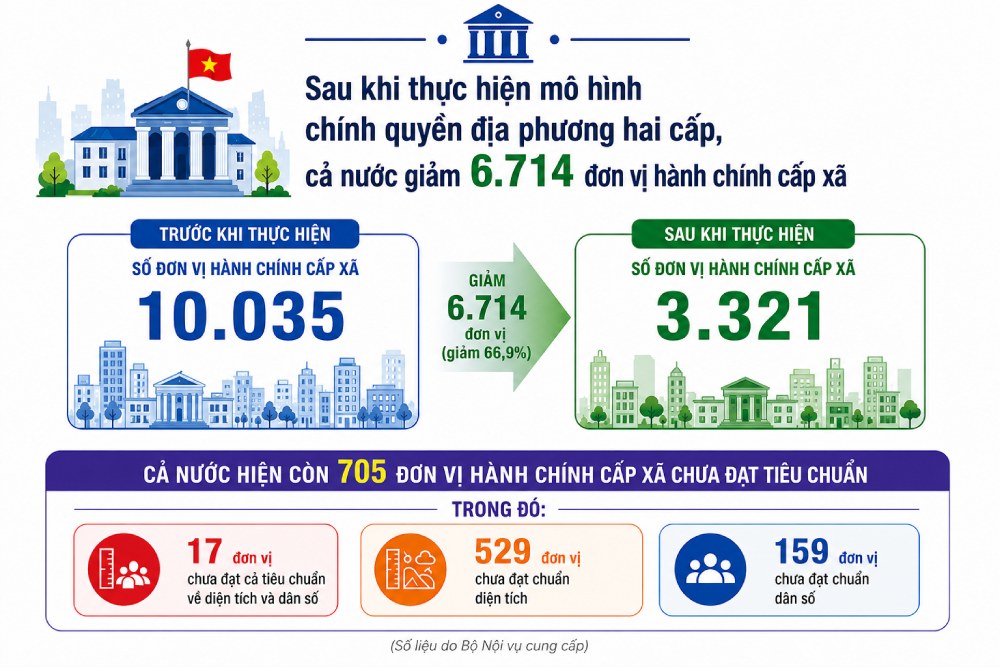
The whole country currently has 705 commune-level administrative units (UAs) that do not meet standards. Among them, Ho Chi Minh City currently has 54 units that do not fully meet the standards for population and area.
The Party Committee of Ho Chi Minh City People's Committee has directed the continued study of plans to arrange commune-level administrative units in Ho Chi Minh City. In which, the Department of Home Affairs is assigned to preside over and coordinate with the Organization Committee of the City Party Committee and relevant agencies and units to review administrative units that do not fully meet standards and conditions or have unreasonable issues arising during operation.
The review is carried out on the principle of only proposing adjustments when truly necessary, ensuring science, caution, creating social consensus and not causing disruption.
Wards in the central area of Ho Chi Minh City such as Saigon, Ben Thanh, Tan Dinh, Gia Dinh, Binh Thanh agreed on a plan that has not been arranged or merged.
In the suburban area, up to now, some communes including Ba Diem, Vinh Loc, Tan Nhut, Cu Chi, Xuan Son, Long Hai, Bau Bang propose to maintain the stability of administrative boundaries, without mergers, separations or adjustments.
Similarly, localities such as Ca Mau and Son La have not yet had a policy to arrange commune-level administrative units.
Talking to Lao Dong Newspaper, Mr. Nguyen Tuc - Chairman of the Advisory Council on Culture and Society (Central Committee of the Vietnam Fatherland Front) - emphasized that the ultimate goal of arranging administrative units is to build a reasonable governance space, an efficient apparatus and better serve the people.
When the number of administrative units is still large, the need to arrange leadership and management cadres also increases, leading to the dispersion of human resources. Conversely, if some communes and wards continue to be reasonably arranged, this will be a screening, selection, and arrangement of cadres with better capacity...
In the context of localities promoting digital transformation and streamlining the apparatus, it is necessary to continue reviewing units that have not met the criteria. However, "necessary" does not mean that it must be done at all costs or arranged mechanically.
According to Mr. Nguyen Tuc, if administrative units continue to be arranged, they should be implemented selectively. Only areas that are not yet suitable in terms of standards and have clearly revealed inadequacies in management should be adjusted.
When necessary, it is possible to study adjusting a part of the administrative boundaries instead of merging the entire area; and at the same time assess the impact and get people's opinions before deciding.
Therefore, the arrangement needs to closely follow the Central Government's policy but must take into account historical, cultural, economic space and geographical conditions of each area. If only looking at the number of area or purely population, it is very easy to lead to paper merger, causing unnecessary disruption.
At the dialogue conference between the Standing Committee of the City Party Committee and trainees of the training class, updating knowledge and skills for city leaders and managers, Politburo member, Secretary of the Ho Chi Minh City Party Committee Tran Luu Quang emphasized that, besides the criteria stipulated by the National Assembly, it is necessary to comprehensively consider factors such as development potential, geographical location, infrastructure conditions, national defense, security and specific characteristics of each locality.
Therefore, whether to continue arranging administrative units or not will be researched and proposed by Ho Chi Minh City and each locality based on practice.


