
On the afternoon of June 11, in Hanoi, General Secretary and President To Lam chaired the conference to summarize the activities of the Central Steering Committee for Judicial Reform (Steering Committee).
Concluding at the conference, General Secretary and President To Lam stated clearly that the current requirement is not only to continue judicial reform, but to strongly innovate the leadership and direction mechanism to bring judicial reform into a new phase, closely linked to perfecting institutions, law enforcement, power control and serving national development.
According to the policy of the Politburo, the Steering Committee is consolidated and arranged in a new mechanism, merged with the Central Steering Committee for Institutional Improvement and Law Enforcement. Ending the operation of the Steering Committee according to the old model does not mean ending the task of judicial reform.
Conversely, this is a shift to a new leadership and direction model with a broader vision, higher requirements, more synchronous methods and clearer responsibilities.
The new thinking is to place judicial reform in a unified rule-of-law cycle: building good laws, organizing strict law enforcement, impartial judicial activities, justice being protected, power being controlled, human rights and citizen rights being guaranteed, and national development being served by a smooth, transparent, and effective institution.
Judicial reform in the new phase is not only reform for judicial agencies, but also to improve the capacity to operate the rule-of-law State; not only to handle cases, but also to protect justice and build trust; not only to complete professional targets, but also to serve the people, serve development, and protect the future of the country by law and justice.
Regarding key tasks in the coming time, the General Secretary and President requested not to slow down, lighten or interrupt the task of judicial reform because of changing the organizational model of the Steering Committee.
Investigation must be based on objective, scientific, electronic, and data evidence. Prosecution and procuracy must be strict and objective. Trial must ensure independence, only comply with the law, and enhance the persuasiveness of judgments. Judgment enforcement must be considered a decisive stage in the actual effectiveness of justice.
Strictly control judicial power, prevent and combat negativity in judicial activities; and at the same time build a team of honest, brave, professional judicial officials and promote digital justice, managing judicial reform using data.
Improve the mechanism for preventing, detecting, and handling illegal interference acts; control conflicts of interest; transparency in case assignment, appraisal, valuation, auction, and judgment enforcement; strictly handle bribery, case brokerage, falsifying dossiers, and abusing positions and powers in judicial activities.
Promoting electronic records, electronic evidence, publicizing judgments, managing cases by data and data interconnection between judicial agencies and national databases.
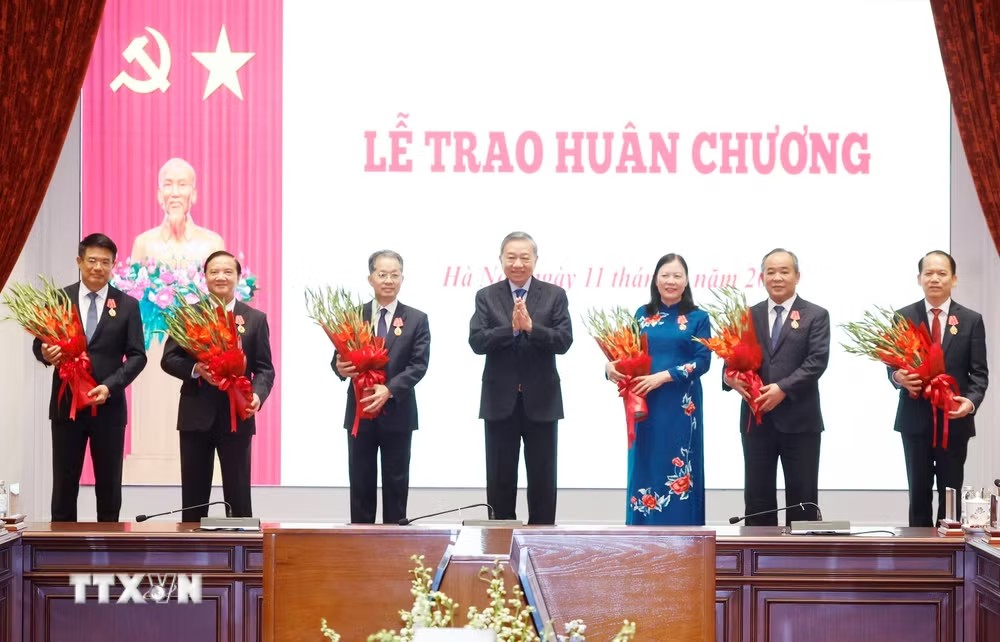
On this occasion, General Secretary and President To Lam awarded the First-class Labor Medal to 3 individuals: Chief Justice of the Supreme People's Court Nguyen Van Quang, Vice Chairman of the National Assembly Nguyen Khac Dinh, Chief Procurator of the Supreme People's Procuracy Nguyen Huy Tien;
Awarding the Second-class Labor Medal to 3 individuals: Chairman of the Presidential Office Le Khanh Hai, Minister of Justice Hoang Thanh Tung, Chairman of the National Assembly's Committee for Petitions and Supervision Le Thi Nga for outstanding achievements in judicial reform.


