
SJC gold bar price
As of 6:00 AM, SJC gold bar prices were listed by DOJI Group at the threshold of 181.1-184.1 million VND/tael (buying - selling), down 900,000 VND/tael in both buying and selling directions. The difference between buying and selling prices is at the threshold of 3 million VND/tael.

SJC gold bar price was listed by Bao Tin Minh Chau at the threshold of 181.1-184.1 million VND/tael (buying - selling), down 900,000 VND/tael in both buying and selling directions. The difference between buying and selling prices is at the threshold of 3 million VND/tael.
Phu Quy Jewelry Group listed SJC gold bar prices at the threshold of 181.3-184.1 million VND/tael (buying - selling), down 900,000 VND/tael in both directions. The difference between buying and selling prices is at the threshold of 2.8 million VND/tael.

9999 gold ring price
As of 6:00 AM, DOJI Group listed the price of gold rings at the threshold of 181.1-184.1 million VND/tael (buying - selling), down 900,000 VND/tael in both buying and selling directions. The difference between buying and selling prices is at the threshold of 3 million VND/tael.

Bao Tin Minh Chau listed the price of gold rings at 181.5-184.5 million VND/tael (buying - selling), down 500,000 VND/tael in both buying and selling directions. The difference between buying and selling prices is at 3 million VND/tael.
Phu Quy Gold and Gems Group listed the price of gold rings at the threshold of 181.1-184.1 million VND/tael (buying - selling), down 900,000 VND/tael in both buying and selling directions. The difference between buying and selling prices is at the threshold of 3 million VND/tael.
Currently, the buying - selling price difference of gold is at a very high level, around 3 million VND/tael, posing a risk of losses for investors.

World gold price
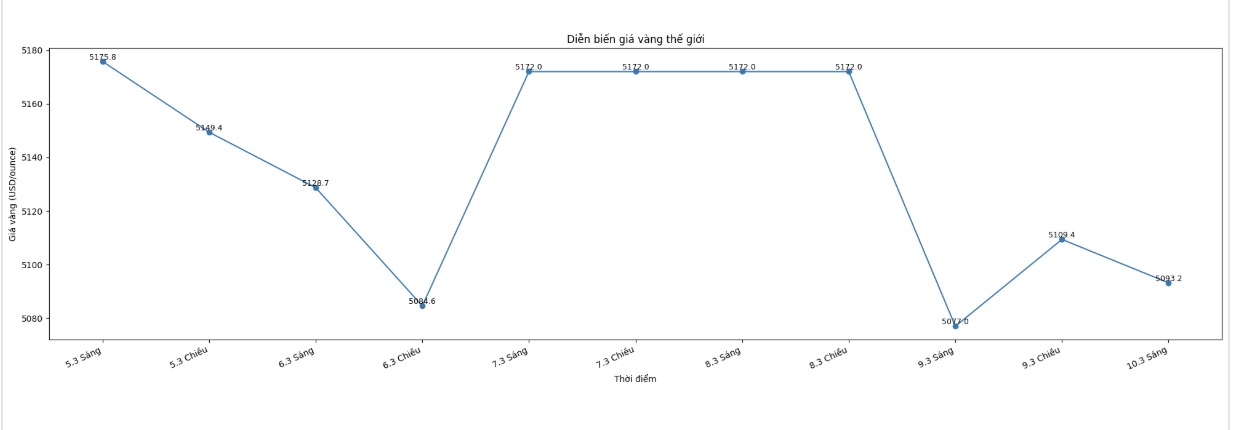
At 0:25 AM, world gold prices were listed around the threshold of 5,093.2 USD/ounce. Compared to the previous day, world gold prices decreased by 78.8 USD.
Gold price forecast
Gold prices fell as market concerns increased that the war in Iran could cause global stagnation, i.e., both high inflation and slow economic growth, while also leading to the possibility of higher interest rates.
In addition, the USD index increased sharply and hit a 3.5-month high, also becoming an external factor putting negative pressure on the precious metals market.
Notably, silver prices have recovered after downward pressure in the night trading session and are currently slightly increasing.
According to Bloomberg, optimism in financial markets about the possibility of an early resolution of the conflict in the Middle East is rapidly declining. Investors are starting to consider the possibility that the supply shock will be deeper and longer.
Market sentiment changed significantly after US President Donald Trump said that there are still areas of Iran that have not been attacked and said that the oil price of $100 per barrel is "a very small price to pay" for "security and peace". This statement has weakened expectations that the conflict will be contained within a limited range.
Bloomberg believes that investors are forced to increase the probability for the worst-case scenario. The biggest challenge is that this shock is stagnant, and the market is currently preparing for a "long winter" without a clear ending timeline.
Meanwhile, International Monetary Fund (IMF) Managing Director Kristalina Georgieva warned that if the conflict in the Middle East lasts, it will negatively impact global markets and economies, while forcing policymakers to prepare for a "new normal state". She said that if energy prices increase by 10% and last for a year, global inflation will increase by about 0.4 percentage points, while economic growth will slow down.
In another development, the People's Bank of China continued to buy more gold in February, extending its net buying streak to 16 consecutive months, according to a Bloomberg report.
However, according to the World Gold Council, central banks' gold buying activities slowed down at the beginning of the year due to increased market volatility reducing demand. Total net buying in January only reached 5 tons, much lower than the 12-month average of 27 tons. Some countries have also sold off some of their gold reserves recently.
Technically, the next price increase target of the buying side is to bring the closing price to exceed the strong resistance level at 5,434.1 USD/ounce. Conversely, the short-term price decrease target of the selling side is to push the futures contract price below the strong support level of 5,000 USD/ounce.
Gold price data is compared to the previous day.
See more news related to gold prices HERE...


