
Minutes of the March meeting of the US Federal Reserve (Fed) show that US monetary officials are increasingly cautious about the unpredictable impacts of tensions related to Iran and the Middle East region.
According to the minutes, members of the Federal Open Market Committee (FOMC) have not been able to draw a definite conclusion on which direction the conflict in the Middle East will affect the US economy more strongly. On the one hand, a sharp increase in energy prices could push inflation up and force the Fed to maintain a tougher stance for longer.
On the other hand, if tensions persist, high oil prices could erode household purchasing power, tighten financial conditions and slow down growth rates. Therefore, the Fed believes that it is necessary to maintain flexibility in management and continue to closely monitor upcoming data.
The minutes also show that the US financial market has clearly reacted to geopolitical risks. The interest rate path that the market expects has shifted in a higher direction, mainly due to investors pushing back expectations of policy easing to the end of the year.

The yield on US Treasury bonds with a 2-year term increased, while the main reason came from increased inflation compensation, reflecting concerns about short-term prices escalating following the upward momentum of energy prices. Meanwhile, stock indices fell, market volatility increased sharply and the USD also rose amid rising defensive sentiment.
However, the US economic picture recorded by the Fed has not yet shown a clear weakening. The actual gross domestic product continues to increase at a fairly steady pace, the unemployment rate has little fluctuated in recent months, and consumer inflation remains at a high level.
The Fed also slightly raised its inflation forecast for 2026 compared to the January session, mainly due to the impact of new data and the recent upward momentum of crude oil prices. This shows that price pressure has not really disappeared and is an important reason why the Fed cannot soon switch to a loose stance.
The most notable point in this minutes is that many Fed members have clearly mentioned the possibility of having to raise interest rates if inflation continues to linger high due to persistently rising oil prices. Accordingly, if inflation does not return to the 2% target as expected, raising interest rates may become a necessary option to keep long-term inflation expectations at a stable level.
However, the majority of members still believe that it is too early to accurately conclude the impact of the Middle East situation on the US economy, so the most appropriate option at present is still to wait for more signals from reality.
In addition, only one member voted against the decision to keep interest rates unchanged, with the view that it should be reduced by 0.25 percentage points immediately. This partly reflects the differentiation within the Fed, but not enough to change the general policy orientation.
For the gold market, the message from the Fed is creating mixed impacts. Usually, geopolitical instability in the Middle East will support the precious metal to rise thanks to safe-haven demand. However, in the current case, that supporting factor is somewhat eliminated by the risk of interest rates remaining high for longer, and may even increase again if energy inflation persists. As bond yields increase and the USD strengthens, gold - which is an interest-free asset - will lose some of its attractiveness in the eyes of investors.
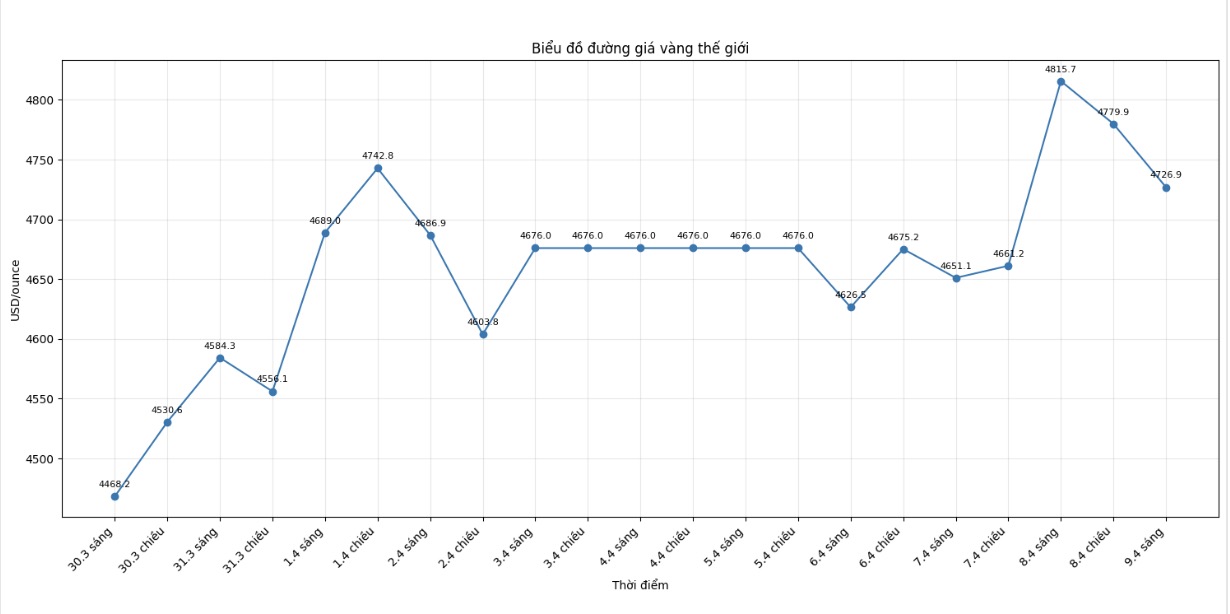
After the minutes were announced, gold prices plummeted. At the time of writing the article (9:38 AM on April 9 - Vietnam time), world gold prices were listed around the threshold of 4,726.9 USD/ounce, down 88.8 USD compared to the previous day.
This development shows that investors still see gold as a shelter in the context of geopolitical risks not cooling down, but at the same time are also very cautious about the possibility that the Fed will continue to maintain tight monetary policy.
In the short term, gold prices may continue to fluctuate strongly as the market simultaneously absorbs two large groups of information, including tensions in the Middle East and the Fed's interest rate outlook. If oil prices continue to rise, US inflation heats up again and the Fed sends tougher signals, gold is likely to be under adjustment pressure. Conversely, if the conflict lasts and increases global anxiety, safe-haven demand may return strong enough to support gold prices.


