
Bitcoin price: Depreciation
As of 5:45 PM today (January 21), Bitcoin - the world's largest electronic currency - according to market value continued to decline by 2.15%, reaching 89,202.98 USD.
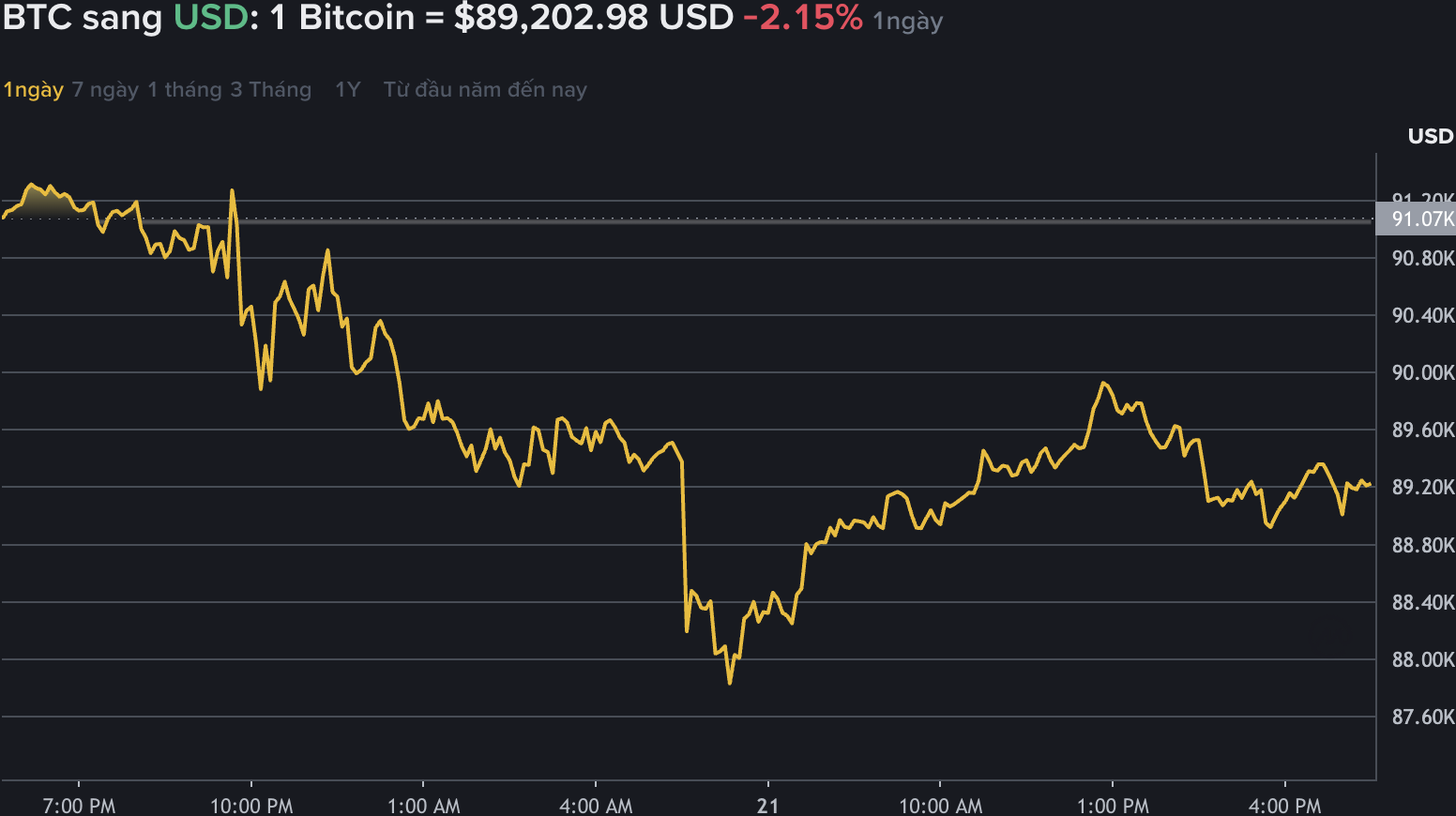
This new price contributed to a sharp decrease in market capitalization, trading at the milestone of 1,782 billion USD, down 118 billion USD. Trading volume in 24 hours increased to 51.53 billion USD, up 14.03 billion USD.
Perspectives and forecasts
Compared to the peak of January at nearly 95,000 USD, Bitcoin has adjusted to around 89,000 USD, significantly eliminating the previous increase. This decrease has led to more than 1 billion USD of leverage positions being liquidated, thereby "cooling down" the market and reducing the overheating situation.
On-chain indicators show quite positive signals: leverage decreases, long-term holders still hold coins, and prices are testing the support zone right around the CME gap area that has just been filled.
If buying power appears, Bitcoin may recover to the resistance zone of 92,000-94,000 USD. Conversely, if macroeconomic pressure continues to increase, the 85,000-87,000 USD zone will be the next area to be monitored. In general, the BTC is in a period of accumulation, fluctuating quite synchronously with the stock market and waiting for clearer signals.
Spot Bitcoin ETFs continue to play a central role in shaping short-term price movements. In early 2026, cash flow into ETFs was quite strong, with many sessions recording hundreds of millions of USD net buying, led by products such as IBIT of BlackRock and FBTC of Fidelity.
Even when volatility increases, the regular participation of institutional capital flows has helped Bitcoin stand firm around important support zones and reinforce the view that declines are still being utilized by long-term investors to accumulate.
However, ETF cash flow is not entirely one-way. Spot Bitcoin ETFs in the US recorded a net withdrawal of about $479.7 million, marking the strongest day of capital withdrawal in a few weeks and temporarily disrupting the previous day of cash withdrawal. However, this does not change the general trend.
For comparison, in the week ending January 16, Bitcoin ETFs and other cryptocurrency trading products still recorded a net capital flow of 2.17 billion USD - the highest level since October 2025. This shows that the recent capital withdrawal is likely only a short-term position adjustment, instead of a structural sign of retreat.
Macroeconomic factors are also creating more uncertainty for the market. President Donald Trump's speech at the World Economic Forum (WEF) in Davos is being closely monitored by traders, especially related to tariff policies and trade tensions with Europe.
New "hawkish" statements or tax threats could prolong risk-avoidance sentiment in the stock market and cryptocurrencies, thereby curbing Bitcoin below short-term resistance zones.
In Vietnam, the cryptocurrency asset market has been piloted from September 9, 2025, the pilot implementation period is 5 years.
However, organizations and individuals participating in the cryptocurrency asset market must comply with relevant legal regulations on preventing and combating money laundering, terrorist financing, financing the dissemination of weapons of mass destruction, electronic transactions, network information security, network security, data protection to ensure security and safety in the cryptocurrency asset market and other relevant specialized laws.


