
World gold prices regained green color in last night's trading session, after two consecutive sessions of strong selling pressure. Recovery momentum appeared when US private sector jobs data was lower than expected, increasing concerns about the health of the labor market.
Recorded at 11:20 PM, world gold prices were listed around the threshold of 4,369.7 USD/ounce, an increase of about 39.6 USD compared to the previous day.
Newly released data shows that the US private sector only created 38,000 jobs in August, lower than the 46,000 jobs in July and below the forecast of about 47,000 jobs. This is also the slowest job creation rate since January.
The manufacturing sector recorded a significant job loss, while some specialized service and information sectors also narrowed down personnel. Notably, job growth has been lower than expected for three consecutive months, showing that the US labor market is gradually losing momentum.
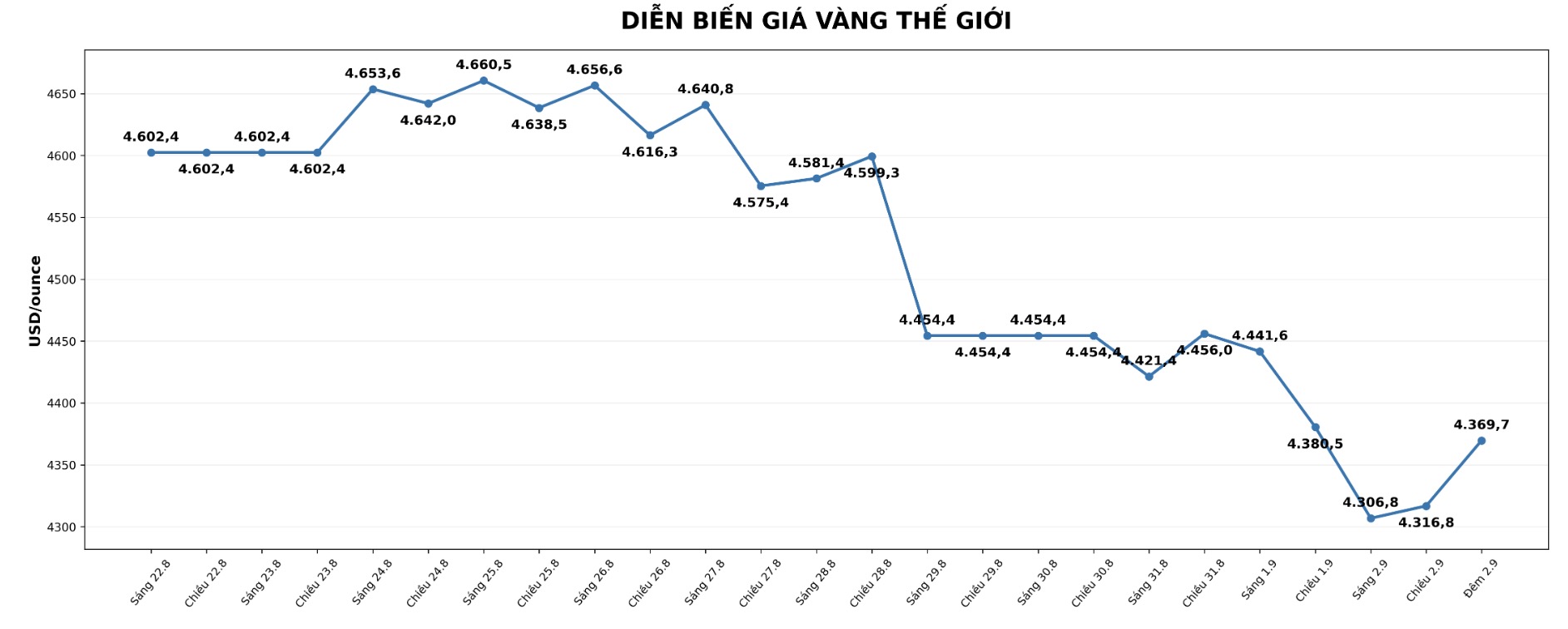
This information helps gold receive buying power again after the previous sell-off. However, the recovery level is still relatively limited because investors have not given up the possibility that the US Federal Reserve (Fed) will continue to raise interest rates in September.
Depending on the update time, the market is assessing the probability of the Fed raising interest rates this month at around 62-70%. The reason is that inflationary pressure is still present as oil prices remain high, while US government bond yields continue to rise sharply.
The yield on 10-year term bonds is currently above 4.8%, while the 30-year term is around 5.28%. The USD also maintains a relatively stable position. These are all disadvantages for gold - an asset that does not bring yields.
The upward momentum of oil continues to be a noteworthy variable. WTI oil prices traded above 90 USD/barrel, while Brent oil approached 95 USD/barrel amid tensions in the Middle East increasing concerns about transportation through the Strait of Hormuz.
This development creates a tug-of-war for gold. Geopolitical risks drive demand for defensive assets, but rising energy prices increase inflation expectations. When inflation is under pressure, the possibility of the Fed maintaining a tough monetary policy is also higher, thereby putting pressure on precious metals.
Technically, the short-term trend of gold is still not really positive even though the price is recovering. The 4,422 USD/ounce zone, which once played a supporting role, is now becoming a noteworthy resistance level.
If it surpasses and maintains above 4,422 USD/ounce, gold prices could move towards the areas of 4,487 USD/ounce and beyond to 4,573 USD/ounce.
In the opposite direction, 4,263 USD/ounce is the near support zone. Breaking through this level could cause the price to fall back to 4,221 USD/ounce, even 4,150 USD/ounce.
The market is currently focusing its attention on the US August non-farm payroll report released at the end of the week. If the data continues to be weak, expectations of the Fed raising interest rates may decline, creating more room for gold recovery. Conversely, a better-than-forecast payroll could pull yields and the USD up, causing the current gold rally to quickly lose momentum.
The article only provides market developments, not investment recommendations. Investors need to be cautious in the face of strong fluctuations in gold prices and consider carefully before making a decision.


