
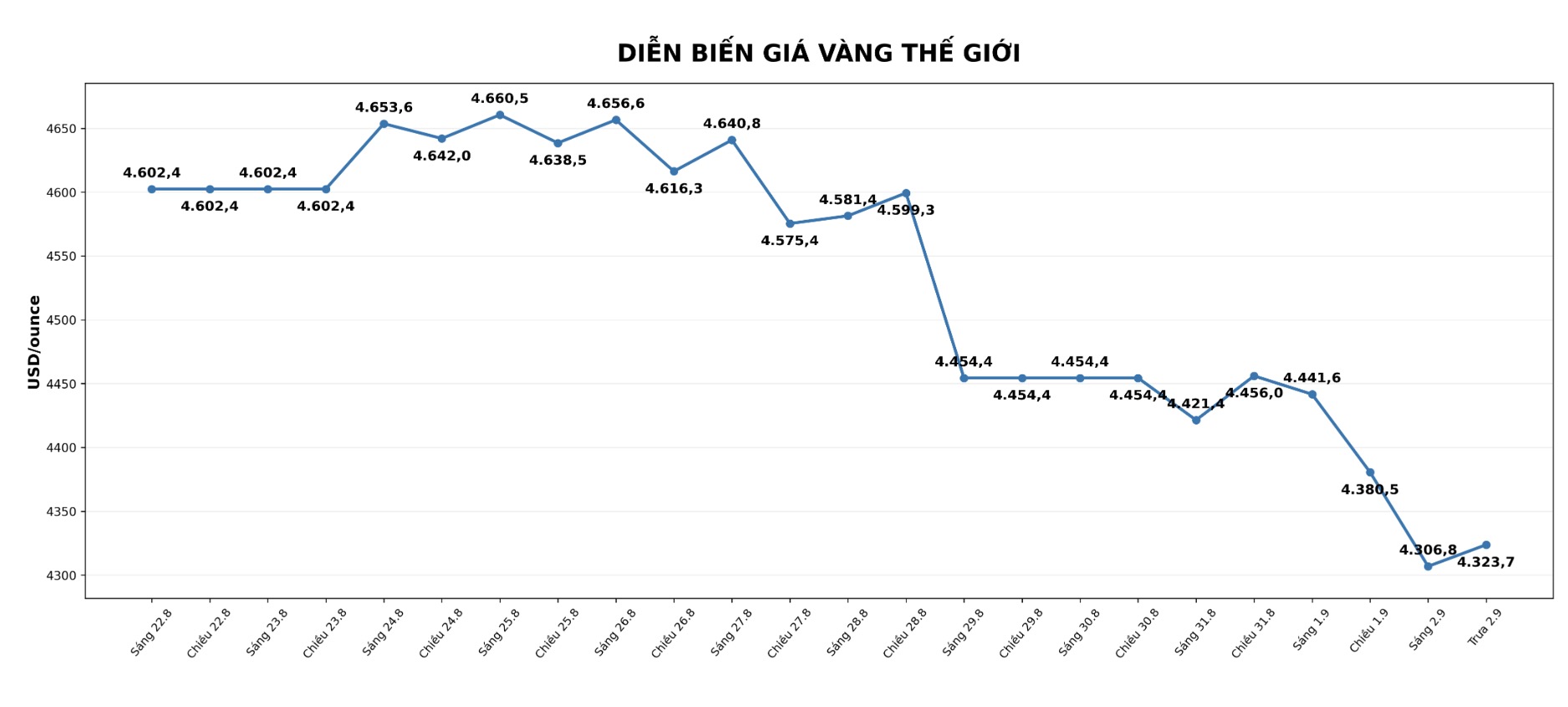
World gold prices continued to face strong selling pressure in the trading session on September 2nd, extending the downward streak to the fourth consecutive session.
As of 4:45 PM on September 2 (Vietnam time), spot gold prices decreased by 0.6%, to 4,302.99 USD/ounce. This is the lowest level since August 7. Notably, the precious metal is still trading below the 200-day moving average - a technical threshold that many investors are monitoring to assess long-term trends.
Meanwhile, US gold futures for December delivery fell 1.1% to 4,349.90 USD/ounce.
Rising oil prices put pressure on gold
One of the main factors putting pressure on the gold market is the escalating geopolitical tensions in the Middle East.
New developments in US-Iran relations have raised market concerns that conflict could prolong, affecting energy supplies. Oil prices accordingly increased for the third consecutive session.
Usually, geopolitical instability can boost demand for gold thanks to its role as a safe haven asset. However, in the current context, the impact from rising energy prices is creating a different direction.
More expensive crude oil risks increasing inflationary pressure in the US. This strengthens market expectations that the US Federal Reserve (Fed) will maintain tight monetary policy, and even continue to raise interest rates if the rate of increase does not cool down quickly enough.
US government bond yields increased while the USD remained high, further disadvantaging gold. Strong greenbacks make gold, which is valued in USD, more expensive for buyers using other currencies.
Gold is often considered an inflation hedging tool, but this asset does not yield yields. Therefore, when interest rates and bond yields increase, gold's relative attractiveness may decline.
Market raises odds on Fed interest rate hike
Expectations for monetary policy are becoming a factor strongly dominating the developments of precious metals.
According to the market interest rate expectations tracking tool, investors currently value about 68% of the possibility that the Fed will raise interest rates at the policy meeting this month.
Recent signals from the Fed also make market sentiment more cautious. Some US central bank officials believe that if inflation does not fall fast enough, further interest rate hikes could become a necessary option to bring inflation back to the 2% target.
In that context, investors' attention is shifting to US jobs data. The private sector jobs report is expected to be released on the same day, before the market welcomes the non-farm jobs report at the weekend.
These may be important data orienting gold prices in the short term. If the US labor market weakens significantly, interest rate hikes may be reduced, thereby creating conditions for gold to recover.
Conversely, if job data continues to show that the US economy maintains good resilience, the possibility of the Fed maintaining a tough stance will increase. At that time, the USD and bond yields may continue to put pressure on the precious metal.
Not only gold, other precious metals also decreased in price. Spot silver lost 0.9%, to 63.68 USD/ounce; Platinum decreased 0.9%, to 1,725.03 USD/ounce; palladium decreased 1.3%, to 1,293.86 USD/ounce.
The precious metals market is entering a period of strong fluctuations as it is also affected by geopolitical tensions, energy prices, inflation, US monetary policy and important economic data about to be released.
The content of the article is to update the developments of the gold market, not to recommend investment. Investors need to carefully consider risk factors before making a decision.


