
Gold prices may continue to benefit in the context of the US government increasing intervention measures to control borrowing costs, according to Mr. Charlie Morris - Investment Director and founder of ByteTree.
In the latest Atlas Pulse Gold report, Mr. Morris said that US Treasury Secretary Scott Bessent's move to double the size of long-term US Treasury bond purchases has many similarities with quantitative easing (QE) policies.
According to this expert, the goal of the above move is to contribute to pulling down long-term bond yields, thereby reducing US government borrowing costs. This is also considered a factor beneficial for gold.
The trend of gold is improving," Morris said, while suggesting that precious metal prices are likely to soon return above the 200-day moving average.
One of the factors that makes Mr. Morris have a positive view of gold is the growth rate of US public debt. According to data he cited, the total US public debt recently reached $40,000 billion.
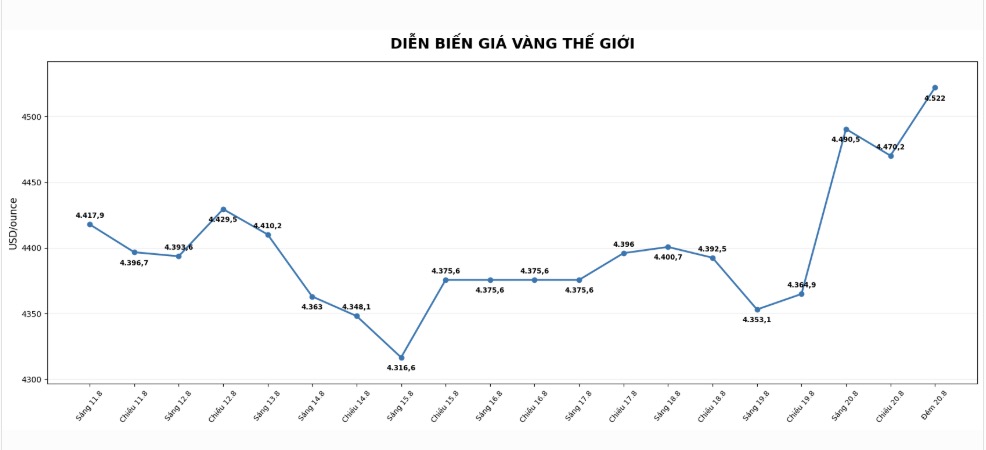
The average US debt growth rate is also increasing, from about 3.7% per year in the 1990s to 7.8% in the pre-pandemic period and about 8.6% since the pandemic.
Mr. Morris noted that in the past century, the total value of gold in the world has tended to increase corresponding to the total size of US debt. While gold supply can only increase by about 2% per year, gold prices must play a key role in the process of price adjustment.
According to ByteTree's calculations, the total value of gold worldwide is currently about $31,000 billion, equivalent to 77% of US debt size. Historically, this rate has exceeded 100% in some periods of economic tension.
Compared to the US stock market, the value of global gold is currently only equivalent to about 37%. Mr. Morris believes that this figure still has room to increase if the economic environment experiences conditions similar to the Great Recession or the high inflation period in the 1970s.
Another noteworthy issue is that US public debt is growing faster than nominal GDP. According to Mr. Morris, while debt increases by about 8.6% per year, nominal GDP only increases by about 6.5%, making the debt problem increasingly difficult if this trend persists.
Expert ByteTree also mentioned recent moves by US Treasury Secretary Scott Bessent. At the end of July, the US Treasury Department took intervention measures to support the yen. After that, Morris continued to see increased purchases of long-term Treasury bonds as a form of intervention with a similar impact to QE.
However, he warned that the amount of long-term bonds on the market is significantly lower than short-term bonds. Buying back bonds may help reduce yields in the short term, but to maintain low yields, the US government may have to continue to intervene.
Refinancing pressure is also a factor to monitor. In 2027 and 2028, about 3,000 billion USD of US government debt is expected to be refinanced, not to mention budget deficits and interest payment costs.
According to Mr. Morris, it is the increasing debt environment and the demand for high-liquidity assets that are driving central banks to buy gold.
If they reduce their holdings of US Treasury bonds, which other option is large enough, highly liquid, with limited supply and can retain long-term value? All paths lead to gold," he said.
Gold demand from central banks is also recovering after Russia and Turkey recorded net selling in the first quarter. China is considered one of the important factors as it has a large trade surplus and part of its capital is shifted to gold.
Mr. Morris believes that in the context of increasingly unpredictable global economic relations, gold is becoming an asset prioritized by many organizations.
The article updates market developments, not investment recommendations; investors need to consider before deciding.


