
Fed increases concerns about inflation
Gold prices remained at a high level after the minutes of the meeting on July 28-29 of the US Federal Open Market Committee (FOMC) were released. The content of the minutes shows that policymakers of the US Federal Reserve (Fed) are increasingly concerned that price pressure may extend beyond expectations.
According to the minutes, the developments in the financial market in the period between the two meetings were significantly affected by the conflict in the Middle East. Oil prices increased, bond yields and expectations for monetary policy also fluctuated.
However, short-term inflation expectations only increased slightly after oil prices rose sharply. Market responses show that investors still assess the Fed's determination to bring inflation back to the 2% target.
Long-term inflation expectations are generally stable and still consistent with the Fed's long-term inflation target.
However, real inflation continues to be high. Some FOMC members believe that price increases in the past year have been widespread, ranging from goods to services.
Notably, some officials believe that even if goods most directly affected by tariffs and energy prices are removed, core inflation remains high.
Most members predict inflation will decrease in the rest of 2026 as the impact of tariffs and previous energy price increases weaken. However, many warn that inflation may be more persistent than expected.
Fed staff forecast inflation will continue to cool down in 2027, as the impact of tariffs and Middle East conflicts subsides, before falling to around 2% in 2028.
Risks for inflation prospects are still assessed as leaning towards increase.
The possibility that the Fed will continue to tighten policy
The market paid special attention to the views of FOMC members on the direction of interest rates.
The minutes stated that many members believe that the Fed may need to continue to tighten monetary policy if inflation does not decrease. Some even believe that current financial conditions are not limited enough to ensure inflation returns to the 2% target.
Some members who supported raising interest rates right at the July meeting said that early action could help the Fed avoid having to implement a series of stronger and more costly interest rate hikes later.
At the end of the meeting, the majority of members voted to keep interest rates unchanged. Meanwhile, Beth Hammack, Neel Kashkari and Lorie Logan disagreed, supporting raising interest rates by another 25 basis points.
The labor market is assessed as relatively stable, with labor supply and demand close to balance. The unemployment rate is also maintained near the long-term level.
The Fed also forecasts that the US economy will continue to grow, in which investment in artificial intelligence (AI) and household spending are important drivers.
Gold prices maintain high levels
Usually, the prospect of the Fed maintaining tight monetary policy for a long time may put pressure on gold due to increasing the opportunity cost of holding non-performing assets.
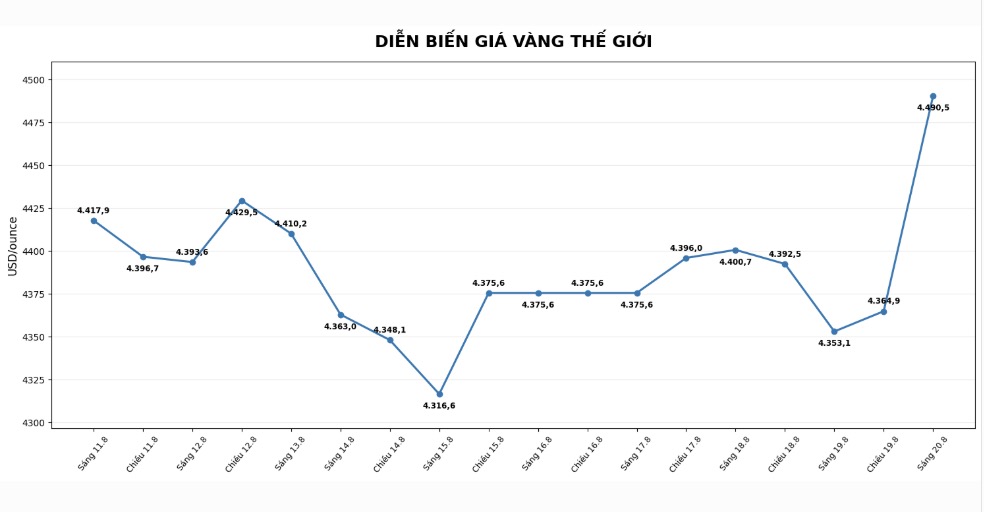
However, after the FOMC minutes were released, gold prices still maintained in a high trading range and consolidated the previous increase.
This development shows that the gold market is currently not only reacting to interest rate expectations but also affected by many factors such as geopolitical risks, inflation prospects, USD fluctuations and the need to seek defensive assets.
Another content that attracted attention was Fed Chairman Kevin Warsh's proposal to reduce the number of regular FOMC meetings from 8 to 6 per year from 2027.
According to the minutes, meetings every two months may help policymakers have more data to assess the economy and spend more time on strategic issues. However, the Fed has not made a decision and the meeting schedule for the rest of 2026 will remain unchanged.
In the context that gold prices are approaching the psychological level of 4,500 USD/ounce, signals about inflation and interest rate orientation from the Fed continue to be factors that investors are closely monitoring in the coming time.
The article updates market developments, not investment recommendations; investors need to consider before making a decision.


