World gold prices continued to weaken in the trading session on July 8 as investors turned their attention to the minutes of the June monetary policy meeting of the US Federal Reserve (Fed), while also monitoring new developments in the Middle East that could affect inflation and interest rate orientation.
As of 4:03 PM Vietnam time, spot gold prices fell 2.23% to 4,053.74 USD/ounce. The precious metal continued to fall below 4,100 USD/ounce, unable to overcome the 4,200 USD/ounce zone.
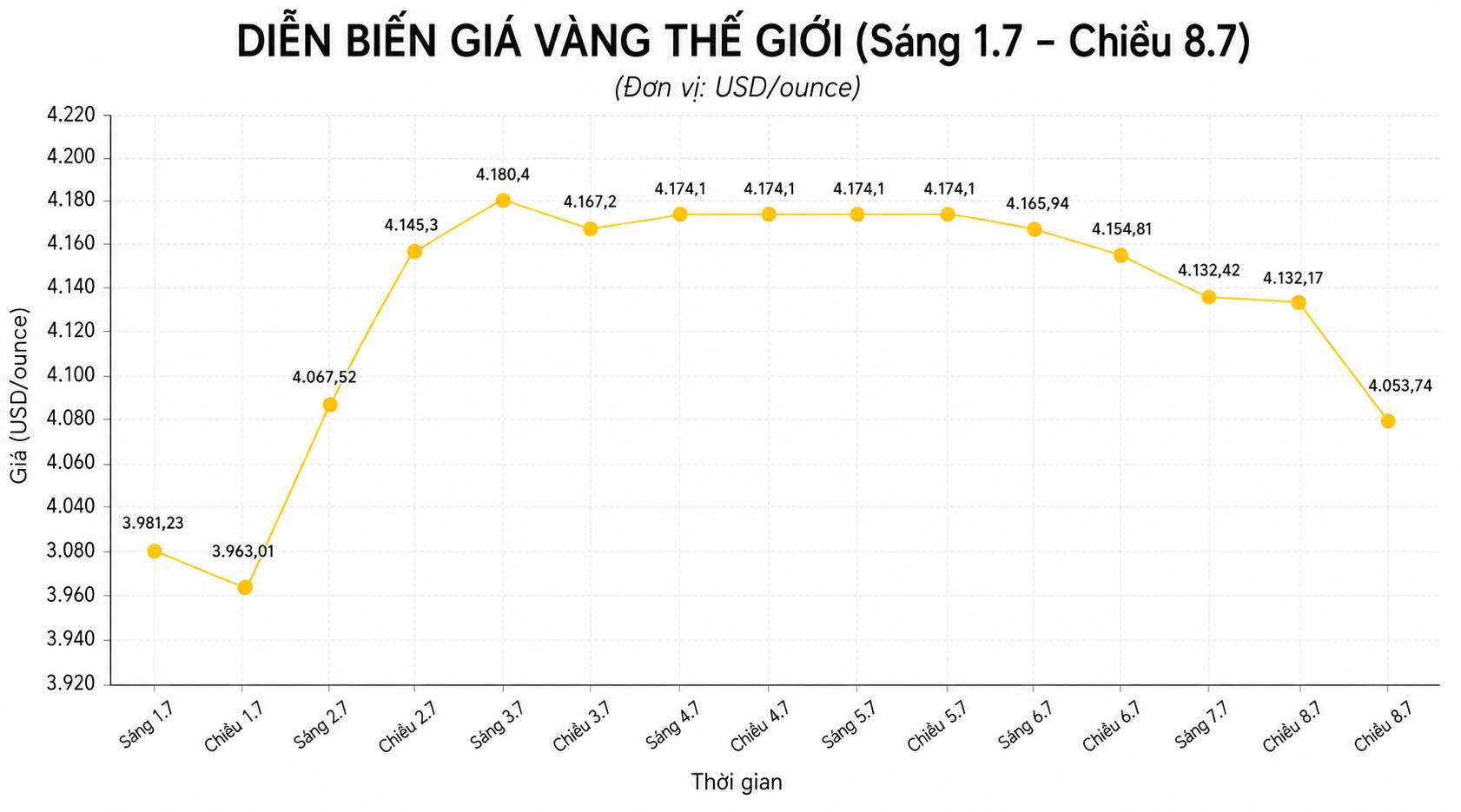
Besides the monetary policy factor, geopolitical tensions in the Middle East continue to affect market sentiment.
According to published information, the US conducted airstrikes in response to attacks on maritime operations in the Strait of Hormuz after Washington revoked its license allowing Iran to continue exporting oil. In response, Iran declared an attack on several US military targets in the region.
Concerns about the risk of energy supply disruption pushed oil prices up more than 3% in the session, thereby increasing inflationary pressure and strengthening expectations that the Fed will maintain a more cautious monetary policy for longer. According to the CME FedWatch tool, the probability of the Fed raising interest rates in the September meeting has increased to more than 63%, higher than the recorded level of about 57% the day before.
The USD and US government bond yields also went up, continuing to increase the opportunity cost of holding gold – an asset that does not yield yields.
However, not all experts believe that the downward trend of gold will last.
Mr. Craig Hemke – an analyst at Sprott Money – said that gold and silver prices may have bottomed out in 2026 and will soon be supported again by the long-term momentum of the upward cycle.
According to Mr. Hemke, expectations that the Fed will continue to pursue a tough stance peaked right after the June meeting of the US Federal Open Market Committee (FOMC). He believes that the market's repeated expectations that the Fed would cut interest rates in 2026 are already unlikely to happen, while the Iranian conflict caused oil prices to rise sharply from about 65 USD to 110 USD/barrel, leading to expectations of inflation escalating.
However, as much of the military tension subsided, oil prices fell back to the $68/barrel range. According to Mr. Hemke, this could help cool down inflationary pressure in the coming months, thereby reducing the risk of the Fed continuing to raise interest rates.
A symbolic interest rate hike may still occur, but it is likely that the Fed's policy will return to its original orientation of cutting interest rates to reduce borrowing costs and bring real interest rates to negative levels," he said.
According to this expert, if the above scenario takes place, the bottom of gold and silver prices set at the end of June may also be the bottom of the whole year 2026.
From a long-term perspective, buying power from central banks is still considered an important supporting factor for the gold market.
Newly released data shows that the People's Bank of China (PBoC) raised its gold reserves to 75.44 million ounces of Troy gold at the end of June, up from 74.96 million ounces of Troy gold last month, marking 20 consecutive months of net buying.
The World Gold Council (WGC)'s 2026 Central Bank Gold Reserves survey also shows that more and more central banks are expected to continue to increase their gold holdings in the next 12 months.
Meanwhile, Hong Kong (China) has put into trial operation a centralized gold payment and clearing system, and at the same time restored gold futures contract trading to gradually build a gold trading, custodian and payment center in the region.
In the precious metals market, the price of silver bars decreased by 2.57% to 58.40 USD/ounce, while the price of platinum was almost flat and palladium decreased slightly.