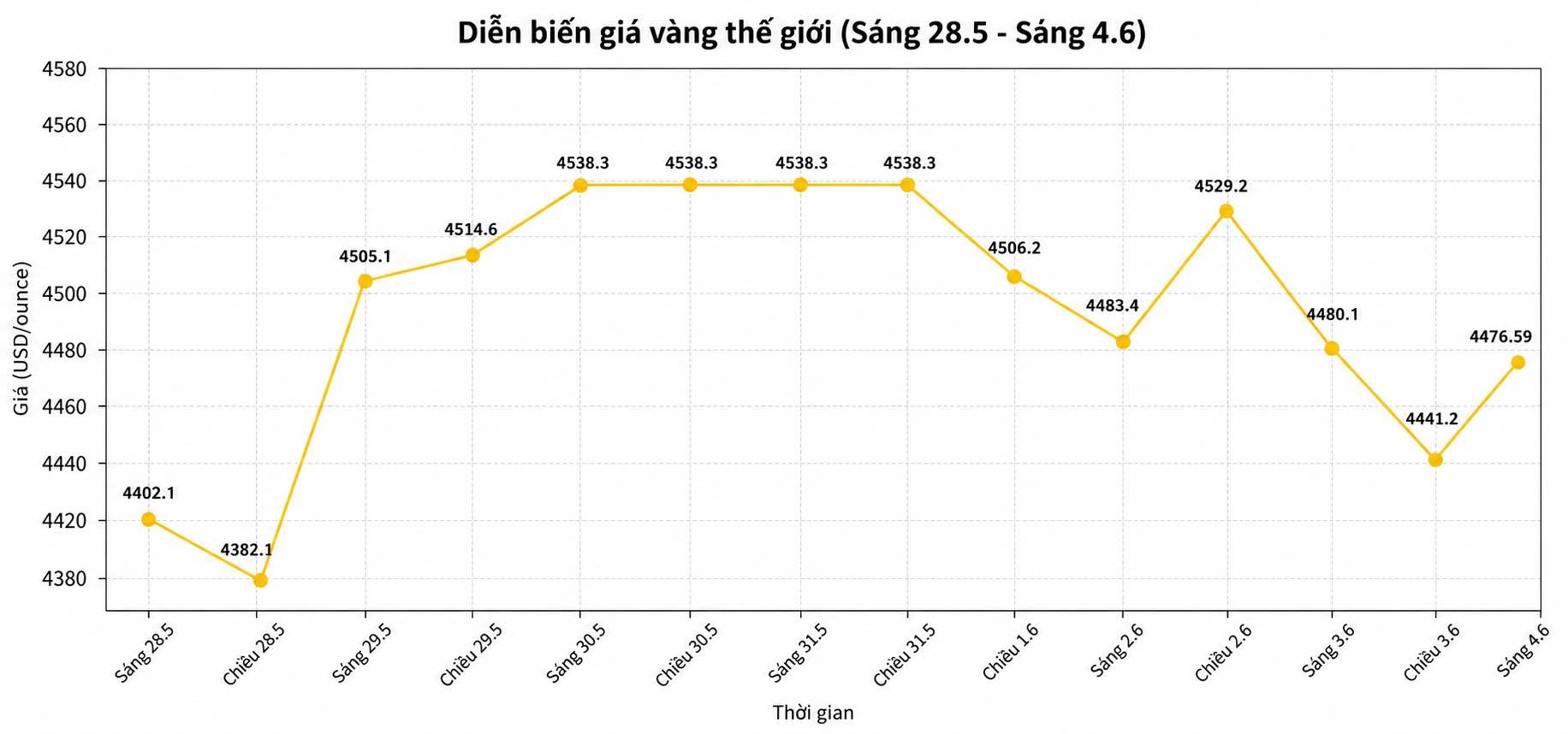
Gold prices rose again after Israel and Lebanon reached a conditional ceasefire agreement, a development that could pave the way for cooling down the larger conflict in the Middle East - the cause that has disrupted the global energy market and increased the risk of inflation.
The precious metal at one point increased by 0.7%, to nearly 4,465 USD/ounce, thereby regaining part of the decrease of 1.2% of the previous session when bottom-fishing buying power returned to the market.
In a joint statement with the US, Israel and Lebanon said the agreement would only be effective if Iranian-backed Hezbollah forces "completely ended" attacks.
The agreement was announced after fighting broke out again in the Middle East on June 3, marking the most serious escalation since the ceasefire took effect in April. Kuwait and Bahrain were also caught up in a spiral of conflict as attacks threatened to disrupt the peace negotiation process between the US and Iran.
Although Washington and Tehran have agreed on a preliminary framework to extend the ceasefire and reopen the Strait of Hormuz, the final agreement has not yet been completed.
US President Donald Trump said that this strategic shipping route will be reopened "immediately" if Iran signs a memorandum of understanding. However, Tehran has not yet accepted the peace terms proposed by Washington.
The prolonged disruption to energy flow through the Strait of Hormuz has pushed oil prices up and raised concerns about global inflation. This makes it more likely for central banks to maintain high interest rates or even continue to raise interest rates - a disadvantage to gold because the precious metal does not yield yields.
Since the conflict broke out at the end of February, gold prices have generally moved in the opposite direction to oil prices. The precious metal fell sharply in the early days of the war and is still about 16% lower than the level right before the war broke out, although it has fluctuated in a narrow range for the past few weeks.
After three consecutive rising sessions, oil prices turned down when the market received information about an agreement between Israel and Lebanon.
Regarding gold, Ms. Hebe Chen - an analyst at Vantage Markets said that the hope for a ceasefire between Israel and Lebanon has helped reduce pressure from bond yields and the USD in the short term, while gold's adjustment to near the long-term trend line is attracting bottom-fishing buying back.
However, if a more comprehensive solution to the conflict is not reached, inflationary pressure is likely to remain prolonged.
Ms. Lorie Logan - Chairman of the Dallas Federal Reserve Bank said that policymakers may have to raise interest rates in the near future to bring inflation back to the US Federal Reserve (Fed) target of 2%.
Meanwhile, experts Ryan McKay and Bart Melek of TD Securities said that as long as inflation concerns continue to make the market bet on the possibility of the Fed raising interest rates, at least until early 2027, gold will find it very difficult to create a truly strong recovery.
As of 10:08 a.m. in Singapore, spot gold price decreased slightly by 0.32% to 4,476.59 USD/ounce. Silver prices increased 1.23% to 73.60 USD/ounce. Platinum and palladium also rose simultaneously.
Meanwhile, the Bloomberg Dollar Spot Index - a measure of the strength of the USD - decreased 0.1% after increasing 0.3% in the previous session.