
Gold price increases by more than 3.7%
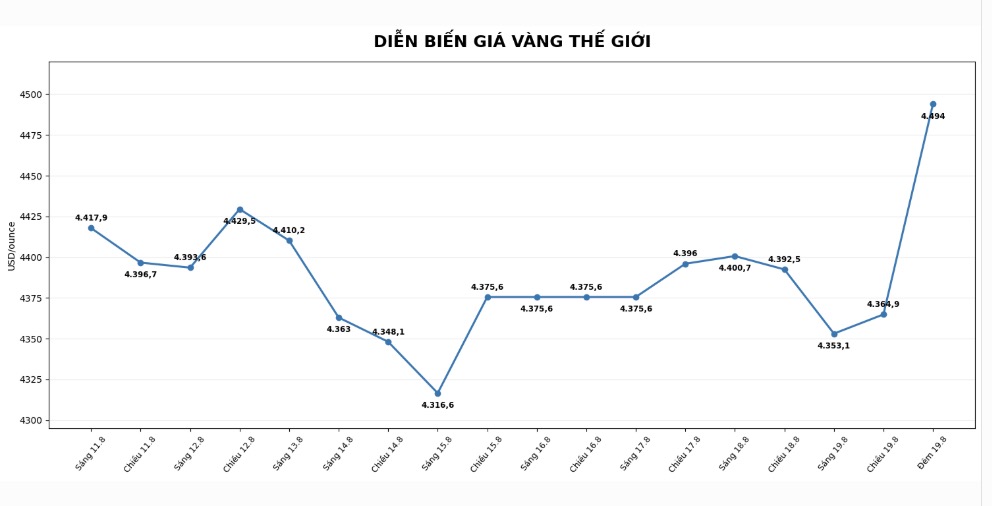
World gold prices recorded a strong breakthrough in the trading session on August 19 (US time), reversing previous cautious developments and quickly approaching the important psychological milestone of 4,500 USD/ounce.
Spot gold prices at one point increased by 3.73%, to 4,498 USD/ounce - the highest level in more than two and a half months. US gold futures also increased sharply, surpassing 4,545 USD/ounce.
Notably, at the beginning of the US session, spot gold prices were trading around 4,367.50 USD/ounce, up about 0.79%. Thus, in just a short time, the precious metal has increased by more than 100 USD/ounce.
The important driving force for gold prices came from the unexpected announcement by the US Treasury Department about doubling the scale of long-term bond repurchases to support liquidity. This information pulled down US Treasury bond yields, while putting pressure on the USD.
The USD Index fell to about 98.93 points, the lowest level since the end of May. The weaker greenback made gold cheaper for buyers holding other currencies, thereby stimulating demand.
Previously, the gold market was under great pressure as long-term bond yields in the US and many developed economies rose to their highest level in many years. On August 18, spot gold prices fell by about 1.1% to around 4,364.90 USD/ounce.
Expecting interest rates to continue to support gold prices
Another factor supporting the precious metal is the expectation that the US Federal Reserve (Fed) will not continue to raise interest rates in September.
Recent US economic data, including weaker retail sales, easing consumer inflation and weakening consumer sentiment, have caused the market to reduce bets on the possibility of the Fed raising interest rates.
The market currently assesses the probability of the Fed keeping interest rates unchanged in September at around 65-67%.
Gold is an asset that does not yield interest, so it often benefits when bond yields and interest rate expectations fall.
Besides monetary policy, geopolitical tensions in the Middle East continue to create additional demand for shelter. Developments in the Strait of Hormuz are strongly impacting oil prices and inflation expectations. In the session on August 19, Brent oil traded around 91.5 USD/barrel, while WTI oil was around 85 USD/barrel.
Before the strong increase, the 4,446 USD/ounce zone was considered an important resistance level for gold. The fact that the price crossed this zone opened up the possibility of testing the 4,595 USD/ounce zone if the upward momentum is maintained.
In the opposite direction, the 4,320 USD/ounce zone is considered a near support for gold prices.
Current developments show that gold prices are still subject to mixed impacts between geopolitical tensions, the USD, bond yields and Fed policy expectations. Investors are monitoring further US economic signals to assess the sustainability of this increase.
The article updates market developments, not investment recommendations. Investors need to consider carefully before making a decision.


