According to Kitco, gold prices adjusted in March, but investment demand in China still strongly broke through in Q1/2026. Gold ETF funds recorded record high inflows, wholesale demand recovered, while the People's Bank of China (PBoC) also took advantage of buying more gold reserves as prices fell.
According to Mr. Ray Jia - Head of China Market Research at the World Gold Council (WGC), the Chinese gold market in Q1 recorded mixed developments as gold prices weakened in March, but investment and stockpiling demand increased sharply.
The latest updated report from the WGC said that world and Chinese gold prices simultaneously fell sharply in March. LBMA PM gold price in USD decreased by 12% in the month, mainly due to expectations that the US Federal Reserve (FED) will cut interest rates to cool down quickly, along with profit-taking pressure on the futures contract market, ETF and options. Meanwhile, the standard gold price in China decreased by 11%, but the decrease was somewhat limited thanks to the depreciation of the domestic currency.
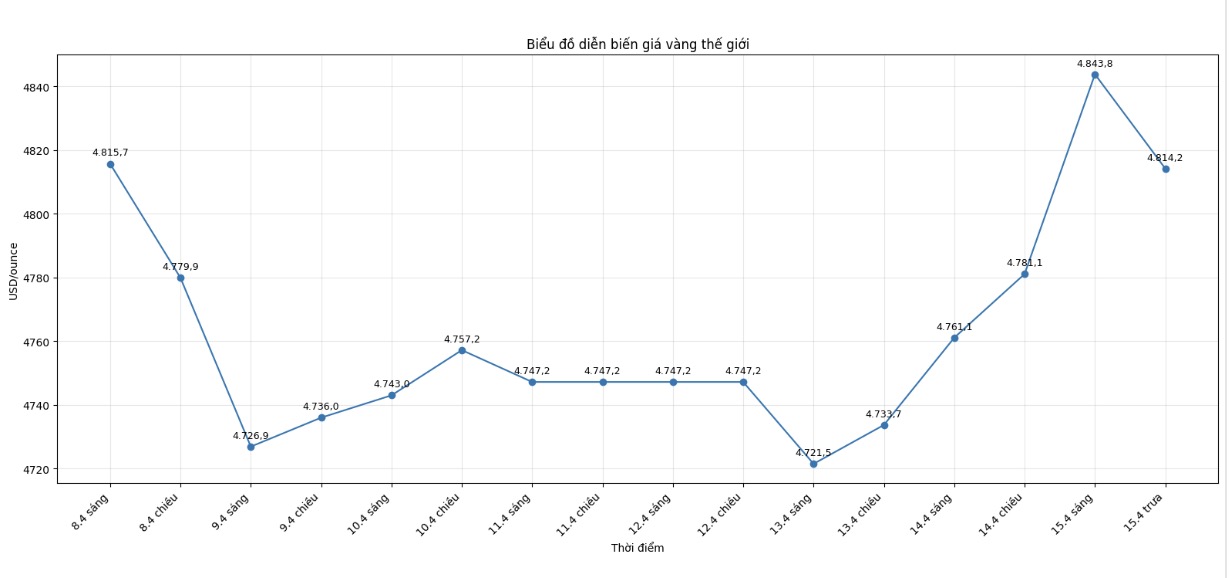
However, in the first quarter, the international gold price in USD and the standard gold price in China in yuan still increased by 7%. According to the WGC, the market has shown signs of recovery since the end of March and the beginning of April.
In the wholesale demand segment, the amount of gold withdrawn from the Shanghai Gold Exchange (SGE) in March reached 134 tons, up 57% compared to the previous month and up 12% compared to the same period last year.
WGC believes that the monthly increase is mainly seasonal, due to the number of working days in March being higher than in February and businesses in the industry promoting restocking after the Lunar New Year holiday. In addition, the decline in gold prices also stimulated additional buying activities when prices were low.
For the whole first quarter of 2026, wholesale gold demand in China reached 345 tons, up 3% compared to the same period last year but still 23% lower than the 10-year average. WGC said that this reflects the fact that strong investment demand is compensating for the prolonged weakening of the gold jewelry segment.
Notably, gold ETF funds in China continued to attract capital for the 7th consecutive month. In March alone, these funds attracted 12 billion yuan, equivalent to about 1.7 billion USD, adding 8.4 tons of gold held.
According to the WGC, the buying momentum was supported by the CSI300 index falling 6%, the domestic currency depreciating 0.8% against the USD, and safe-haven demand in the face of geopolitical tensions in the Middle East and the region.
Accumulated in Q1/2026, Chinese investors have poured a total of 59 billion yuan, equivalent to 8.5 billion USD or 50 tons of gold, into gold ETFs. This is the highest level ever recorded in the quarter.
Total managing assets of gold ETFs in China increased by 26%, to 304 billion yuan, equivalent to 44 billion USD, while gold holdings increased to 298 tons - all at peak levels at the end of the quarter.
On the derivatives market, gold futures trading volume in China in March decreased by 12% compared to the previous month, down to an average of 443 tons/day. WGC believes that lower price volatility and less vibrant price trends have reduced the attractiveness to speculators.
However, on average for the first quarter, trading volume on the Shanghai Futures Exchange still reached 468 tons/day, significantly higher than the 5-year average of 265 tons/day.
The downward price movement in March also created conditions for the People's Bank of China to continue to increase gold reserves. According to the WGC, the PBoC announced its 17th consecutive month of gold purchases in March, with an additional purchase volume of 5 tons - the highest level since February 2025 - thereby raising China's total official gold reserves to 2,313 tons.
Currently, gold accounts for about 9% of China's foreign exchange reserves, down from 10% in February, mainly due to gold price adjustments in March. In the first quarter alone, the country's central bank net bought 7 tons of gold - the highest level since the first quarter of 2025.
Looking into Q2, WGC believes that this is still the traditional low point of the jewelry market in China. However, demand may improve if gold prices are more stable. Along with that, gold investment demand is likely to continue to be supported by reduced bond yields and the lack of other attractive investment channels in the domestic market.