
World gold prices are in a sensitive zone after a period of strong fluctuations. Although the long-term upward trend has not been completely broken, some experts believe that this precious metal needs to maintain important technical support zones. Otherwise, selling pressure may increase and pull gold prices deeper down in the short term.
Mr. Adam Turnquist - chief technical strategist at LPL Financial - said that gold has been under pressure since March due to increased bond yields, faint expectations of interest rate cuts and improved risk appetite in the market. These factors have weakened gold holding demand at some points, especially when investors switch to more profitable assets.
However, according to Mr. Turnquist, structural support forces for gold have not disappeared. Central bank buying demand continues to be maintained at a high level, while concerns about the US fiscal deficit, persistent inflation risks, geopolitical tensions and the trend of diversification away from the USD are still long-term supporting factors.
From a technical perspective, LPL Financial experts noted that gold has adjusted sharply after setting a record high of 5,595 USD/ounce in January. Since then, the price has formed a series of low peaks and is currently testing an important support zone around the 200-day moving average, along with a long-term upward trend starting from the beginning of 2024.
Mr. Turnquist believes that momentum indicators are still leaning towards a downward trend, but selling pressure is showing signs of easing. However, he warned that if the price breaks down decisively below the trend support zone, the risk of further decline will increase, with the 4.099 USD/ounce zone being the next major support below.
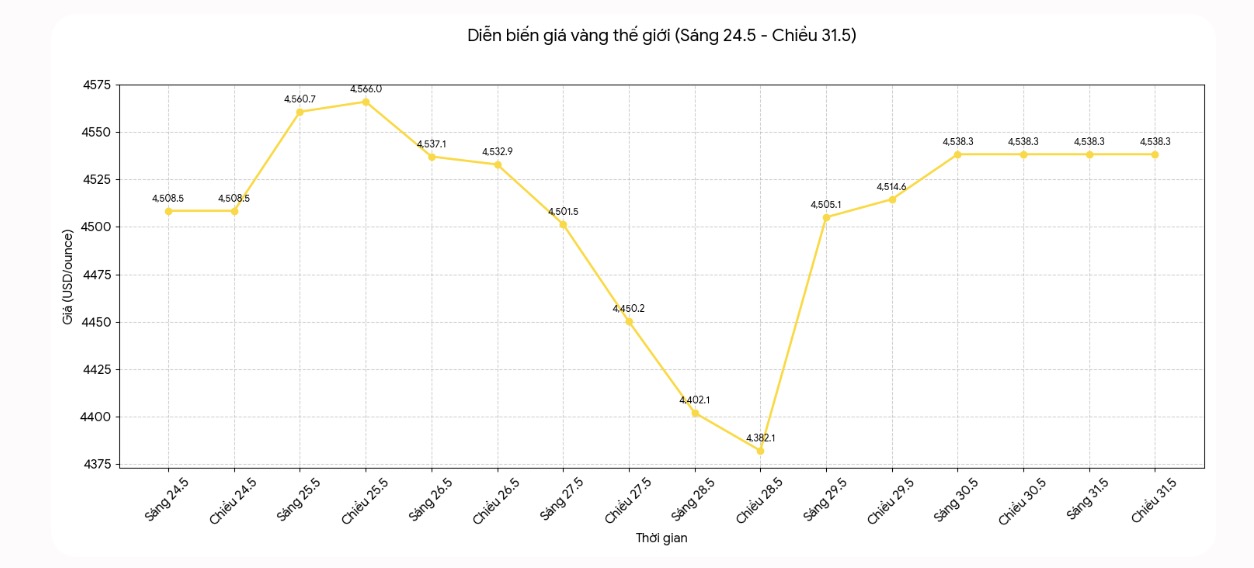
A cautious view was also given by Mr. Alex Kuptsikevich - senior market analyst at FxPro - he predicted that gold prices could fall next week, after the precious metal at one point fell below 4,400 USD/ounce and broke below the 200-day moving average in the session.
According to Mr. Kuptsikevich, the area around the 200-day moving average has repeatedly attracted buying in the past 3 years. The last week of May was no exception, as gold prices rebounded after checking this area. However, FxPro experts believe that the current market conditions are more balanced than the recovery in March, while gold is no longer in a state of being oversold.
This means that the current recovery momentum may not be sustainable enough. Mr. Kuptsikevich believes that if gold breaks below the current support zone, the price may fall back to about 4,000-4,100 USD/ounce. In a more negative scenario, if selling pressure increases sharply, the decline may pull the price down deeper, even to the 3,400 USD/ounce zone.
However, this expert also does not rule out the possibility that the market will be stuck around the current price range for a few days to a week to accumulate again after the decline.
A more positive scenario is that gold will break through the 50-day moving average at 4,630 USD/ounce. If this happens, the downward trend in recent months may end and the long-term upward trend will be restored.

Meanwhile, analysts at CPM Group recommended selling in the short term, with the initial target price of 4,375 USD/ounce in the period from May 29 to June 12, with a stop loss at 4,610 USD/ounce. This analysis group said gold has decreased to test the 4,400 USD/ounce zone, at one point touching 4,395.60 USD/ounce before recovering to 4,545 USD/ounce.
According to CPM Group, gold and other major precious metals are moving in a short-term extreme downtrend, continuously testing short-term support zones. Breaking below 4,400 USD/ounce could trigger a new wave of selling, pulling gold prices back to 4,100 USD/ounce - a zone being mentioned by some technical analysts.
CPM Group also noted that the excitement of a part of investors has cooled down.
The common point in the above three assessments is that gold still has a long-term support foundation, but the risk of short-term correction cannot be underestimated.
For investors, the current period requires caution. When gold prices fluctuate strongly around important technical zones, chasing purchases in recovery phases may contain risks. Buyers need to closely monitor the price response at the support zone, as well as the upcoming US economic data, because these will be factors that can determine the next direction of the precious metal.


