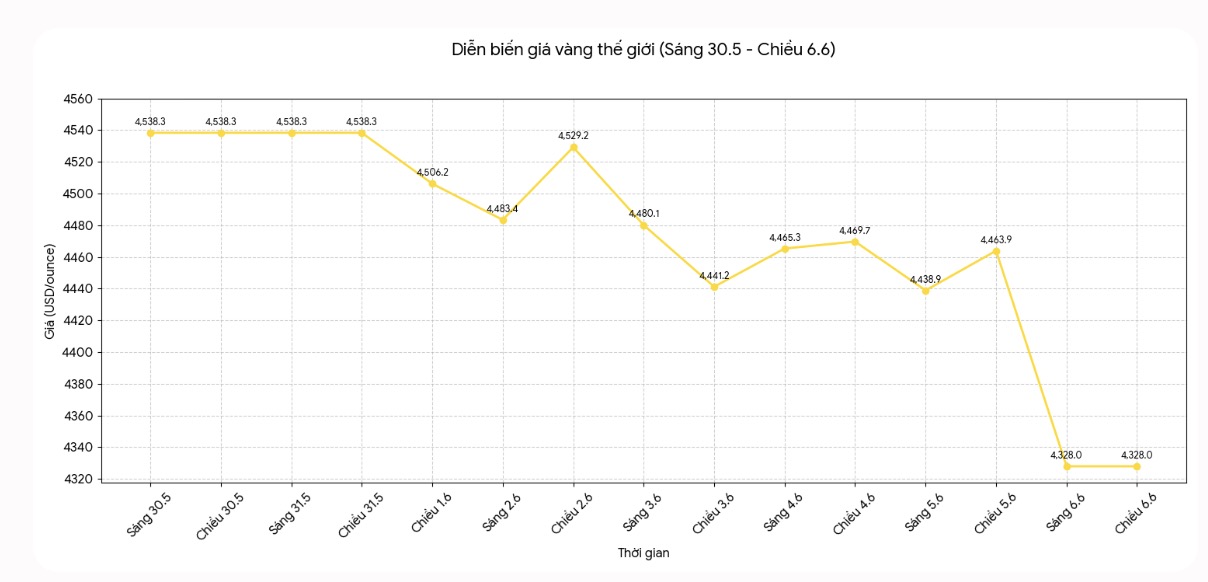
Gold prices recorded their sharpest decline since March in Friday's trading session, after the US jobs report exceeded expectations, almost extinguishing hopes that the US Federal Reserve (Fed) would cut interest rates soon. This development also pushed the USD to rise sharply again above the important threshold.
Gold futures fell 148 USD, equivalent to 3.30%, to 4,353.9 USD/ounce. This decrease has erased most of the recent price increase of the precious metal, causing significant technical damage and wiping out gold's increase from the beginning of 2026 to now.
The main factor comes from the US Department of Labor's May non-farm payroll report. Data shows that the US economy created 172,000 jobs in the previous month, nearly double the forecast of 88,000 jobs by economists in a Bloomberg survey. The unemployment rate remained unchanged at 4.3%.

Notably, the April jobs data was also adjusted to increase to 179,000 jobs, compared to the initial announced level of 115,000 jobs. The March figure was also raised to 214,000 jobs, marking the first month to exceed the 200,000 jobs mark since the beginning of 2024.
This data immediately strongly impacted interest rate expectations in the market. According to CME Group's FedWatch tool, the probability of the US Federal Open Market Committee keeping interest rates unchanged in the meeting scheduled to take place after about 12 days has increased to 96%. This almost eliminates the possibility of the Fed soon reversing policy - a factor that has supported gold prices in recent weeks.
The expected adjustment also spread to the money market, thereby amplifying the downward momentum of gold prices. The USD Index increased by 0.63%, closing at 100.08 points, regaining the 100-point mark for the first time since March.
Because gold is valued in USD, the strengthening greenback makes the precious metal more expensive for buyers holding other currencies, thereby often putting pressure on demand.
Technically, this decrease has a much greater impact than a simple price decrease. Gold prices have decisively broken through the simple 200-day moving average - a long-term trend indicator closely monitored by investors and once played a role as a solid support zone in the recent price increase.

This is the first time gold prices have closed below the 200-day moving average since November 2023. This development may cause traders based on technical analysis and institutional investors to cautiously re-evaluate their positions, especially those who used to use this support zone as a basis to maintain buy status.
Whether Friday's sell-off is a real trend reversal signal or just a strong correction in a long-term upward cycle will largely depend on upcoming economic data and how these data shape the Fed's policy calculations in the coming weeks. However, at the present time, the selling side is temporarily regaining the initiative in the gold market.