
Gold prices today continue to fall deeply
Recorded on the morning of June 20, SJC gold bar prices at some businesses continued to fall deeply. DOJI and Bao Tin Minh Chau listed gold prices at 142.5-146.5 million VND/tael, corresponding to buying and selling prices.
Phu Quy Jewelry Group listed SJC gold bars at 143.7-146.7 million VND/tael. The difference between buying and selling directions is at 3 million VND/tael.
Gold ring prices also decreased accordingly. DOJI and Bao Tin Minh Chau listed gold rings at 142.5-146.5 million VND/tael, while Phu Quy listed at 143-146.5 million VND/tael.
How much has the value of gold purchased at the peak decreased?
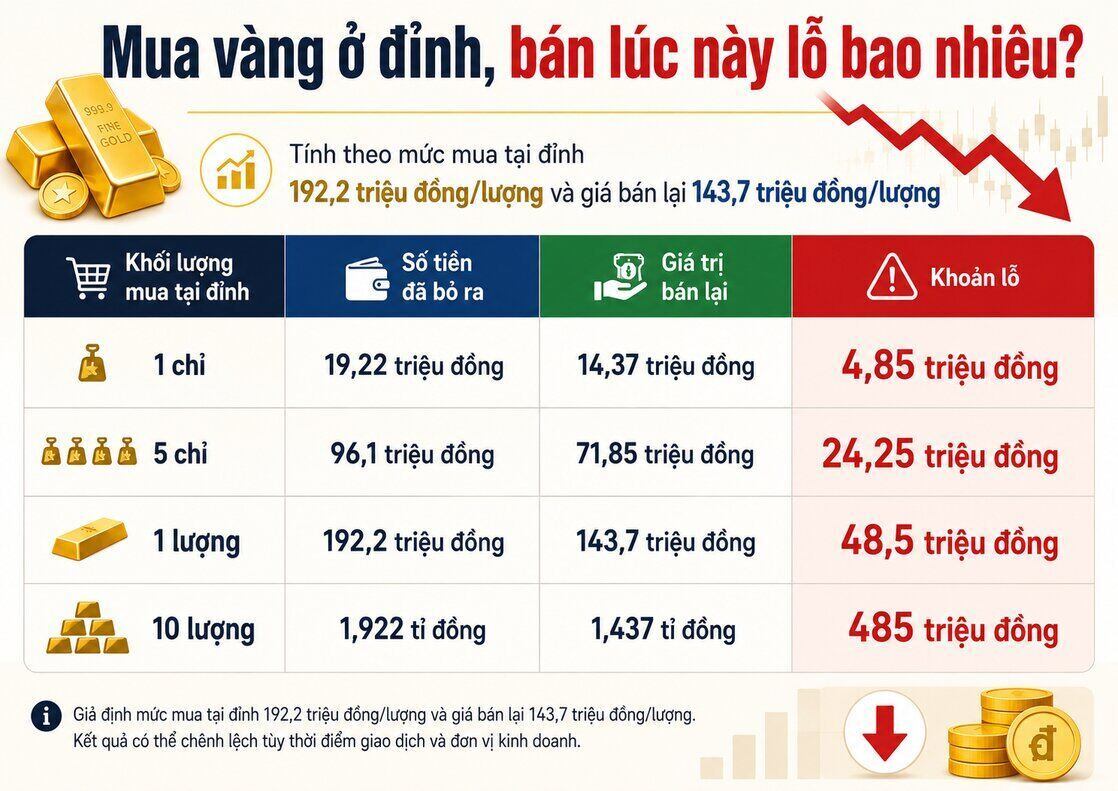
At the end of January 2026, SJC gold bar prices once set a historical peak at 187.2 million VND/tael for buying and 192.2 million VND/tael for selling.
Compared to the selling price of 146.7 million VND/tael on the morning of June 20, SJC gold price has decreased by 45.5 million VND/tael, equivalent to about 23.7% compared to the peak.
For people who used to buy a tael of gold at a price of 192.2 million VND, if they resell it at the level that businesses are buying at, which is 143.7 million VND/tael, the amount collected is lower than 48.5 million VND, equivalent to about 25.2% of the initial capital.
Similarly, people buying one tael of gold at the above price have an estimated difference of about 4.85 million VND; buying 5 taels with a difference of 24.25 million VND; and buying 10 taels, the current exchange value is about 485 million VND lower.
The short-term decrease in gold prices does not mean that all buyers in the peak area must sell out. For those who buy for long-term accumulation, the current fluctuation is only a phase in the holding process and it is not yet possible to determine the final profit or loss.
However, the reality recorded by Lao Dong Newspaper reporters at gold shops shows that every time prices increase sharply, the number of people coming to trade is usually higher. Many customers said they buy gold for accumulation purposes, but there are also cases of fearing missing opportunities, so they buy in after hot uptrends. When prices reverse, anxiety makes some people rush to sell out, easily falling into the situation of buying at high prices but selling at low prices.
World gold prices continue to be under pressure
On the international market, at 9:39 am on June 20, world gold prices recorded a level of 4,154.7 USD/ounce, down about 61.4 USD compared to the previous day.
Precious metal prices continued to face pressure in the last session of the week after the US Federal Reserve issued a tougher signal on monetary policy. In the context of the US stock and bond markets holiday on Juneteenth, thin liquidity also made price fluctuations easily amplified.
After the June policy meeting, the Fed kept interest rates unchanged in the 3.50-3.75% range. However, the agency emphasized that inflation is still higher than the target of 2%, partly due to rising energy prices, while continuing to focus on price control.
Instead of expecting the Fed to cut interest rates soon, the market is starting to consider the possibility that interest rates may continue to be kept at a high level, even increasing in 2026. High interest rates increase the opportunity cost of holding gold, an asset that does not provide regular cash flow.
According to Mr. Laurence Booth, Global Market Director at CMC Markets, the current decline in gold is leaning towards risk reduction rather than a panicked sell-off.
This expert believes that the downward trend is still relatively orderly, although gold has lost more than 200 USD/ounce in just a few days. A notable signal is the physical gold demand, as the price difference in China and some major markets is weakening, causing gold to lack its own support.
Geopolitical risks in the Strait of Hormuz have not completely disappeared. Transportation through this area has not fully returned to normal due to navigation requirements and train congestion. This makes safe haven demand for gold remain, but not enough to overwhelm the pressure from monetary policy.
Technically, the 4,180-4,200 USD/ounce zone is considered a near resistance level. If it crosses this zone, gold prices may head towards the 4,370-4,390 USD/ounce zone. Conversely, if it loses the low in the session around 4,121 USD/ounce, gold is at risk of falling back to the 4,040 USD/ounce zone, further back to 4,020 USD/ounce.


