
According to Kitco, although gold has long been seen as a defensive asset to help prevent economic instability and inflation, the role of this precious metal as a safe haven in specific geopolitical risk events is quite obscure.
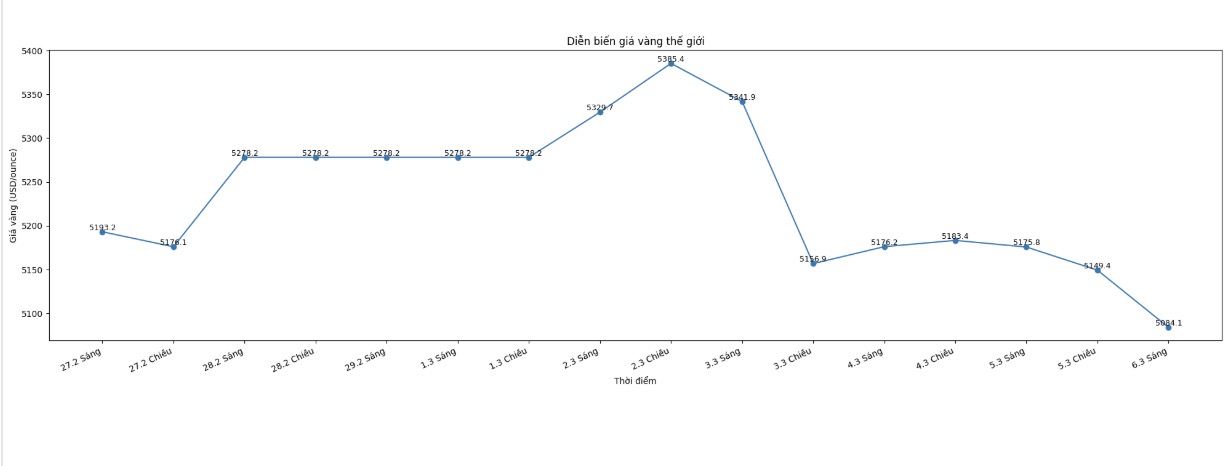
Earlier this week, gold prices once tested the resistance zone around 5,400 USD/ounce as investors reacted to the joint military action of the US and Israel against Iran. However, that upward momentum only lasted for a short time; by Thursday afternoon, gold prices had fallen below 5,100 USD/ounce.
In the latest commodity report, Metals Focus analysts said that although it is disappointing that gold has not maintained its recent increase, they still see the possibility that the price of this precious metal will continue to rise in the remainder of the year.
The upward momentum that gold usually gets is thanks to tensions or geopolitical shocks that rarely last. In fact, this is largely true for most markets, except for assets with supply, demand or trade activities directly affected by that event.
Even when conflicts drag on, investor fatigue also quickly appears and demand for safe-haven assets decreases. This is likely to repeat itself in the war with Iran. However, we believe that significant "tail" risks still exist: due to the specific characteristics of this conflict, the situation may develop differently," analysts wrote in the report.
According to analysts, the risk is increasing for the global energy market as conflict affects transportation through the Strait of Hormuz, along with the fact that 12 countries have been drawn into the war, increasing the risk of conflict continuing to spread.
However, they also noted that there is currently very little support for another prolonged war in the Middle East.
A prolonged or out-of-control war in Iran, in the context very close to midterm elections in the US, will bring political risks to the Republican Party. Voters are likely to be dissatisfied with the inevitable financial and life costs of the war, as well as the impact on inflation (both real and perceived) from rising oil prices," the report said.

However, they also emphasized that any signs that conflict is spreading or the oil market is seriously disrupted could easily push gold prices up to $6,000/ounce.
Beyond the fluctuations caused by short-term events, the British research company remains optimistic about gold, because the current conflict highlights a broader picture of economic and geopolitical instability.
Whether you agree with or disagree with the US decision to attack Iran, this action still has long-term consequences for the country's foreign policy. Along with the recent intervention in Venezuela, it shows that the US is ready to push for regime change or political change, using hard power if necessary to achieve strategic goals.
Meanwhile, the lack of coordination or consultation with most allies shows that the trend of unilateral action is increasing. In general, such changes from the world's largest economy and leading military power will increase geopolitical instability" - the report stated.
Metals Focus also believes that this military action could make gold more attractive than US Treasury bonds. Although the USD has attracted part of the capital flow this week, the yield of 10-year US government bonds still returned above 4%.
Limited capital flows into Treasury bonds this week further increase existing concerns about their traditional role as a safe haven asset.
This is clearly beneficial for gold, both directly - when gold competes with Treasury bonds to attract safe-haven capital flows - and indirectly, through the impact of these concerns on the USD" - analysts said.


