
In the latest report on the gold market, Ms. Suki Cooper - Global Director in charge of Commodity Research at Standard Chartered Bank - said that gold prices are gradually forming temporary bottoms.
However, instability related to the conflict in Iran and concerns about inflation may continue to put pressure on this commodity in the next few months.
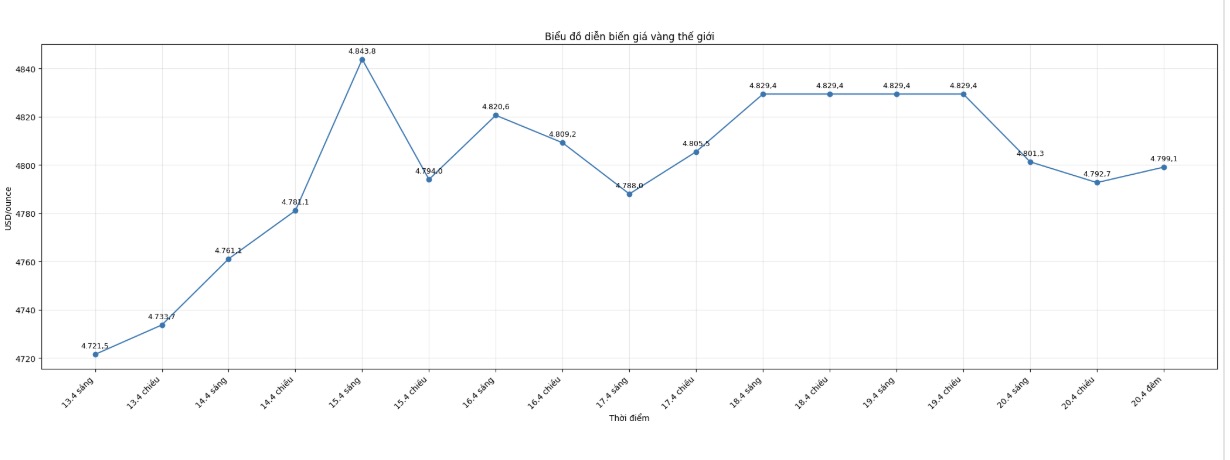
According to the official forecast of Standard Chartered, the average gold price in the second quarter may be around 4,605 USD/ounce, before increasing to an average of 4,850 USD/ounce in the third quarter.
Ms. Cooper said that the trend of gold is still heavily dependent on the temporary ceasefire and the peace negotiation process in the Middle East. Although negotiations are still ongoing, traffic through the Strait of Hormuz is still disrupted, thereby continuing to affect the global supply chain.
“In the context of a fragile ceasefire and the market shifting its focus to real yields, gold has not really escaped risk. Liquidity demand may continue to put pressure on prices in the short term.
However, structural supporting factors remain intact and we expect gold prices to resume their upward momentum to test old peaks in the coming months," Ms. Cooper stated in the report.
Also according to this expert, the fear of inflation is one of the reasons why gold price diễn biến in the past time has been less positive than expected. She said that gold currently has a negative correlation of 24% with the 5-year real-term yield, while before the conflict broke out, this number was almost 0.
The market is currently struggling between inflation risk valuation and the risk of slow growth. Gold usually performs positively in an environment of unexpectedly high inflation as well as during periods of US economic recession.
However, the current gold market has not really reflected these risks, meaning that there is still room for price increases in the coming months. However, policy response will be a key factor as gold gradually separates from the trend of moving along with risky assets," Ms. Cooper said.

Besides short-term risks, Standard Chartered also recorded some positive signals from the gold market. According to Ms. Cooper, speculative positions have decreased, helping to eliminate the "hot" factor in the market.
In addition, investment demand is also improving as preliminary data from gold-guaranteed exchange-traded funds (ETFs) show that capital has returned.
“We still believe that the market is still under pressure from the amount of gold that is in a loss-making state, estimated at about 53 tons. However, signs have emerged that liquidity demand may be gradually stabilizing,” she added.
See more news related to gold prices HERE...


