
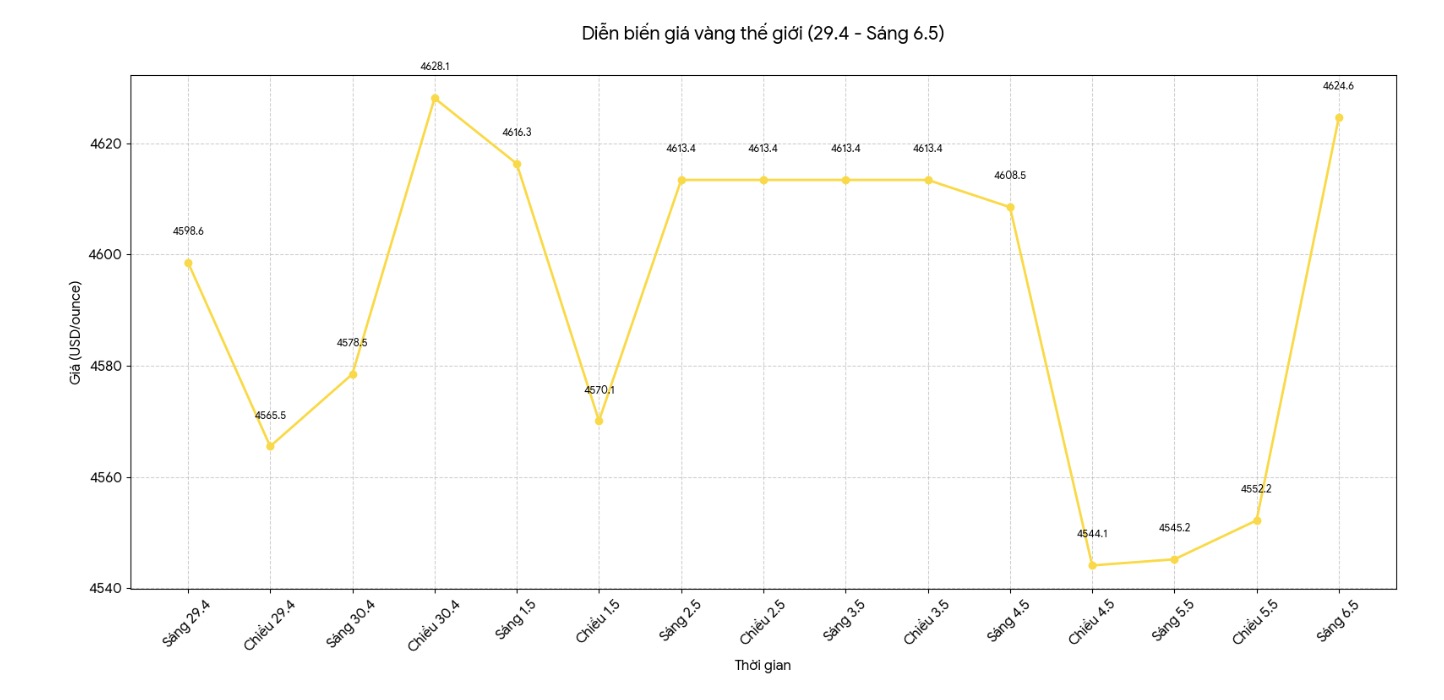
Although world gold prices have not been able to break through strongly, many experts believe that this precious metal still plays an important role in long-term investment strategies.
Mr. John LaForge - chief asset change strategist at Ned Davis Research (NDR) - said that the current adjustment and accumulation phase is a suitable opportunity for investors to gradually increase gold holdings.
According to Mr. LaForge, market signals are supporting a positive trend for gold, especially as the USD weakens again and pessimism in the gold market is at an extreme level.
All three of our USD trend models are sending sell signals. At the same time, the main psychological indicator for gold has fallen into the extreme pessimistic zone - this is often a favorable signal for building long-term positions," he said.

NDR experts recommend that investors allocate 3% to 8% of their portfolios to gold. According to him, gold should be seen as a separate group of assets in the commodity portfolio, rather than just a short-term safe haven.
Mr. LaForge believes that investors with low gold holdings or who do not yet hold gold should not continue to wait for deeper corrections to "bottom-fish".
Our point of view is that we should start building a strategic position right now, instead of trying to keep track of the market momentum. The current gold support story is structurally long-term and not just a short-term factor" - he emphasized.
According to Ned Davis Research, the biggest role of gold lies not in its ability to fight inflation, but in the diversification of its portfolio and the position of a neutral currency asset.
Mr. LaForge said that gold often works in periods when confidence in the financial system declines or when traditional investment assumptions are no longer effective.
Gold has a low correlation, even negative, with stocks and bonds, especially during periods of financial stress. In 2022, when both stocks and bonds plummeted - a rare scenario - gold still maintained a fairly stable price," he said.
The above assessment was made in the context that gold prices are still fluctuating strongly despite geopolitical tensions in the Middle East continuing to escalate, especially the conflict between Iran and Western allies.
The energy market is under great supply pressure, causing oil prices to remain high and raising concerns about global inflation returning. This forces many central banks to maintain a more cautious monetary policy stance, while significantly reducing expectations of interest rate cuts this year.
Usually, high interest rates will increase opportunity costs when holding gold - an unprofitable asset. However, Mr. LaForge believes that gold still has a special attraction in an increasingly risky financial environment.
He emphasized that gold is one of the few large assets in the world that does not carry partner risk.
Gold does not depend on CEOs, governments or any legal system to maintain value. That is why global central banks have continuously increased gold reserves in recent years," he said.
According to him, many countries are gradually realizing that they hold too many assets based on debt in a risky global financial system. In that context, increasing gold reserves is seen as a cautious and long-term risk management measure.


