
World gold prices continued to maintain strong gains in the first trading session of the week, after setting a 3-month high. Purchasing power was strengthened as the USD weakened, US bond yields fell, and investment capital in gold increased sharply.
As of 9:19 am Vietnam time, spot gold prices increased by 0.73% to 4,649.24 USD/ounce. Meanwhile, December gold futures contracts on the US market increased by 8.96 USD, equivalent to 0.19%.
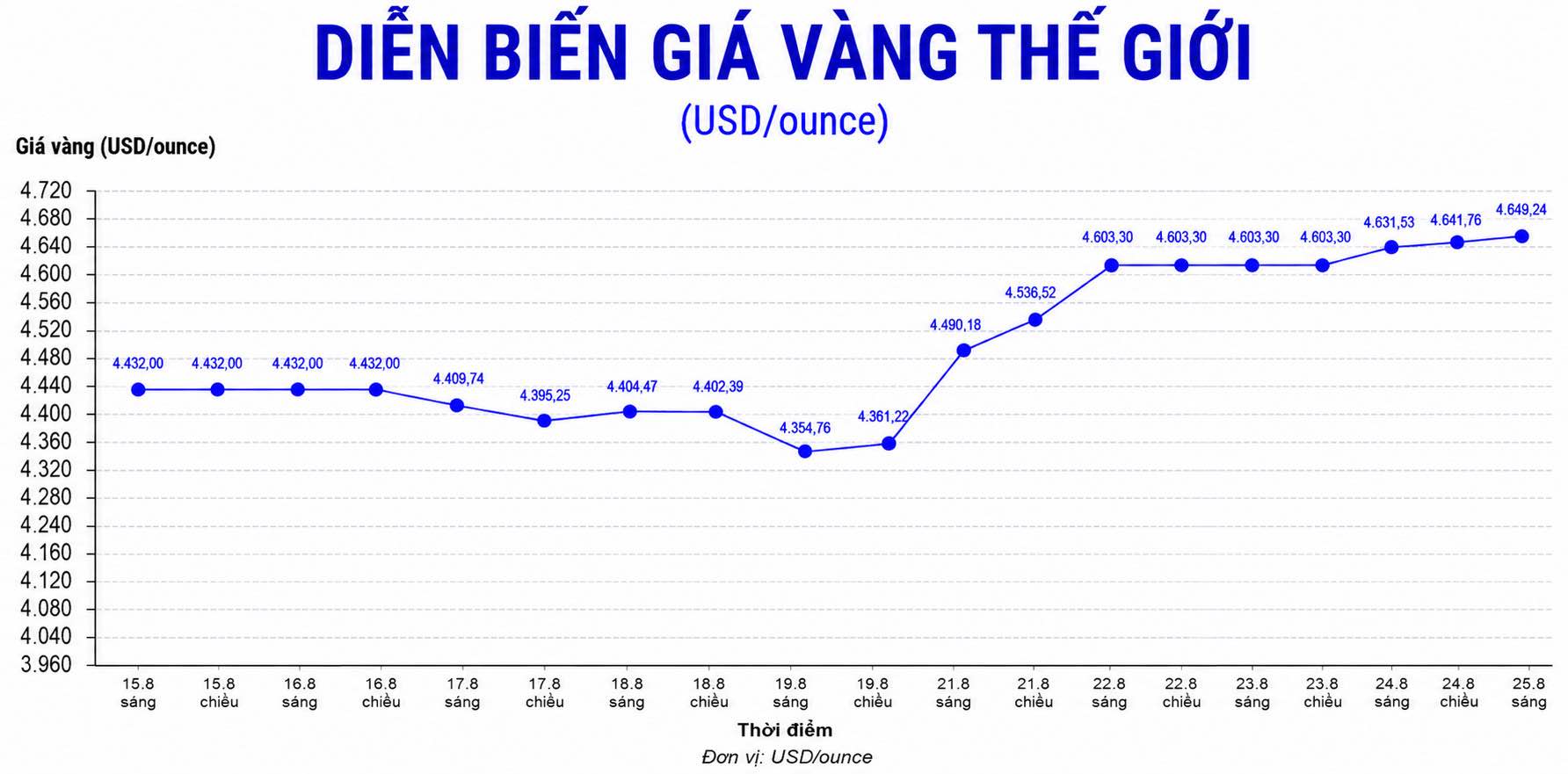
This development continued the strong increase session on August 24. According to market data, spot gold prices at one point jumped to 4,680.70 USD/ounce - the highest level since May 14 - before narrowing the increase momentum and closing the session at 4,639.49 USD/ounce, up 0.8%. December gold futures contracts closed the session at 4,697.80 USD/ounce, up 0.4%.
Gold's upward momentum is being supported by a combination of fundamental and technical factors. After increasing by more than 5% last week, gold prices have surpassed the 200-day moving average in the week ending August 23, consolidating positive signals for the price trend.
Mr. Jim Wyckoff - market analyst at the famous precious metals and rare coins trading company in the United States (American Gold Exchange) - said that fundamental and technical factors are creating a favorable environment for gold. According to him, if there is no technical reversal signal, the dominant trend of gold in the coming weeks may continue to be sideways to upward.
One of the important drivers for the gold market today is the US Treasury Department's move to buy back long-term government bonds. This plan has contributed to pushing the USD down to a low level for many months, thereby making gold - which is valued in greenbacks - more attractive to investors holding other currencies.
Previously, gold prices had increased sharply after the US Treasury Department announced plans to increase the scale of long-term bond repurchases. This move caused US bond yields to decrease, especially in long-term terms, and sparked debate about the fiscal health and debt burden of the world's largest economy.
Cash flow into gold ETFs also shows a noteworthy return of investors. According to the World Gold Council (WGC), gold-backed ETFs attracted capital equivalent to 46.7 tons of gold last week, worth about 6.4 billion USD. This is the week with the largest net gold inflow in 10 months, with funds listed in North America and Europe leading the cash flow.
This trend is taking place in the context that many central banks around the world are increasing the role of gold in their reserve portfolios, relative to US government bonds. Diversifying reserve assets is becoming one of the foundational factors supporting gold demand in the medium and long term.
In addition, the market is turning its attention to US economic data released this week. The July Personal Consumption Price Index (PCE) - an inflation measure that the US Federal Reserve (Fed) is particularly interested in - will provide more signals about the monetary policy outlook.
Fed Chairman Kevin Warsh's speech at the Jackson Hole conference at the weekend was also closely watched by investors. Any signal about the Fed's interest rate roadmap could directly affect the USD, bond yields, and thereby gold prices.
Meanwhile, geopolitical developments continue to create additional supporting factors for the need for safe haven assets. President Donald Trump's administration has announced the expansion of secondary sanctions against entities and countries that maintain business dealings with Iran.
However, gold's upward momentum still faces certain risks. If US bond yields rise again or inflation data tightens expectations for monetary policy, profit-taking pressure may appear after a sharp increase.
On the precious metals market, spot silver price on the morning of August 25 decreased by 0.96%, to 68.29 USD/ounce. Platinum price decreased by 0.14%, to 1,877.90 USD/ounce, while palladium decreased by 0.20%, to 1,357 USD/ounce.
Currently, gold is more prominent than other precious metals as it both benefits from the weakening USD and receives support from ETF cash flow and the demand for diversification of central bank reserves. The fact that gold prices have maintained above 4,600 USD/ounce after a strong breakthrough is opening up the possibility that the market will continue to move towards higher price zones, although inflation and Fed policy in the coming days will be an important test for this upward momentum.


