
Gold prices react cautiously to PPI data
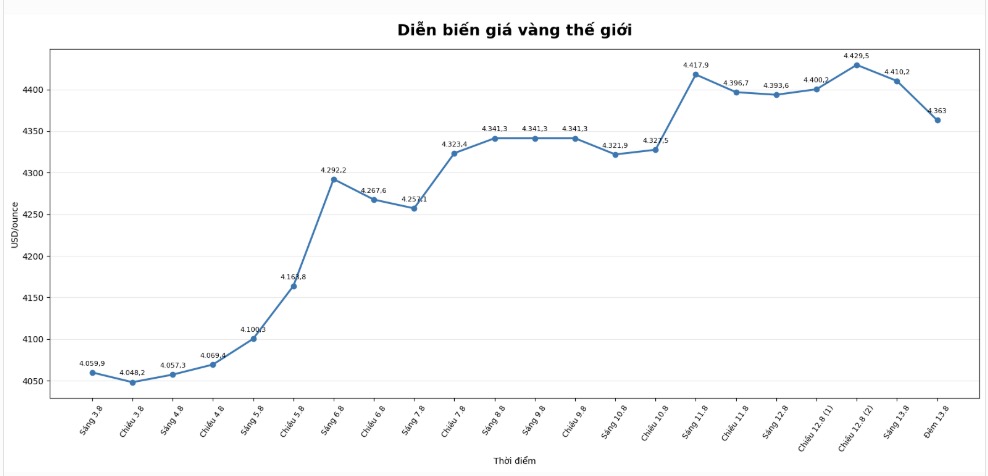
Last night, gold prices fell sharply. Recorded at 11:40 PM on August 13, world gold prices fell sharply to the threshold of 4,363 USD/ounce. The precious metals market is being interspersedly affected by inflationary signals in the US.
According to the latest report from the US Department of Labor, the producer price index (PPI) in July remained unchanged compared to the previous month, an increase of 0.0%. This result is lower than analysts' forecast of an increase of 0.2% and follows a decrease of 0.3% in June.
Compared to the same period last year, the overall PPI increased by 4.7%, lower than the forecast of 4.9% and significantly decreased compared to the level of 5.5% in June.
Meanwhile, core PPI - excluding food and energy prices with large fluctuations - increased by 0.2% in July, lower than the forecast of 0.3%. Year-on-year, core PPI increased by 4.2%, in line with market expectations and lower than the previous level of 4.7%.
Gold prices reacted relatively limitedly immediately after the data was released. At one point, spot gold was traded around 4,387.56 USD/ounce, down 0.47% during the day.
PPI is often considered an early indicator of inflation, because the input costs of businesses can be transferred to the selling prices of goods and services to consumers.
Previously, the consumer price index (CPI) report for July showed that consumer prices in the US increased by 0.1% compared to the previous month and increased by 3.4% compared to the same period last year. Core CPI increased by 0.2% monthly and 2.5% annually.
Besides inflation, the US labor market is also sending a noteworthy signal. The number of initial jobless claims increased by 9,000 to 209,000, while the 4-week average remained unchanged at 19,000.
The above data is not enough to create a clear signal that the Fed will soon switch to a softer stance. The yield of 10-year US Treasury bonds is still fluctuating near the 4.7% area, while the USD index remains relatively stable.
Investors are currently continuing to await the US July retail sales report, an important data that could affect interest rate expectations.
Geopolitical risks continue to support gold
Besides monetary policy, tensions related to the Strait of Hormuz continue to be a noteworthy factor for the energy and precious metals markets.
The risk of disruption of transportation in this area may support safe-haven demand for gold. However, if oil prices rise sharply again, inflationary pressure is likely to increase, making it difficult for the Fed to ease monetary policy soon.
WTI oil is currently trading around 82 USD/barrel, while Brent oil is around 87.7 USD/barrel.
Technically, gold buyers need to bring prices above the resistance level of 4,448 USD/ounce to strengthen the upward momentum, with the next targets at 4,575 USD and 4,666 USD/ounce.
In the opposite direction, if the price falls below 4,332 USD/ounce, the market may head towards support zones of 4,262 USD and 4,205 USD/ounce.
The article updates the developments of the gold market, not an investment recommendation. Investors need to consider carefully before making financial decisions.


