
The international commodity market in the afternoon of August 12 recorded positive developments for both crude oil and precious metals. US crude oil prices increased by 0.61%, to 83.71 USD/barrel; Brent oil increased by 0.62%, reaching 89.46 USD/barrel and is heading towards its sixth consecutive increase session.
Previously, both standard oils increased by more than 1 USD/barrel in the August 11 session, recording the highest closing level since July 31. The upward momentum continued after oil prices jumped about 5% in the first session of the week.
Oil prices continue to be supported by concerns about maritime security on important shipping routes, amid continuous attacks and military operations in the Middle East region.
In the Red Sea, the Yemeni government on August 11 accused Houthi forces of firing missiles at the Tihamah cargo ship in the Bab al-Mandeb Strait area. The attack caused the ship to catch fire and suffer serious damage, killing 4 people on board. When rescue forces deployed to evacuate the crew, the rescue area continued to be attacked, killing 2 more rescuers and injuring 10 people. This is recorded as the first Houthi attack on a ship causing casualties since the Middle East conflict broke out at the end of February.
Tensions also increased in the Gulf of Oman. The US Central Command said that a US Navy MH-60 helicopter fired 2 missiles into the engine room of the cargo ship M/V Vela Nova after the ship did not comply with the warning. The US side said that the Panamanian-flagged ship was trying to cross the Gulf of Oman to aim for an Iranian port, violating the blockade order.
These developments increase concerns about the risk of disruption of important energy transport routes. Besides the Middle East, the geopolitical environment in the Asia-Pacific has also become noteworthy when the US announced plans to expand its military presence and build deterrence capabilities along the first island chain, from Malaysia to Japan.
In the context of geopolitical risks not cooling down, the market continues to add risk compensation to oil prices, especially in the face of the risk of disruption of transportation activities through strategic shipping routes.
The lack of clear progress in negotiations, along with statements related to Iran's control of the Strait of Hormuz, continues to put the risk for oil prices in an upward trend.
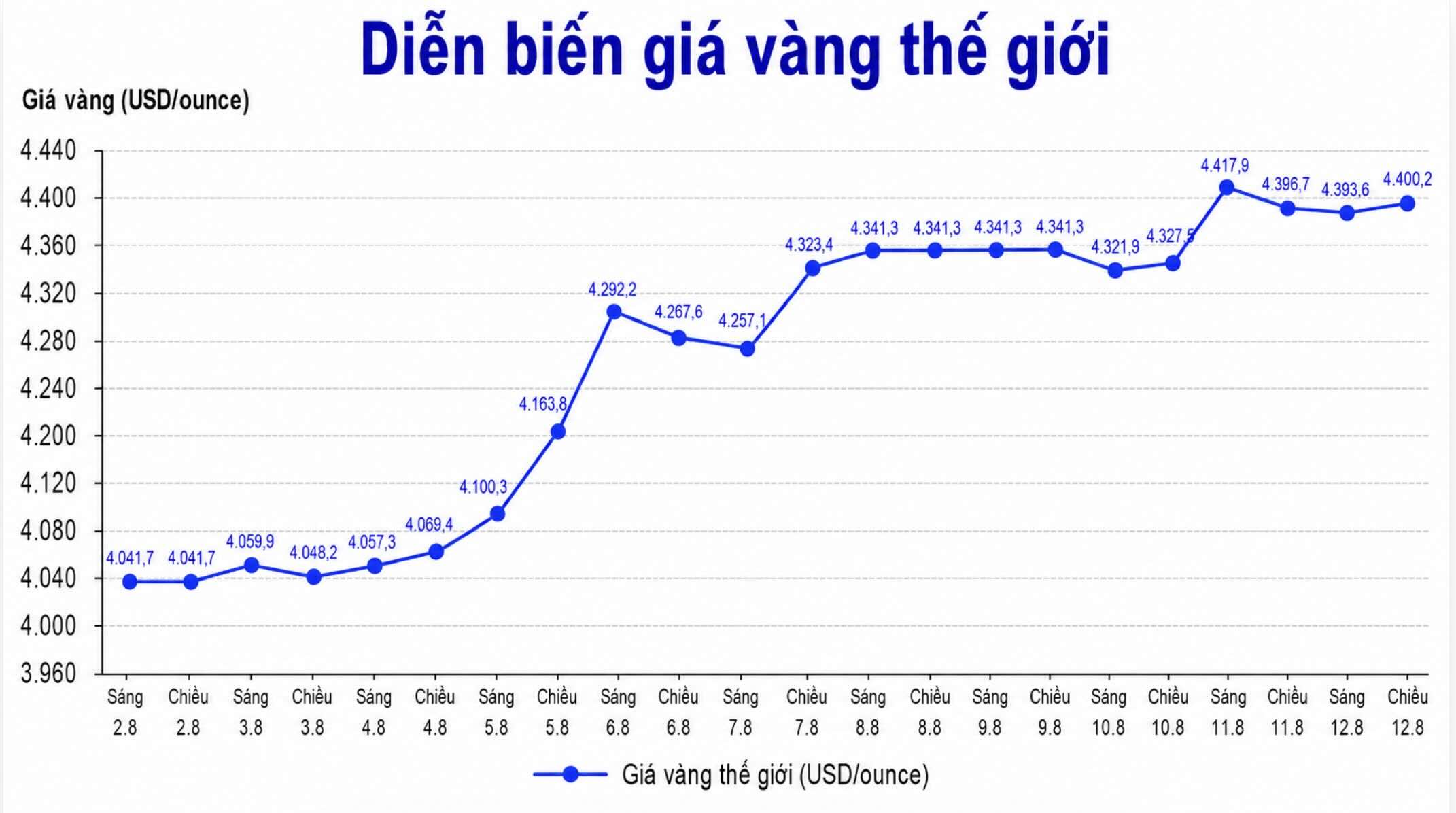
Not only oil, safe-haven demand also boosted precious metal prices. Spot gold price increased by 0.77%, to 4,400.2 USD/ounce. Spot silver price increased by about 1%, reaching 65.30 USD/ounce.
Defense sentiment in the market was further strengthened after North Korea launched a ballistic missile off the east coast of the Korean peninsula, just days before the large-scale joint military exercise between South Korea and the United States.
In that context, Asian stocks still increased. The MSCI Asia-Pacific index in addition to Japan increased by about 0.8%. Japan's Nikkei also increased by 0.8% when the market reopened after the holiday. Notably, South Korea's Kospi increased by about 4%, mainly thanks to the technology stock group.
The focus of the market on August 12 is US CPI data. Although July data does not fully reflect the recent increase in energy costs, the published results may still strongly impact expectations about the interest rate decision of the US Federal Reserve (Fed) in September.
Forecasts show that the US CPI in July may increase by 0.1% compared to the previous month, after falling 0.4% in June. Annual inflation is expected to fall from 3.5% to 3.4%.
Boston Fed Chairman Susan Collins said she could support an interest rate hike in September if inflation continues to remain high. The money market currently assesses the possibility of the Fed raising interest rates at the next meeting at a near-balancing level.
The USD also edged up before the CPI was announced. The Dollar Index increased by 0.07%, to 99.88 points. The Japanese Yen weakened to about 159.38 Yen per 1 USD.
Concurrent developments of oil, gold, USD and bond yields show that the market is in a particularly sensitive state. In the short term, geopolitical tensions may continue to support oil and gold prices, while US inflation data will be an important factor orienting the expectations of monetary policy and capital flows in global financial markets.
the article only updates market developments, not investment recommendations.


