
According to Kitco, in the context of the ongoing conflict in the Middle East continuing to disrupt the global economy and financial markets, gold – a traditional safe haven asset during times of instability – is still struggling to maintain its upward momentum.
The gold market continues to face significant selling pressure as prices cannot maintain above 5,100 USD/ounce. However, a market strategist believes that gold prices still have room to increase in the near future.
In a report released on Monday, Mr. Bernard Dahdah - a precious metals analyst at Natixis - said that gold prices may be under pressure as the market begins to see the consequences of the worst-case scenario: war causing the Hormuz Strait to be blocked, thereby seriously affecting the global energy supply chain. He believes that this incertitude is supporting the USD - which is considered the safe haven of the world at the present time.
There may also have been profit-taking activities to compensate for loss-making positions or meet margin requirements for investments in the stock market," said Mr. Dahdah.
Since the US and Israel launched missiles to attack Iran a week ago, the S&P 500 index has fallen more than 3%, currently trading around 6,645 points. Meanwhile, gold prices last week peaked at 5,419 USD/ounce but then continuously decreased. The nearest spot gold price was recorded at 5,093.2 USD/ounce, down more than 1% during the day.
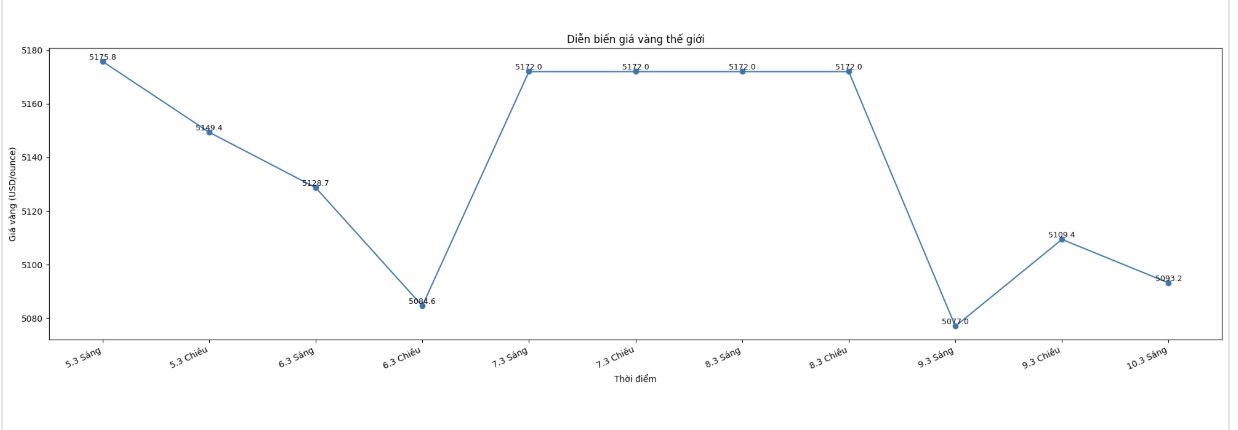
Although gold prices are still accumulating above the 5,000 USD/ounce support zone, Mr. Dahdah believes that this precious metal may eventually recover.
According to him, the reason is due to the inflationary impact that high energy prices may cause on the global economy, thereby pushing gold prices up. “In this scenario, we can see gold prices gradually increase back to the 5,500 – 5,800 USD/ounce range,” he said.
However, Mr. Dahdah also noted that the need for safe shelter caused by specific risk events is often not sustainable.
After the war ended, we believe that gold prices may fall back to the level before the conflict broke out, around 4,600 USD/ounce. In fact, we believe that the market is currently valuing about 450 USD/ounce of costs related to the Iran war," he said.
The world gold market operates through two main pricing mechanisms. The first is the spot market, which quotes prices for transactions and immediate delivery.
The second is the futures contract market, where prices are set for futures delivery. Due to year-end closing activities, December gold futures contracts are currently the most actively traded type on the CME.


