
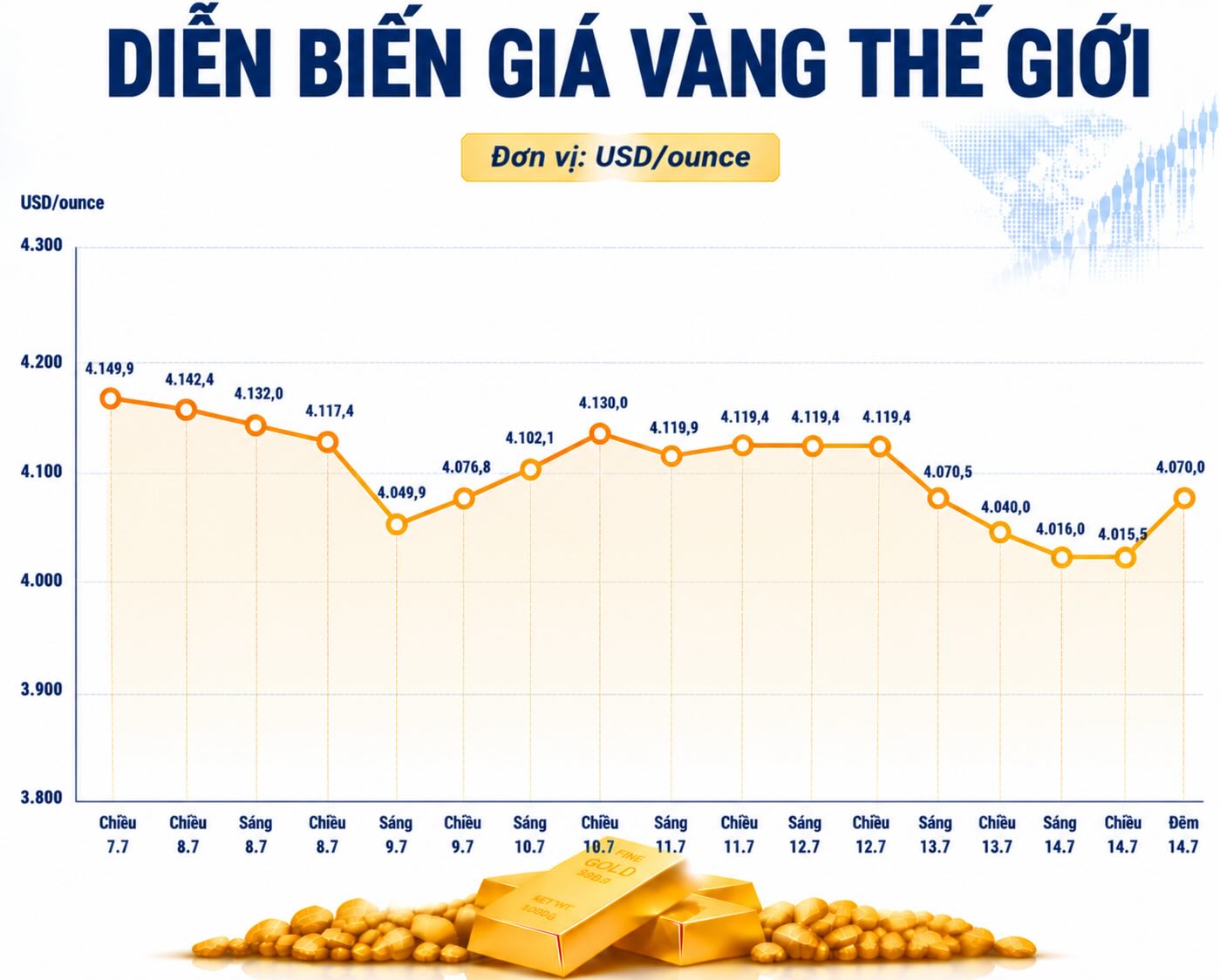
Gold prices last night increased sharply in the trading session on July 14 after US inflation data was lower than forecast, thereby reducing pressure on the interest rate policy of the US Federal Reserve (Fed).
At the recorded time (10:40 PM on July 14 - Vietnam time), world gold prices were listed around the threshold of 4,070 USD/ounce, up 67.8 USD compared to the previous day.
During the session, gold prices fluctuated from 3,985 to 4,101.5 USD/ounce. The rapid return above the psychological threshold of 4,000 USD/ounce shows that bottom-fishing demand increased after a series of sharp declines.
Silver prices also recovered significantly, fluctuating in the range of 56.76-59.45 USD/ounce, surpassing back to the 58 USD/ounce zone and approaching the important technical resistance area.
The main driver supporting the precious metal comes from the US consumer price index report. Total CPI fell 0.4% in June, after rising 0.5% in May. This is the strongest monthly decrease since April 2020.
Compared to the same period last year, US inflation fell from 4.2% to 3.5%. Core CPI, excluding food and energy prices, remained flat in the month and increased by 2.6% over the same period, lower than the previous 2.9%.
This figure eases concerns about inflation returning after a sharp increase in oil prices. The market therefore reduced expectations that the Fed would continue to raise interest rates in the short term.
The yield of 10-year US government bonds still fluctuated around the 4.6% area, but has fallen below the high at the beginning of the session. The USD index also weakened as investors narrowed down their positions betting on the scenario of interest rates remaining at high levels for a long time.
The declining USD makes gold more attractive to buyers using other currencies. Meanwhile, the less stressful interest rate outlook also reduces the opportunity cost of holding non-rotating precious metals.
In the first hearing before the US House Financial Services Committee, Fed Chairman Kevin Warsh said that the agency's top goal is to manage monetary policy in the right direction and make the high inflation period in the past 5 years a thing of the past.
Mr. Warsh emphasized that although prices may fluctuate monthly, the long-term inflation trend is largely still determined by monetary policy. Members of the Federal Open Market Committee do not accept prolonged high inflation.
This message shows that the Fed still maintains a cautious stance. Lower-than-forecast CPI data helps reduce pressure to raise interest rates, but does not mean that the agency is willing to loosen strongly.
Assessing the US economy, Mr. Warsh said that economic activity is still expanding at a steady pace. Household consumption is increasing at a moderate rate, production is improving, while the housing sector continues to slow down.
Enterprise investment is considered a highlight, mainly thanks to the construction of data centers and the large demand for equipment and software related to artificial intelligence.
The US labor market is also assessed as relatively stable, with low unemployment rates, limited number of layoffs and nominal wages continuing to increase.
Besides the monetary factor, US-Iran tensions continue to support safe-haven demand. Brent oil was traded around 86.73 USD/barrel, while WTI oil stood near 80.55 USD/barrel.
Transportation through the Strait of Hormuz has not been completely blocked, but military risk and risk of disruption remain high. This development helps oil prices maintain the geopolitical risk compensation, while creating more support for gold.
Technically, the 4,091-4,107 USD/ounce zone is an important test area. If it sustainably surpasses this zone, gold prices may head towards 4,140 USD/ounce. Conversely, near support zones are at 4,021 USD and 3,959 USD/ounce.
The next developments in gold prices will depend on the reaction of bond yields, the USD, oil prices and the risk of transport disruptions in the Strait of Hormuz. The information in the article is for reference only, not an investment recommendation.


